Abstract
The Drosophila telomere is one of the best-studied examples of active transposable elements (TEs) benefiting, rather than harming, the host genome. All Drosophila species lack telomerase, and most species instead have telomeres composed of head-to-tail arrays of specialized retrotransposons. These TEs ostensibly act as mutualists by elongating chromosome ends, but evidence from species closely related to Drosophila melanogaster suggests that telomeric transposons may also antagonize their host genome. Importantly, the limited number of Drosophila species characterized thus far has precluded our ability to delineate idiosyncrasies from universal evolutionary forces and genetic mechanisms that shape the history of these TEs. Here, we have surveyed long-read genome assemblies of more than 100 species of Drosophila, identifying a total of 396 telomeric TE families. Our findings show that these telomere-specialized elements evolve dynamically and also undergo striking convergent evolution: The complete loss of telomeric TEs has occurred repeatedly across the genus, whereas individual telomeric TE lineages have repeatedly lost one of their two protein-coding genes. These elements have also repeatedly undergone horizontal transfer between distantly related Drosophila lineages and have repeatedly captured host gene fragments that promote their selfish suppression of host TE-silencing systems. Furthermore, telomere specialization itself appears to have evolved convergently, as some nontelomeric families have gained the ability to target their insertions to telomeres. These results provide unprecedented resolution into the evolution of these unusual TEs and highlight several novel mechanisms by which they evolve in conflict both with each other and their host genome despite the essential telomere function they provide.
Transposable elements (TEs) selfishly replicate in the genomes of most species, often at the expense of their host. Although most new TE insertions are either neutral or deleterious, TE copies can also be co-opted by their host genome to serve a beneficial purpose, usually as a source of new genes or novel gene regulatory elements (Feschotte and Pritham 2007; Cosby et al. 2019; Sundaram and Wysocka 2020; Almeida et al. 2022; Fueyo et al. 2022). A large number of eukaryotic genes and regulatory sequences have been acquired from TEs. For the vast majority of these cases, the co-opted TE no longer actively mobilizes in the host genome and may evolve beyond recognition.
However, not all adaptive TEs are immobile. Work from a variety of species raises the possibility that active TEs can perform essential host functions, a process recently termed “TE addiction” (Shimada et al. 2024; Chang et al. 2025). This phenomenon refers to a period of host/TE cooperation that occurs during the transition of the TE from a selfish parasite to a fully co-opted, immobile element (Chang et al. 2025). Arguably the most well-characterized example of an active TE providing a benefit to its host genome involves the telomeric transposons of the Drosophila genus. All “true fly” Dipteran species lack telomerase activity (Mason et al. 2016) and the vast majority of Drosophila species have telomeres composed of head-to-tail arrays of specialized retrotransposons (Levis et al. 1993; Abad et al. 2004; Villasante et al. 2007). These TEs are derived from the Jockey clade of LINE retrotransposons and were first characterized in Drosophila melanogaster, in which three telomeric TE families have been identified: HeT-A, TAHRE, and TART, collectively known as HTT elements (Mason and Biessmann 1995; Abad et al. 2004; Frydrychova et al. 2008; Mason et al. 2008). The Jockey clade of LINEs generally contains two open reading frames (ORFs): a gag-like ORF1, characterized by major homology region (MHR) and zinc knuckle (CCHC) motifs, which play roles in nuclear localization and multimerization (Fuller et al. 2010), and ORF2, which contains both endonuclease and reverse transcriptase (RT) domains (Casacuberta 2017).
These telomeric elements provide a clear benefit to their host: They prevent chromosome shortening owing to the incomplete replication of chromosomal DNA during cell division (i.e., the end-replication problem) (Olovnikov 1973). Furthermore, the transcriptional silencing of these elements by the host genome may promote the assembly of a multiprotein complex, known as Terminin (analogous to Shelterin), that protects the chromosome ends from inappropriate double-strand break repair (Raffa et al. 2009; Cacchione et al. 2020). However, there is substantial evidence that these telomeric TEs are evolving in conflict with their host genome rather than existing exclusively as mutualists (Ellison et al. 2020; Markova et al. 2020; Saint-Leandre and Levine 2020). For example, genes required for telomere integrity tend to evolve rapidly under positive selection (Lee et al. 2017), a signature of genetic conflict. Furthermore, telomeric TEs themselves show dynamic patterns of evolution. Recent work found multiple cases of the replacement of telomeric TE lineages among closely related Drosophila species. Notably, the same study found that telomeric TEs were completely lost in Drosophila biarmipes (Saint-Leandre et al. 2019), suggesting that this ostensibly essential, mutualistic relationship between TE and host is not universally required for telomere maintenance. Furthermore, swapping into D. melanogaster an adaptively diverged version of a Terminin protein from a close relative resulted in a burst of transposition to the telomere ends, suggesting that telomere binding proteins in Drosophila play a role in constraining telomeric TE activity in addition to their end-capping function (Perrini et al. 2004; Saint-Leandre et al. 2020; Cui et al. 2021).
The piRNA pathway also constrains the activity of telomeric TEs (Savitsky et al. 2006; Shpiz et al. 2007, 2011; Khurana et al. 2010). Many TE transcripts, including those from telomeric TEs, are cleaved into sense and antisense piRNAs via the Argonaute proteins Ago3 and Aub (Brennecke et al. 2007). These piRNAs then direct the formation of heterochromatin at TE loci in the genome via another Argonaute protein, Piwi, and a variety of accessory proteins including Panoramix and Nxf2 (Batki et al. 2019; Murano et al. 2019; Zhao et al. 2019; Fabry et al. 2021). Mutations in the piRNA pathway result in increased retrotransposition of telomeric transposons to chromosome ends (Savitsky et al. 2006). Conversely, increasing the efficiency of the piRNA pathway results in telomere shortening (Ryazansky et al. 2017), thus underscoring the intrinsic tradeoff between genome defense and telomere elongation in Drosophila (Kalmykova and Sokolova 2023). This tradeoff creates the potential for intragenomic conflict: Without active host constraints, unchecked TE proliferation at telomeres will ultimately compromise host fitness (Walter et al. 2007).
Additional evidence of ongoing host–TE conflict comes from the D. melanogaster TART telomeric TE, which produces abundant sense and antisense piRNAs across its entire length (Ellison et al. 2020). The imprecise replication of a variety of TE families, including LINE elements, has been shown to result in the acquisition of host DNA sequence by the TE, a phenomenon known as transduction or gene capture (Pickeral et al. 2000; Grabundzija et al. 2016; Catoni et al. 2019). Through this process, TART has captured a portion of the host piRNA pathway gene nxf2 (Ellison et al. 2020). A subset of the abundant antisense piRNAs produced from TART are able to target nxf2 for suppression, which represents a form of host antisilencing (Cosby et al. 2019). The host gene nxf2 is evolving rapidly specifically in the region that was captured by TART, likely owing to selection to escape targeting by TART-derived piRNAs (Ellison et al. 2020). Although these results support an antagonistic relationship between telomeric TEs and their host genomes, other work raises the possibility that the rapid evolution of telomeric TEs is instead a consequence of their adaptation to the telomeric niche, which itself is inherently unstable (McGurk et al. 2021; Cacchione et al. 2025).
Are telomeric TEs in the process of being tamed by their host genome, as predicted by the “TE addiction” theory? Or, do they remain fundamentally selfish despite the beneficial function they provide? If these elements are true mutualists, we would expect their evolutionary diversification to be tightly coupled to that of their host, resulting in a pattern of cospeciation, as has been observed for obligate endosymbionts of various insect species (Moran and Baumann 1994). Under this scenario, the previously described examples of gene capture and loss of telomeric TEs would represent rare edge cases in which mutualism has reverted back to parasitism. On the other hand, a lack of cospeciation, repeated gene capture, and loss of telomeric TEs would be more consistent with a parasitic relationship. These questions remain unresolved, in part because telomeric TEs have been described in only a tiny fraction of Drosophila species (16 [Villasante et al. 2007; Saint-Leandre et al. 2019] out of more than 1600 species in the genus [O'Grady and DeSalle 2018]). Indeed, this limited picture of telomeric TE diversity precludes our ability to delineate universal from idiosyncratic evolutionary forces and genetic mechanisms that shape the history of these seemingly beneficial but active TEs. Here, we manually curate 396 telomere-specialized TE families from more than 100 species of Drosophila and perform phylogenetic and sequence analysis of these transposons to determine whether telomere-specialized TEs evolve antagonistically with their hosts, despite the essential function they serve.
Results
Identification of telomere-specialized retrotransposons
We searched for non-LTR retrotransposons from the Jockey superfamily in long-read genome assemblies from a total of 106 Drosophila species and three outgroup species of Drosophilidae (Supplemental Table S1). We used an automated pipeline to detect ORFs with homology to known Jockey superfamily ORF1 and ORF2 peptides in each assembly, followed by a phylogenetic approach to assign ORFs to telomeric versus nontelomeric clades (see Methods) (Supplemental Fig. S1). We then used manual curation to generate full-length consensus sequences for each TE family and to confirm that candidate telomeric TEs form head-to-tail arrays at contig ends, consistent with telomere specialization (see Methods) (Supplemental Figs. S1, S2).
We identified a total of 396 putatively telomere-specialized TE families across 109 species (Supplemental Table S2). Of the 396 telomeric TE families, we detected 188 families in head-to-tail arrays at the extreme ends/termini of gene-rich, megabase-long contigs in their host species’ genome assembly. One hundred eighty-nine TE families were found in multiple head-to-tail copies but only on short contigs lacking genes that would allow their assignment to chromosome arms. The remaining 19 TE families were present in a single copy in their host species genome assembly but were supported as telomeric based only on their position in our ORF1 and/or ORF2 gene trees (Supplemental Fig. S3). We were unable to identify Jockey telomeric TEs in a total of 15 species, including the previously reported case in D. biarmipes (Saint-Leandre et al. 2019). In three of these species (Drosophila kurseongensis, Drosophila orena, and an undescribed species from the funebris group, labeled as Drosophila sp. St01m by Kim et al. 2021), we identified fragments of Jockey telomeric TEs lacking intact ORFs, but no full-length TEs (Supplemental Table S3). To confirm the absence of active Jockey telomeric TEs in all 15 species, we analyzed the raw genome sequencing reads and recovered only the same TE fragments present in the genome assemblies of the three species above, confirming the absence of Jockey telomeric TEs in these species. To determine whether other non-Jockey TEs could have become telomere specialized in these species, we manually searched telomeric (based on synteny) scaffold ends in these genome assemblies but were unable to find any TE arrays. Thus, in total, we infer that telomere-specialized TEs were independently lost at least 10 times across the genus (Fig. 1).
Evolutionary relationships of the species included in this study. Colors correspond to major Drosophila clades, as delineated by Suvorov et al. (2022). The dashed gray branches indicate the 15 species for which no telomeric TEs were identified. The bar plot shows the number of telomeric TE families identified in each species.
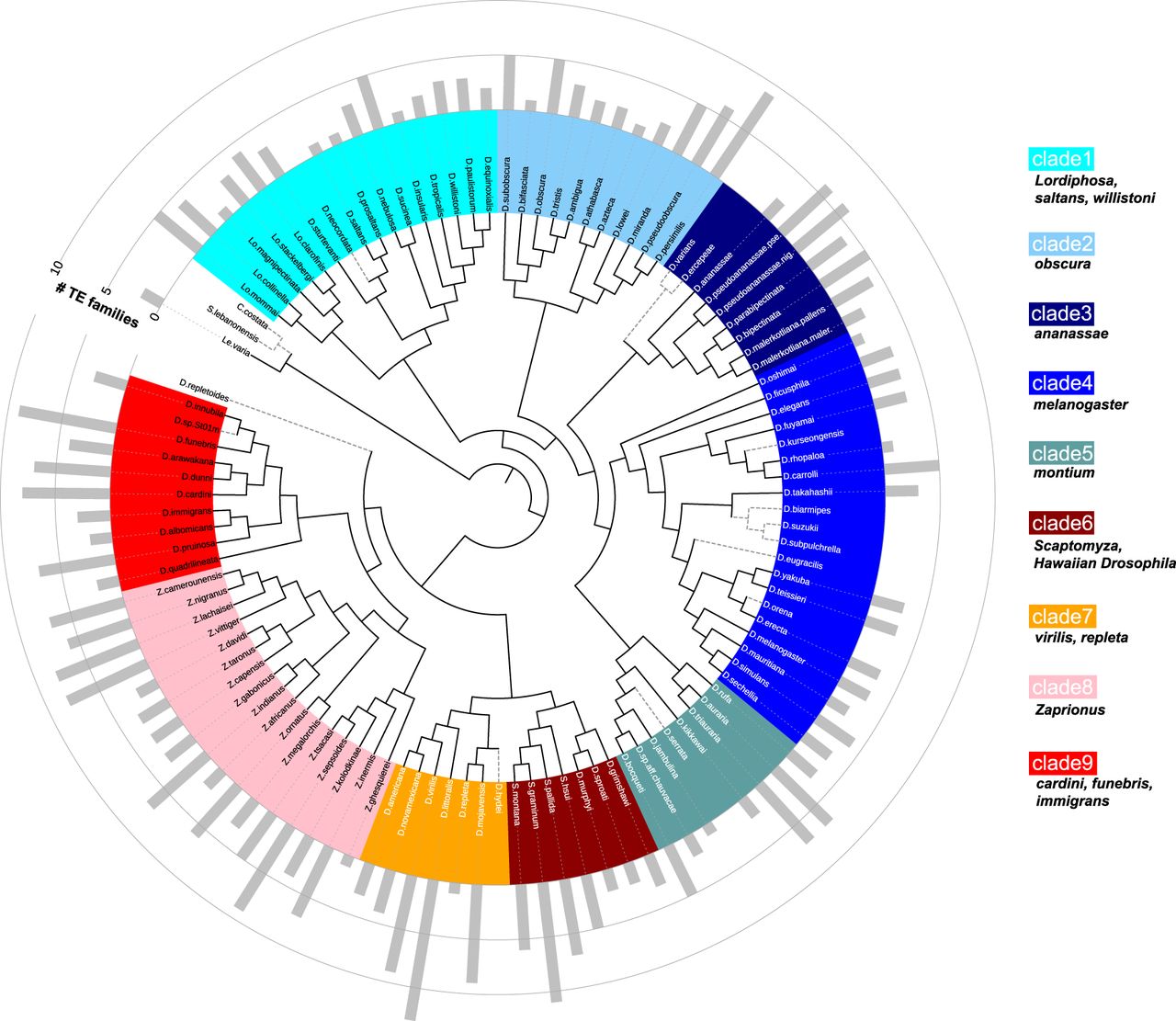
In the remaining species, we identified about four telomere-specialized families per species, on average (Supplemental Fig. S4). On average, full-length elements were 8.00 kb in size and present in approximately 11 copies per genome, based on read depth (see Methods) (Supplemental Fig. S4). The vast majority of species with telomeric TEs have at least one telomeric TE family that carries both ORF1 and ORF2; however, we identified full-length TEs carrying only ORF1 in the genomes of Zaprionus ghesquierei and Drosophila rufa but only fragments of telomeric TEs with ORF2. Overall, ∼60% of telomeric TE families contained both ORF1 and ORF2, whereas ∼40% contained ORF1 only, having lost ORF2 (Supplemental Fig. S4). We also found 18 TE families in which ORF2 was present but ORF1 was missing, a structure that has not been previously reported. In five of these families, ORF1 was interrupted by a premature stop codon whereas the remainder completely lacked ORF1 sequence (Supplemental Table S2). These TEs have significantly reduced copy numbers compared with TE families with either ORF1 only or both ORF1 and ORF2 (Wilcoxon test P = 0.0004 and P = 0.0022, respectively) (Supplemental Fig. S4). We therefore conclude that these likely represent older fragments of previously active TEs.
To assess the accuracy of our classification of Jockey elements as telomeric versus nontelomeric, we focused on a subset of 30 Drosophila species with chromosome-level genome assemblies. We identified 363 insertions of telomeric clade Jockey TEs across these species, 337 (93%) of which were located within 500 kb of the telomeric end of a chromosome-length scaffold (for discussion of telomeric Jockey elements with locations outside the telomere, see Supplemental Materials). Insertions of TE families belonging to the nontelomeric clade of Jockey elements showed the opposite pattern: Of the 57,760 insertions of nontelomeric Jockey elements across all 30 species, only 321 (0.5%) were located within 500 kb of the telomeric scaffold end (Supplemental Fig. S5). The nontelomeric Jockey families are instead highly enriched in pericentromeric heterochromatin (Supplemental Fig. S5). These results strongly suggest that our phylogenetic classification of telomeric versus nontelomeric Jockey elements is accurate.
Taken together, our results show that the genomes of the vast majority of Drosophila species contain multiple families of telomere-specialized retrotransposons and that the dependence of ORF1-only telomeric TEs on ORF2 proteins encoded by other telomeric TE families is widespread across the genus. The two species for which we were unable to identify any intact telomeric TEs with ORF2 (in either the genome assembly or the raw reads) raise the possibility that some telomeric TEs could be using ORF2 from other nontelomeric Jockey clade TEs for replication.
Evolutionary diversification of telomere-specialized retrotransposons
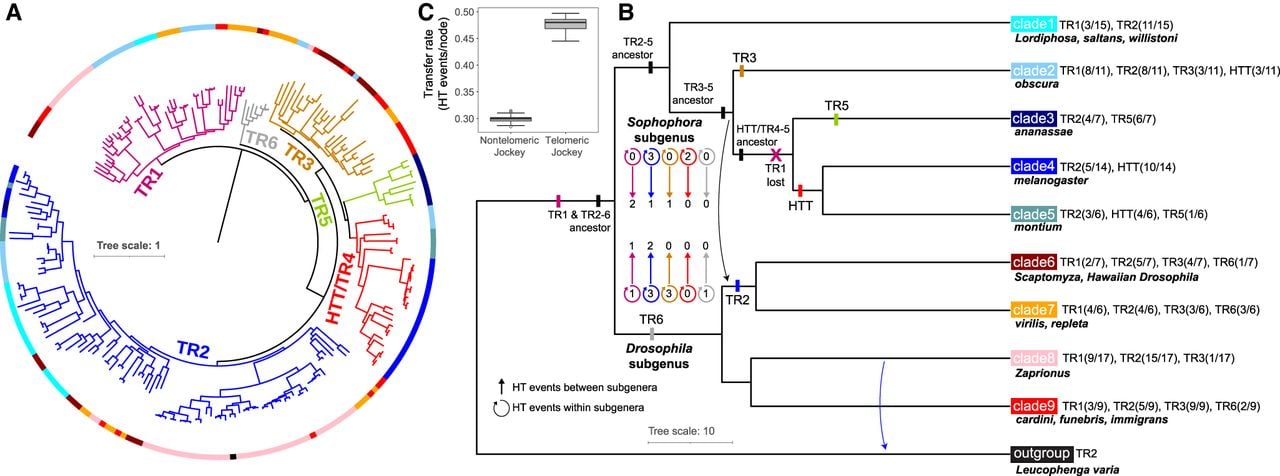
We used ORF1 and ORF2 peptide sequences to create phylogenetic trees showing the evolutionary relationships among all 396 telomeric TE families. We identify six major clades of telomeric retrotransposons across 109 Drosophila species. These clades are present in both our ORF1 and ORF2 trees and include all original telomeric TE clades described by Villasante et al. (2007): TR1, TR2, TR3, TR4, and HTT, although we note that our more comprehensive trees suggest the TR4 clade is actually part of the HTT clade (Fig. 2A; Supplemental Fig. S6). We therefore use HTT/TR4 here to encompass both groups (see Methods) (Fig. 2A; Supplemental Fig. S6). Our results confirm the monophyly of the Villasante et al. clades and also provide evidence of two novel clades, which we name TR5 and TR6. Many species contain diverse assemblages of telomeric TEs: 94 species have telomeric TEs from more than one TR clade, with 18 species harboring three or more TR clades (Fig. 2A; Supplemental Table S2).
Evolutionary history of telomeric TE families. (A) Phylogeny of telomeric TE families inferred from ORF2 peptide sequences. Six major telomeric retrotransposon (TR) clades were identified, each with 100% bootstrap support (see Supplemental Fig. S6). The naming scheme is based on TR clades originally described by Villasante et al. (2007), with the addition of the novel TR5 and TR6 clades identified here. The tree branches are colored by TR clade, and the outer circle colors correspond to the host species clades shown in B. The tree is rooted using ORF2 sequences from nontelomeric Jockey clade TEs (data not shown) (see Supplemental Fig. S6). (B) Dated species tree showing major events in the diversification of Drosophila telomeric TEs based on species tree/TE tree reconciliation (see Methods). Rectangles are colored based on the TR clades shown in A. TR clade origins are indicated by filled rectangles, and losses are indicated by an “X.” Horizontal transfer events are summarized by circular (transfers within subgenera) and vertical (transfers between subgenera) arrows. Both types of arrows are colored based on TR clade. Two additional transfer events are shown by curved arrows: one giving rise to the origin of the TR2 clade (black arrow) and the other showing the transfer of a TR2 clade TE to the outgroup species Leucophenga varia (blue arrow). For additional descriptions of TR clade evolution, see Supplemental Text in the Supplemental Materials. Parentheses next to the major Drosophila species clades indicate the number of species harboring the corresponding TR clade over the total number of species within each species clade. (C) Rates of horizontal transfer for nontelomeric versus telomeric Jockey clade TEs.
We used our ORF1 tree to investigate the evolutionary relationships among the abundant ORF1-only TEs found across the Drosophila genus. The location of these TEs within our ORF1 tree suggests that ORF2 has been repeatedly lost across dozens of independent TE lineages (Supplemental Fig. S7). However, we also find monophyletic clades containing between two and six ORF1-only TE families, which suggests that not all ORF1-only TEs arise from independent loss of ORF2 (Supplemental Fig. S7). Instead, ancestral ORF1-only TE lineages can birth new ORF1-only TE lineages. The repeated loss of ORF2 from telomeric TEs is particularly striking given that this phenomenon does not seem to occur in nontelomeric Jockey elements (Arkhipova 2012).
We next sought to investigate the evolutionary history of these telomeric TEs across the Drosophila genus. In a mutualistic relationship, in which the symbiont is transmitted vertically from parent to offspring, its evolution will be tightly coupled to that of its host, resulting in a pattern of cospeciation. Such a pattern has been observed in a variety of obligate endosymbionts (Moran and Baumann 1994). Thus, if telomeric TEs are acting as mutualists, the major telomeric TE clades should mirror the major clades found in the Drosophila species tree. We would also expect that the most ancient TE clade should be found broadly, across all extant Drosophila species, because its origin would coincide with or predate the most recent common ancestor of the genus. Instead, we find that many distantly related species harbor closely related telomeric TEs. For example, TR1, TR2, and TR3 clade elements are found in species from both the Sophophora and Drosophila subgenera. Furthermore, the early diverging TE clade, TR1, is found in only six of 10 major species clades, whereas TR2, one of the more derived clades, is found across all 10 species clades (Fig. 2).
There are two evolutionary scenarios that could explain these observations: (1) The divergence of the majority of telomeric TE clades predated the common ancestor of the Drosophila genus, and different TE clades were subsequently lost from different Drosophila lineages, or (2) divergence of the TE clades accompanied the divergence of the genus, followed by frequent horizontal transfer (HT) of TE clades among Drosophila species groups. To assess the evidence for these two scenarios, we performed gene tree/species tree reconciliation (see Methods) to infer duplication (in the case of TEs, this would be divergence of an ancestral TE family into two related families within a single host lineage), transfer, and loss events for the telomeric TEs. To more easily visualize the reconciliation results, we focused on nine major species clades (Suvorov et al. 2022) and pruned the species and TE trees (for the pruned TE tree, see Supplemental Fig. S6) to include the minimum number of species necessary to account for the presence of each TR clade within each species clade (Fig. 2B). We found that the inferred rate of HT exceeded the inferred rates for both duplications and losses (HT, 22; duplications, six; losses, 13). We confirmed that these putatively horizontally transferred TEs showed patterns of sequence similarity consistent with HT (Supplemental Figs. S8, S9) and repeated this analysis on the unpruned species and gene trees, which infers a total of 82 HT events, 12 duplication events, and 70 losses. For comparison, we ran the same analysis pipeline on a set of 465 nontelomeric Jockey TEs recently identified in Drosophila (Tambones et al. 2019). The rate of HT for telomeric TEs is ∼63% higher than that of nontelomeric TEs, a difference that is highly significant (Wilcoxon test P < 2.2 × 10⁻¹⁶) (Fig. 2C). Thus, our reconciliation analysis suggests that the six major telomeric TE clades originated within different Drosophila lineages at different time points during the diversification of the genus and subsequently expanded their host range via HT.
Convergent evolution of telomere specialization
Telomeres can act as a “safe harbor” in which TEs can insert without deleterious consequences. Indeed, transposon insertions have been identified within the canonical telomere repeats in species of fungi, silk moths, and plants (Higashiyama et al. 1997; Fujiwara et al. 2005; Gladyshev and Arkhipova 2007; Rahnama et al. 2020). One might therefore expect other transposons to target their insertions to Drosophila telomeres. To assess this possibility, we asked whether there were Jockey family TEs from the nontelomeric clade that form head to tail arrays at the telomeric regions of any species included in our analysis. We identified Jockey retrotransposons from the nontelomeric clade at the telomeres of six species: Drosophila cardini, Drosophila funebris, Drosophila littoralis, Drosophila virilis, Scaptomyza hsui, and Scaptomyza pallida (Fig. 3). These TEs form a monophyletic clade within the larger clade of nontelomeric Jockey elements, despite their appearance in species that are only distantly related. For example, D. cardini, D. funebris, and S. hsui/pallida diverged from each other more than 20 million years ago (Kumar et al. 2022). The presence of these closely related TEs in distantly related species is indicative of HT (Fig. 3; Supplemental Fig. S10). Hereafter, we refer to this as the NTT clade (nontelomeric clade TEs at telomeres).
Convergence and neofunctionalization in telomeric TE families. (A) Species tree showing the six species harboring nontelomeric clade TEs at their telomeres (NTTs, red branches) and the four species carrying potentially neofunctionalized ORF2 (blue arrows). The outer circle colors delineate major species clades. (B) Pruned TE tree showing that the NTT families (red branches) form a monophyletic subclade within the larger clade of nontelomeric Jockey elements, inferred from ORF2 peptide sequences. (C) Schematic examples of two species (D. virilis and S. hsui) showing telomeric regions composed of head-to-tail arrays of telomeric TEs and NTTs. In S. hsui, we found a fragmented TE sequence (red arrow) at the telomeric end of the contig whose partial ORF2 sequence placed it within the telomeric clade. (D) Seven telomeric TEs from members of the virilis species group (see A) contain an ORF2 (brown box) that shows no significant homology with the ORF2 (purple box) of other telomeric TE families from this same group via peptide BLAST. Lengths correspond to the full-length TE in base pairs and the ORF2-encoded peptide in amino acids (aa). (E) A profile HMM created from the seven unusual ORF2 sequences shows homology with several regions of the ORF2 from a D. littoralis telomeric TE that also contains the canonical endonuclease and RT domains usually found in Jockey clade ORF2 peptides, plus a domain of unknown function termed X. The unusual ORF2 sequences in E may represent a case of neofunctionalization, in which the ancestral function provided by the endonuclease and RT domains has been lost and replaced by a currently unknown function.
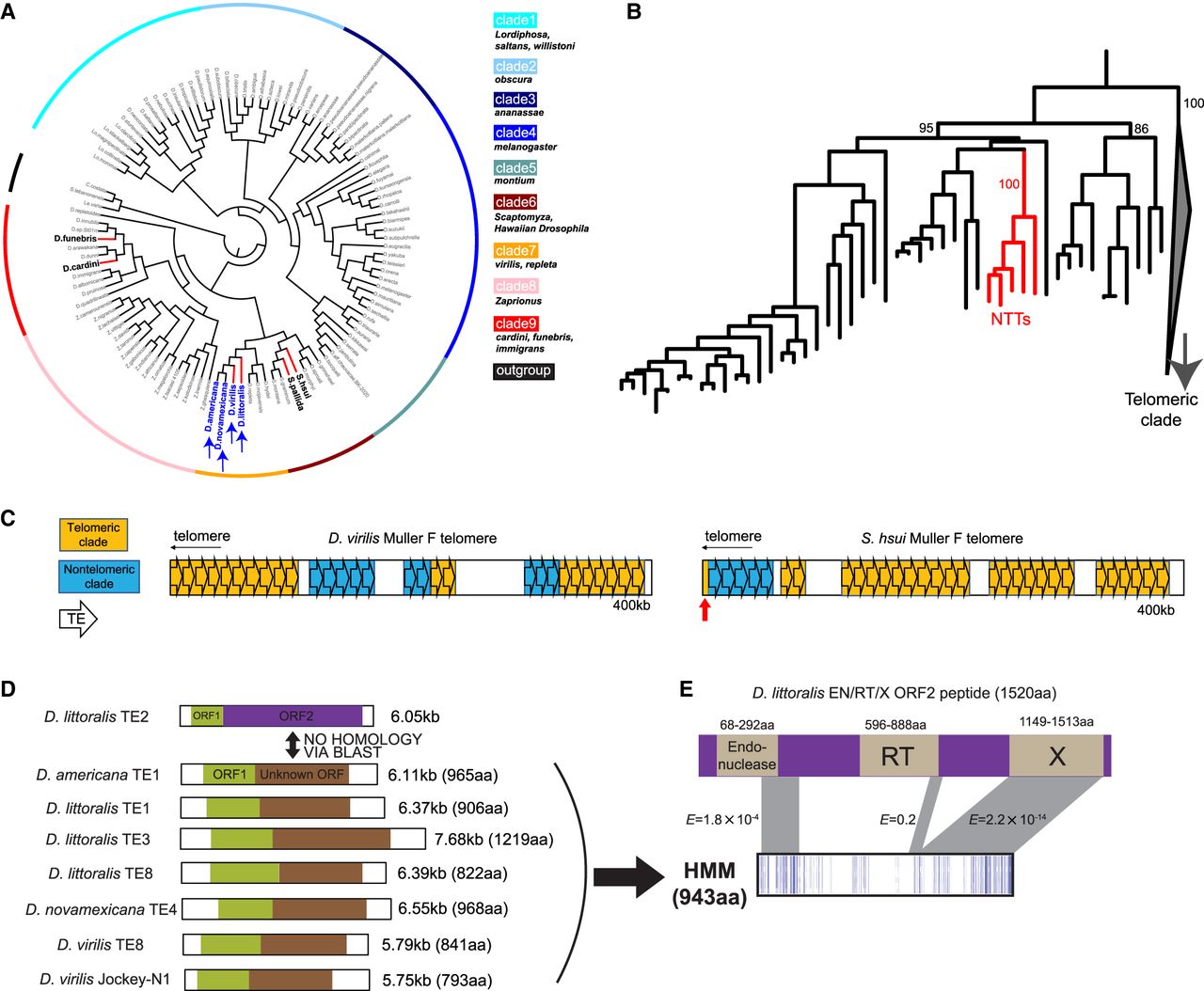
These elements are not found elsewhere in the genomes of any of the six species listed above, consistent with telomere specialization; however, in all six species, their arrays are found in between and/or adjacent to arrays of telomeric-clade Jockey TEs (Fig. 3C; Supplemental Fig. S10). Their genomic location suggests that these elements have acquired the ability to target their insertions to the telomeric regions of the genome. Nevertheless, it remains unclear if they are able to act as bona fide telomeres (i.e., by mobilizing directly to chromosome ends) or if they are instead parasitizing the telomeric niche by homing in on pre-existing telomeric TE arrays.
It is also conceivable that other non-Jockey TEs have evolved telomere specialization. To assess this possibility, we calculated the median distance to the telomere for all TE families from 30 Drosophila species with chromosome-level genome assemblies. With the exception of the above NTT elements and telomeric Jockey TEs, no other TE families showed a telomere-biased distribution in their genomic locations, suggesting that NTT and Jockey elements are the only telomere-specialized TEs across these 30 species (Supplemental Fig. S11).
Potential neofunctionalization of ORF2
The ORF2 of all LINE elements, including mammalian LINE-1, contains, at a minimum, an endonuclease and a RT domain (Eickbush and Malik 2002). The domain organization of ORF2 within the Jockey clade of LINEs, which includes all Drosophila telomeric TEs, is similar to that of LINE-1 elements, with the endonuclease domain preceding the RT domain (Eickbush and Malik 2002; Wicker et al. 2007). The presence of a conserved endonuclease domain within the ORF2 carried by Drosophila telomeric TEs is surprising, considering that transposition to chromosome ends should not require DNA nicking (Casacuberta 2017). To better characterize the extent of ORF2 domain conservation across Drosophila telomeric TEs, we used InterPro to identify conserved domains in the ORF2 sequences from our library of telomeric TEs. Seven and nine ORF2 proteins were found to be missing the RT and endonuclease domains, respectively (Supplemental Table S4). Two of these cases were because of a premature stop codon truncating the ORF2 reading frame, whereas the seven remaining ORF2 proteins showed no signs of truncation but were missing both RT and endonuclease domains. All seven ORF2 proteins are from species in the virilis group, and according to InterPro, these unusual ORFs contain no conserved domains at all aside from a single disordered region. The first ORF in these TEs is clearly homologous to the ORF1 protein found in other Drosophila telomeric TEs, which is how these elements were classified as telomeric TEs in the first place. However, a peptide BLAST search was unable to detect any significant amino acid similarity between these unusual ORF2 peptides and the canonical ORF2 peptides from other telomeric TEs (Fig. 3D).
In total, we identified seven telomeric TE families carrying this unusual ORF from the following species: D. virilis, Drosophila americana, Drosophila novamexicana, and D. littoralis. The peptides encoded by these ORFs range in size from 793 to 1219 amino acids, and they range from 30% to 96% identical among the seven TE families (Fig. 3D; Supplemental Fig. S12). We were unable to identify homologs of these peptides outside of the above species, despite employing sensitive hidden Markov model (HMM)–based search strategies (see Methods). We calculated the ratio of nonsynonymous (dN) to synonymous (dS) substitutions for all pairs of sequences and found that, in 20 out of 21 pairwise comparisons, there is statistically significant evidence of purifying selection, which suggests that the ORFs encode functional proteins (Supplemental Table S5). The pair that did not reach significance is highly similar to one another, resulting in a lack of power to detect purifying selection (Supplemental Table S5).
In addition to the conserved endonuclease and RT domains, the ORF2 proteins of some Drosophila telomeric TEs carry an additional glutamine-rich region consisting of approximately 400 amino acids at the C terminus, referred to as the “X domain” (Casacuberta and Pardue 2003). We hypothesized that perhaps the unusual ORF that we discovered was derived from this X domain, having lost both the endonuclease and RT domains. To test this hypothesis, we used a HMM approach (see Methods) to compare the seven unusual ORF2 peptides identified here to all telomeric TE ORF2 peptides containing the endonuclease, RT, and X domains (hereafter referred to as EN/RT/X ORF2 peptides). These searches revealed several regions of homology between a D. littoralis EN/RT/X ORF2 peptide and our HMM (Fig. 3E). Small portions of both the endonuclease and RT domains in the D. littoralis EN/RT/X peptide show weak evidence for homology with our HMM (HMMER E-value = 1.8 × 10⁻⁴ and 0.2, respectively). There is much stronger evidence for homology between the C terminus of the HMM and the X domain of this peptide (HMMER E-value = 2.2 × 10⁻¹⁴). These results suggest that the unusual ORF2 peptides we discovered are in fact derived from the canonical ORF2. However, the endonuclease and RT domain regions have evolved so rapidly that they are no longer recognizable as conserved domains and may no longer retain their ancestral function, raising the possibility that this ORF has acquired a novel function in these species. This represents, to our knowledge, the only known example of a LINE ORF2 peptide that lacks both RT and EN domains.
Gene capture by telomeric transposons
In plants, gene capture may allow TEs to evade host silencing by forcing the host to reduce the efficiency of TE suppression mechanisms in order to avoid self-silencing (Lisch 2009; Muyle et al. 2021). Similarly, our prior work showed that the D. melanogaster telomeric TART element has captured a fragment of the host piRNA pathway gene nxf2 and that TART-derived piRNAs likely target nxf2 for suppression (Ellison et al. 2020). This antisilencing strategy imposes a cost to the host genome while benefitting the TE, consistent with TART acting as a parasite rather than a mutualist. We therefore sought to determine if gene capture occurred in the telomeric transposons of other Drosophila species by searching the full-length consensus of all Drosophila telomeric TEs identified here for homology with D. melanogaster peptides. In Drosophila tristis, we identified multiple fragments of the host gene pangolin embedded within the telomeric TE array of the dot chromosome; however upon further inspection, we concluded that the presence of pangolin coding sequence within the telomere of this species is likely owing to unequal crossing over rather than gene capture by telomeric TEs (Supplemental Fig. S13). After manual curation of all remaining BLAST hits (see Methods), we identified 20 telomeric TE families that show evidence of gene capture (Supplemental Table S6), which represents at least nine independent gene capture events across the genus, including the previously described capture of nxf2 (Fig. 4A). Eight of the nine events involve capture of known piRNA pathway genes: the capture of nxf2 by D. melanogaster plus seven additional capture events involving either piwi or aubergine (aub), both of which are members of the Piwi subfamily of Argonaute proteins that bind piRNAs and are required for transposon silencing (Saito et al. 2006; Vagin et al. 2006; Brennecke et al. 2007; Gunawardane et al. 2007).
Repeated capture of piRNA pathway genes by telomeric TEs. (A) Species tree showing independent gene capture events (red thick lines) at the nodes. Labels indicate the gene that was captured, and the outer circle is colored by major species clade. (B) Diagrams showing the location of the captured sequence within the full-length TE consensus sequence and within the host gene. Green and purple boxes indicate the locations of ORF1 and ORF2, respectively. TEs lacking a purple box have lost ORF2. Note that the 5′ UTR of TART-A is copied from a portion of the 3′ UTR during replication; thus, the 3′ UTR of TART-A also carries nxf2 sequences (Ellison et al. 2020), but they are not shown here for clarity.
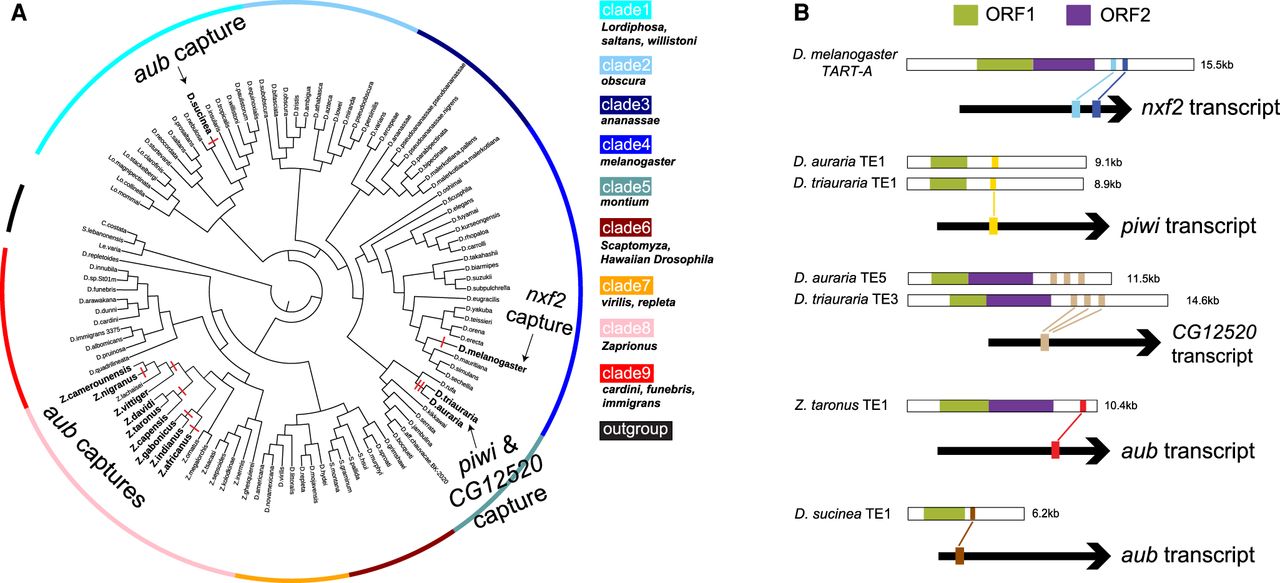
We find that a fragment of piwi was captured by a telomeric TE family present in both Drosophila auraria and Drosophila triauraria, and fragments of aub were captured by a telomeric TE family in Drosophila sucinea and nine different species within the vittiger subgroup of the Zaprionus clade. The other novel capture event involves another telomeric TE family from D. auraria and D. triauraria, which carries fragments from a homolog of the F-box domain containing D. melanogaster gene CG12520. F-box proteins are known to provide substrate specificity to the SCF ubiquitin ligase complex (Kipreos and Pagano 2000). CG12520 is expressed in the female germline (Tiwari et al. 2019), and knockdown of CG12520 causes a very modest upregulation of two telomeric TEs (Czech et al. 2013). This gene is largely uncharacterized; for example, its binding substrate remains unknown (Dui et al. 2012). Across all gene capture TE families, the length of the captured gene fragments ranges from 140 bp to 235 bp, and their similarity to their host gene ranges from a percentage identity of 76.4% to 94.82% (Fig. 4B; Supplemental Table S6).
Five of the nine independent gene capture events occurred in the Zaprionus clade. Out of 17 Zaprionus species with sequenced genomes, we find 10 species harboring one or more telomeric TEs that contain aub gene fragments (Fig. 5A). In total, four different regions of the aub gene were captured by different TE lineages within this group (Fig. 5A). Some of these telomeric TEs, such as those from Zaprionus africanus, Zaprionus gabonicus, and Zaprionus indianus, captured two different regions of the aub gene (Fig. 5A). The captured aub fragments were subsequently amplified within these TEs, up to seven copies in the Z. africanus TE and eight copies in Z. gabonicus and Z. indianus TEs (Fig. 5A).
Multiple captures of aubergine (aub) by telomeric TEs in Zaprionus. (A) Zaprionus species tree showing independent gene capture events. The rectangles are colored based on the aub region that was captured. Diagrams show the location of the captured region within the full-length TE. Note that the region B of aub was captured in the ancestor of Z. vittiger and Z. capensis (solid blue rectangle) and subsequently lost in the Z. davidi/Z. taronus/Z. capensis clade (open blue rectangle), whose TEs now carry region C of aub. (B) Normalized piRNA abundance from the captured host gene (red indicates aub; green, piwi) calculated in 80 bp nonoverlapping windows across the gene transcript. aub is used as a control (blue) in species in which piwi was captured, and piwi is used as a control in species in which aub was captured. The control gene produces significantly fewer piRNAs in all within-species comparisons. Wilcoxon test P < 0.05 in all cases: D. auraria, P = 0.026; D. triauraria, P = 1.3 × 10⁻⁴; Z. davidi, P = 3.0 × 10⁻⁴; Z. gabonicus, P = 6.3 × 10⁻⁴; and Z. indianus, P = 5.2 × 10⁻⁸. (C) Gene tree inferred using aub coding sequence. The clades analyzed in D are indicated by vertical bars. (D) Comparison of rate of evolution of the captured (red) portion of aub versus the uncaptured portion. In the species in which telomeric TEs have captured part of aub (capture clade), the homologous sequence in the aub gene is evolving approximately twice as fast as the uncaptured portion of the gene (Fisher's exact test P = 2.7 × 10⁻⁵). In species in which this region has not been captured, it evolves at a similar rate as the uncaptured portion of the gene (Fisher's exact test P = 0.64).
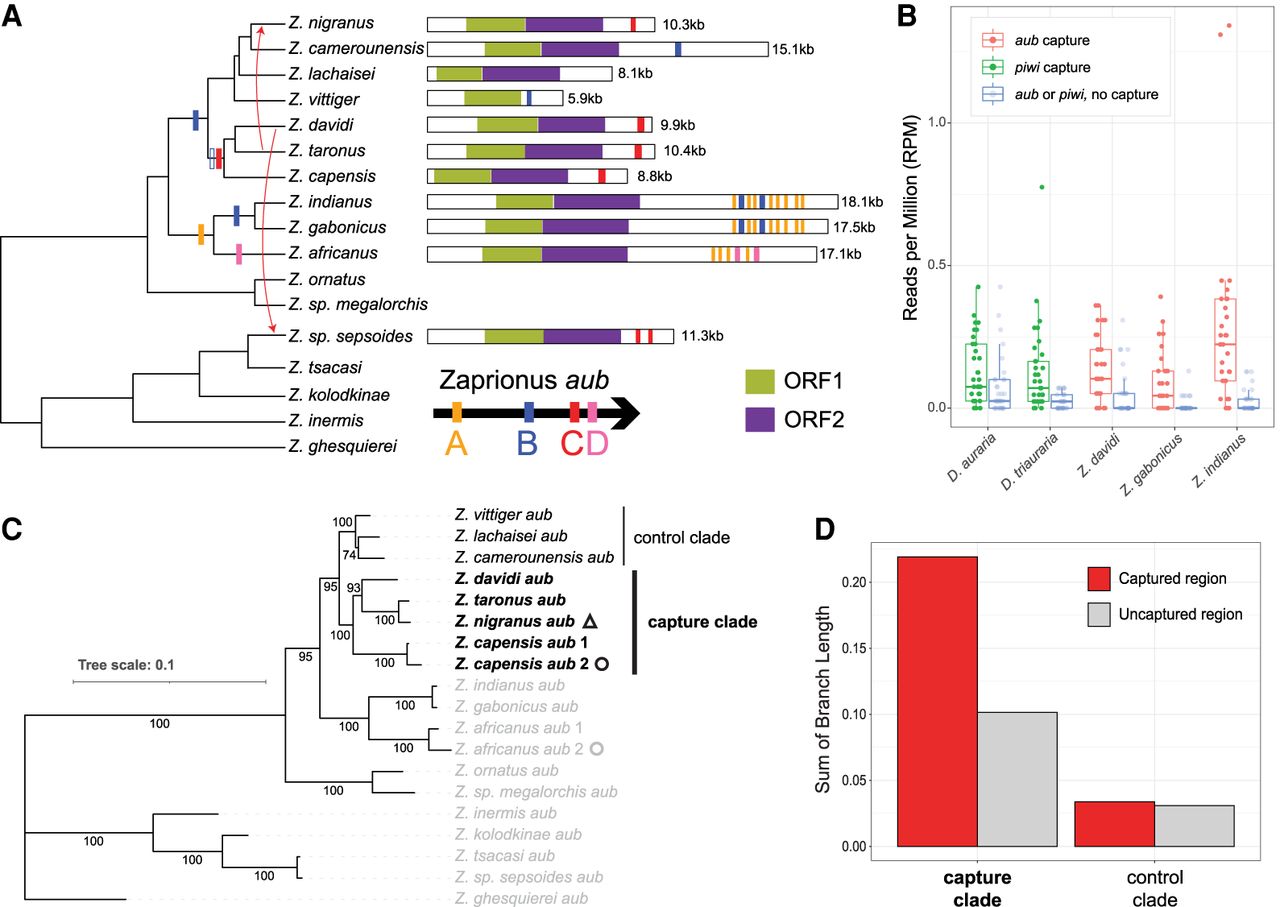
It is possible that these seemingly independent gene capture events actually originated via a single capture event that included a large portion of the aub gene, followed by independent deletions of aub sequence in different TE lineages. Indeed, the Zaprionus TE families that carry aub sequence form a monophyletic clade in the ORF2 TE tree (Supplemental Fig. S14). We tested this prediction by reconstructing the evolutionary history of each capture event (Supplemental Fig. S14). We created gene trees using alignments containing the captured aub-like TE sequences along with their homologous sequences from the aub gene of each Zaprionus species. These trees confirmed our initial inference that five independent capture events occurred within Zaprionus, and allowed us to assign each event to a node in the Zaprionus species tree (Fig. 5A). Unexpectedly, we find that region B of aub was captured in the ancestor of Zaprionus vittiger and Zaprionus capensis and subsequently lost in the Zaprionus davidi/Zaprionus taronus/Z. capensis clade, whose TEs now carry region C of aub (Fig. 5A; Supplemental Fig. S14). We also note that region B of aub was captured independently by two different Zaprionus clades; however, the captured regions overlap but do not share the same boundaries.
The repeated capture of piRNA pathway genes by Drosophila telomeric TEs suggests that acquisition of these gene fragments may increase TE fitness. We previously found evidence that antisense piRNAs produced from the nxf2-like region of TART are capable of targeting the nxf2 host gene for suppression, consistent with an antisilencing strategy to escape host suppression (Ellison et al. 2020). To determine if a similar scenario is occurring in these other species, we performed small RNA sequencing from ovaries for five species in which telomeric TEs had captured either aub or piwi, as well as four related species in which gene capture had not occurred to use as controls. The median identity between captured sequence and host gene is ∼90% across all gene capture TEs (Supplemental Table S6). This identity is noticeably smaller for two gene capture cases: CG12520 in D. auraria/triauraria (∼79% identity) and aub in Zaprionus sp. sepsoides (∼82% identity) (Supplemental Table S6). We find almost a complete lack of piRNAs mapping to the host genes in these latter two cases of elevated divergence (Supplemental Fig. S15), suggesting that the similarity between captured sequence and host gene is too low to direct host gene targeting by TE-derived piRNAs.
In the species with high sequence identity between the captured sequence and the host gene, we found small RNAs from both the gene capture telomeric TEs and the aub (or piwi) host genes whose lengths and 5′ U bias are consistent with piRNAs (Supplemental Figs. S16–S18). Furthermore, in species in which aub (but not piwi) was captured, the abundance of piRNAs from aub is significantly larger than from piwi, whereas the reverse is true for species in which piwi (but not aub) was captured (Fig. 5B). Overall, piRNA abundance from the captured host gene is significantly larger in the species harboring gene capture TEs compared to species whose TEs have not captured any host gene (Wilcoxon test P = 0.0036) (Supplemental Fig. S19), consistent with the host gene being targeted by piRNAs derived from the gene capture region of the telomeric TE. Across all species harboring gene capture TEs, the telomeric TE families that have captured a host gene fragment have significantly higher copy numbers compared with the other noncapture telomeric TEs in the same genome (paired Wilcoxon test, one-sided P = 0.02) (Supplemental Fig. S20), suggesting that gene capture increases TE fitness beyond its role in suppressing the host piRNA pathway (see Discussion).
There are two ways that piRNA biogenesis from the piwi/aub host genes could be initiated: (1) via ping-pong amplification or (2) via a “trigger” piRNA, as has been described for the D. melanogaster row gene, in which phased piRNA production is triggered by a piRNA from the 1360 TE that shares sequence similarity with row (Mohn et al. 2015). piRNA biogenesis from D. melanogaster nxf2 mRNA is more consistent with the latter phenomenon in which a trigger piRNA from the TART telomeric TE induces phased piRNA biogenesis downstream from the region of nxf2 that was captured by TART (Ellison et al. 2020).
To better assess ping-pong and phasing signatures in piwi- and aub-derived piRNAs, we performed additional deep sequencing of piRNAs (see Methods) from four species: D. auraria, D. triauraria, Z. gabonicus, and Z. indianus. For both piwi and aub, we observe sense-strand piRNA production both upstream of and downstream from the region that was captured by a telomeric TE; however, only the downstream piRNAs show a strong signature of phasing (Supplemental Fig. S18). In all four species, antisense piRNAs derived from telomeric TEs align to the captured region of the host gene and overlap with host gene–derived sense piRNAs (Supplemental Fig. S17). In three species (D. auraria, D. triauraria, and Z. gabonicus), the overlap between these sense and antisense piRNAs shows the signature of ping-pong amplification (Supplemental Fig. S17). These results are consistent with ping-pong amplification and/or trigger piRNAs resulting in the biogenesis of phased piRNAs downstream from the captured region of the host genes aub and piwi.
If aub is being targeted for suppression by TE-derived piRNAs, we expect to see accelerated evolution in the corresponding region of aub, which would reduce piRNA targeting by decreasing the similarity between aub and the aub-like sequences within the telomeric TE. We focused on the clade of aub with sequences from the following species: Zaprionus nigranus, Z. taronus, Z. davidi, and Z. capensis, because the telomeric TEs in all of these species have captured the same single region of aub, and the captured sequences have not been amplified within the TE (Fig. 5A). We find that the region of aub that was captured by TEs is evolving approximately twice as fast as the uncaptured portion of the gene, based on a comparison of trees constructed from the captured region of aub versus aub sequence that was not captured by any Zaprionus TEs (Fisher's exact test P = 2.7 × 10⁻⁵; see Methods). As a control, we repeated this analysis on the aub clade from Zaprionus camerounensis, Zaprionus lachaisei, and Z. vittiger, whose TEs have not captured this region of aub. In this case, there was no difference in the rate of evolution (Fisher's exact test P = 0.64) (Fig. 5D).
We also find that aub has undergone two independent duplication events in Zaprionus, once in the Z. capensis lineage and once in Z. africanus (Fig. 5C). This finding alone is remarkable given that a previous survey of 39 Dipteran species (including 22 species of Drosophila) identified only a single duplication event involving aub since its origin more than 150 million years ago, which occurred in stalk-eyed flies (Lewis et al. 2016). Notably, both Zaprionus aub duplications occurred in species with telomeric TEs that have captured an aub fragment (Fig. 5A), raising the possibility that the duplications were selected for as a means to increase aub dosage in response to it being targeted by TE-derived piRNAs.
In addition to duplications, we also find strong support for introgression of aub from Z. taronus to Z. nigranus, likely owing to recent gene flow between these two species (Fig. 5C; Supplemental Figs. S21, S22). This transfer of aub from taronus to nigranus potentially sets the stage for a subsequent invasion of the nigranus genome by taronus telomeric TEs, whose aub-like sequences are 92.26% identical to those of the taronus aub gene. Indeed, two telomeric TEs, both of which carry an aub gene fragment, show evidence of HT from Z. taronus to Z. nigranus (Supplemental Fig. S21). We infer that, based on sequence similarity, the two telomeric TEs initially diverged in Z. taronus, with one family subsequently losing the ORF2 gene (Supplemental Fig. S21). Synonymous divergence between the taronus and nigranus copies of the aub gene (Ks = 0.034) is larger than that of the ORF1 genes for the two TE families (TE-1, Ks = 0; TE-2, Ks = 0.023), suggesting that the transfer of aub from taronus to nigranus occurred first, followed by the transfer of TE-2 and, most recently, the transfer of TE-1 (Supplemental Fig. S21). Notably, these recently transferred TEs (which captured region C of aub) (Fig. 5A) have replaced the ancestral telomeric TEs in Z. nigranus, which carried region B of aub. Thus, different lineages of gene capture TEs may compete with one another to maintain their residence in a given host genome.
Together, these results suggest that capture of piRNA pathway genes by telomeric TEs has occurred repeatedly across the Drosophila genus, likely as a form of counter-defense, in which TEs selfishly target host suppression systems for silencing to increase their own fitness. The accelerated evolution of the region of the host gene that was captured, which was previously described for nxf2 (Ellison et al. 2020) and shown here for aub, suggests there is selection to avoid this targeting by “erasing” the similarity between the captured sequence carried by the TE and the host gene.
Discussion
Recent work in both Arabidopsis and zebrafish has introduced the concept of transposon “addiction” in which an active TE family serves an essential function for its host genome despite causing mutational damage via insertion of new TE copies (Shimada et al. 2024; Chang et al. 2025). The telomeric TEs of Drosophila fit nicely into this framework: They play a critical role in protecting and extending chromosome ends and, importantly, the benefit they provide to their host depends upon their transposition activity. However, the host genome also constrains the activity of these elements, both to ensure that transposition occurs only on chromosome ends (Cui et al. 2021) and to control telomere length as ultralong telomeres have been shown to reduce fertility (Walter et al. 2007). The TE addiction model predicts that telomeric TEs should eventually be fully co-opted by their host genome; however, our results suggest that the tension between selfish mobilization and host control has led to a prolonged period of evolution between these TEs and their host genome that is dominated both by instability and genetic conflict.
Rather than the cospeciation that one might expect from a true genetic mutualist, the telomeric TE phylogeny is dominated by HT and lineage-specific extinction events, consistent with a parasitic relationship between these elements and their hosts. This relationship is similar to what has been described for facultative bacterial endosymbionts like Wolbachia, Rickettsiella, and Spiroplasma, all of which have been shown to undergo frequent HT among host species while also selfishly enhancing their own fitness at the expense of their host through strategies such as cytoplasmic incompatibility and male killing (Gu et al. 2023; Hoffmann and Cooper 2024; Jonathan et al. 2024; Floriano et al. 2025). These facultative endosymbionts are distinct from obligate mutualists, like Buchnera, which are vertically transmitted and provide essential nutrients to their aphid hosts, with whom they have codiverged for more than 200 million years (Moran et al. 1993; Moran and Baumann 1994).
We further find that the relationship between telomeric TEs and their host is unstable: It has completely unraveled at least 10 separate times across the genus, with a total of 13 Drosophila species (and two outgroup species) having lost telomeric TEs entirely and thus presumably relying on an alternative, recombination-based mechanism of chromosome elongation (i.e., alternative lengthening of telomeres [ALT]) (Bryan et al. 1997; Biessmann et al. 2000). This instability may be owing in part to the dynamic nature of the telomeric niche (McGurk et al. 2021); however, we also find evidence of competition among telomeric TE clades. The TR1 and TR6 clades both predate the origin of the TR2 clade, but TR2 elements are found in more than half of all species studied here, which is about twofold as many species compared with TR1 and about 10-fold the number of species carrying TR6 clade TEs. TR2 has therefore spread via HT into lineages whose ancestral telomeres were occupied by TR1 and/or TR6 clade TEs but have since been replaced by TR2 elements.
We also find evidence of potential competition among TEs from nontelomeric Jockey clades for the telomeric niche. The NTTs we identify here are well supported as members of the nontelomeric Jockey clade, yet they appear to be present in head-to-tail arrays exclusively at the telomeres of six Drosophila species, always either adjacent to or in between arrays of telomeric Jockey clade TEs. This localization pattern suggests that these elements are able to target their insertions to the telomeric regions of chromosomes. Future work will determine if they are able to directly mobilize to chromosome ends or if they instead only insert into pre-existing arrays of telomeric clade TEs.
In contrast to what would be expected from a genetic mutualist, we find evidence of extremely rapid evolution and potential functional innovation within a subset of telomeric TE families from several virilis group species. The ORF2 amino acid sequence of these TE families has evolved so rapidly that it is almost unrecognizable as an ORF2 homolog, which is especially notable given that ORF2 (as opposed to ORF1) is preferentially used for phylogenetic classification of LINEs owing to its slower rate of evolution. The endonuclease and RT conserved domains are hallmarks of ORF2 encoded peptides in LINE non-LTR retrotransposons from humans to nematodes (Eickbush and Malik 2002). Neither of these domains are detectable by InterPro (Paysan-Lafosse et al. 2023) in the amino acid sequences of these unusual ORF2s. It is possible that the loss of these conserved domains is caused by degeneration or pseudogenization. However, our dN/dS analysis shows that these unusual ORF2 sequences are evolving under purifying selection. Thus, these peptides may have evolved a novel function that is different from the host DNA cleavage and reverse transcription functions provided by canonical ORF2s, which is now being maintained by purifying selection. How could these TEs continue to mobilize after loss of these two critical ORF2 functions? It is notable that the entire ORF2 is dispensable from a given TE as long as it is encoded by other related TE families, as evidenced by the repeated loss of ORF2 from many telomeric TEs. Such dispensability may have provided this unusual ORF2 the flexibility to evolve a novel function similar to the phenomenon of neofunctionalization after gene duplication (Ohno 1970).
Frequent HT, competition among telomeric TE lineages, and functional innovation within certain lineages are all consistent with antagonistic evolution between telomeric TEs and their hosts. The possibility of antagonistic coevolution is further supported by our evidence that telomeric TEs have repeatedly and specifically captured fragments of piRNA pathway genes, including aub and piwi, in addition to the previously described capture of nxf2 by the D. melanogaster telomeric transposon TART (Ellison et al. 2020). piRNA abundance from a subset of these species is consistent with our previous work, suggesting that piRNAs derived from the captured gene fragment(s) embedded within the telomeric TEs are capable of targeting the host gene for suppression (Ellison et al. 2020). This phenomenon thus likely represents a counter-defense or antisilencing strategy deployed by these TEs (Fu et al. 2013; Hosaka et al. 2017; Cosby et al. 2019; Sasaki et al. 2022, 2023; Lawlor and Ellison 2023). It may seem self-destructive for a single TE family to impair the piRNA pathway, thus potentially leading to the upregulation of the majority of active TEs in the genome. However, the telomeric transposons of D. melanogaster are exquisitely sensitive to disruption of the piRNA pathway (Czech et al. 2013; Morgunova et al. 2021; Kalmykova 2023). Assuming telomeric TEs in other species are similarly sensitive, they may be able to suppress piRNA activity just enough to benefit themselves without causing the upregulation of other TE families, who are less sensitive to piRNA pathway disruption.
Similar to what we observed for nxf2 in D. melanogaster, we find accelerated evolution of the aub gene in Zaprionus, specifically in species harboring aub-capture TEs and specifically in the region of aub that was captured. This process is consistent with antagonistic coevolution: The telomeric TE selfishly captures a fragment of the host gene, which likely decreases expression of the host gene via piRNA-mediated silencing (although we note that this targeting has not been experimentally verified). Host gene mutations that disrupt piRNA targeting would then be favored by natural selection, leading to accelerated evolution of the host gene in the region that was captured. The TE may respond by capturing a new region of the same gene, as we see in Zaprionus. Amplification of the captured gene fragment (as seen in Z. indianus, Z. africanus, and Z. gabonicus) may also be beneficial by allowing the TE to more efficiently acquire mutations that increase or preserve the similarity between the captured fragment and host gene via nonallelic gene conversion among the duplicated fragments (Mano and Innan 2008; Ellison and Bachtrog 2015).
We previously observed that all copies of TART carry the captured fragment of nxf2, both in the D. melanogaster reference genome, as well as in other wild strains (Ellison et al. 2020). However, nxf2-positive TART copies impose a fitness cost on their host genome, which in turn reduces their own fitness because, unlike viruses, their survival depends on vertical transmission from parent to offspring (Cosby et al. 2019). If the sole benefit of the captured nxf2 fragment is derived from its ability to suppress the piRNA pathway, we would instead expect this fragment to be polymorphic among TART copies because nxf2-negative TART copies would benefit from the presence of other nxf2-positive elements without the associated fitness cost. We therefore previously proposed that capturing host gene fragments may increase TE fitness in other ways, potentially by enhancing transposition (Ellison et al. 2020). Our results here support this prediction: We find that telomeric TEs that have captured host gene fragments have significantly higher copy numbers compared with other noncapture telomeric TEs in the same genome (Supplemental Fig. S20), which suggests there is another benefit provided by the captured gene fragment in addition to antisilencing.
The well-ordered arrays of telomeric TEs found at Drosophila chromosome ends are the result of a complex interplay between TE families that both cooperate and compete with each other and with the host piRNA (Savitsky et al. 2006; Shpiz et al. 2007, 2011; Khurana et al. 2010), DNA repair (Cenci et al. 2005; Melnikova et al. 2005), chromosome end-capping (Raffa et al. 2011), and heterochromatin maintenance (Savitsky et al. 2002; Perrini et al. 2004) pathways, each of which is necessary for proper telomere function. Telomeric TE lineages are likely to have coevolved to at least some degree with the host proteins involved in these pathways to ensure the correct formation and maintenance of telomeric arrays. It is therefore remarkable that host proteins from all three of these pathways are known to evolve rapidly (Lee et al. 2017; Parhad and Theurkauf 2019; Lin et al. 2024). Previous work has proposed various types of genetic conflict that could explain this observation (Lee et al. 2017). Our work here adds two new possibilities: (1) the frequent HT of telomeric TEs among species, as well as the invasion of the telomeric niche by NTTs, could require rapid host protein evolution to maintain coordination between TE mobility and telomere maintenance, and (2) repeated gene capture by telomeric TE families could antagonize the piRNA pathway, leading to rapid evolution of pathway members.
Another striking outcome of our study is the degree to which convergent evolution occurs among Drosophila species and among telomeric TE lineages. To the extent that this convergence is a result of adaptive evolution, these events provide insight into both host and TE biology. The repeated loss of telomeric TEs from various Drosophila species raises the possibilities that these elements impose a fitness cost to their host and that it is advantageous to be rid of them when an alternative mode of chromosome elongation is available. In terms of the TEs themselves, their frequent loss of ORF2 raises the possibility that TEs lacking this ORF are more fit than their progenitors (as long as they can utilize ORF2 peptides encoded other TE families). Similarly, the repeated capture of piRNA pathway genes by telomeric TEs suggests that gene capture increases TE fitness (see above). HT is emerging as a key mechanism by which TEs avoid extinction (Schaack et al. 2010; Venner et al. 2017), and our observation of repeated HT of telomeric TEs supports such findings. Finally, our finding of convergent evolution of telomere localization is consistent with the telomeric niche acting as a “safe harbor” for TE insertions, and thus, TEs with telomeric insertion biases may have increased fitness relative to other TEs.
These findings are not without limitations. Although it is a common approach in the field and is often necessary for analysis feasibility, our usage of consensus sequences to represent telomeric TE families masks sequence variation that may be present among individual TE copies. This sequence variation, which remains unaccounted for, could affect the topology of our TE trees, which, in turn, could alter our estimates of HT. Although we attempt to control for this issue by comparing the HT rates of telomeric Jockey TE consensi to those of nontelomeric Jockey TE consensi, this comparison could be confounded by differences in the biology and/or evolutionary constraints between these two groups.
The “transposon addiction” model envisions an intermediate period of cooperation between TE and host in the continuum between selfish TE mobilization and host co-option (or TE extinction) (Chang et al. 2025). We show that this cooperation period can persist for millions of years: Telomeric TEs originated more than 60 million years ago, before the origin of the Drosophila genus, and remain present in the vast majority of Drosophila species that we surveyed in our study. However, cooperation and conflict are not mutually exclusive. Throughout the more than 60 million year period of apparent cooperation, we find numerous signs of conflict both between different telomeric TE lineages and between these TEs and their host genome. It is striking that these signatures of antagonistic evolution recurrently appear across the Drosophila phylogeny, showcasing the major role of convergence in the evolution of these TEs. This convergence extends beyond Drosophila as well. Telomerase, the holoenzyme responsible for telomere elongation across most eukaryotes, utilizes a RT that likely originated from an ancient non-LTR retrotransposon (Eickbush 1997; Lingner et al. 1997; Nakamura et al. 1997). Thus, the same phenomenon of TE addiction that is currently playing out in Drosophila may have also occurred more than 1 billion years ago, ultimately leading to the co-option of a retrotransposon to form the RT component of the holoenzyme that we now know as telomerase (Eickbush 1997). There are echoes of convergence in other TE addiction systems as well. For example, telomeric TEs are not the only “beneficial” TEs that are able to target their insertions to specific locations in the genome. The G2/Jockey-3 and ATHILA retrotransposons that likely aid in centromere formation in Drosophila and Arabidopsis, respectively, have evolved mechanisms to target their insertions to centromeric chromatin (Naish et al. 2021; Chabot et al. 2024; Shimada et al. 2024). Similarly, the Drosophila R2 retrotransposon, which plays a role in the maintenance of ribosomal DNA repeats, is able to target its insertions to rDNA (Yang et al. 1999). In summary, we find that what appears to be a long-standing period of cooperation between telomeric TEs and their host genome is also rife with repeated occurrences of genetic conflict and dynamic evolution. Discovery and characterization of additional TE addiction systems will help to determine the generality of the TE addiction process observed at the Drosophila telomere.
Methods
Species
Drosophila species used in this study were provided by Matute laboratory (Z. indianus, RCR 17.04; Z. gabonicus, JD'18; Z. davidi, JD'18; Z. nigranus, 18 CAR07 Z03) and ordered from the National Drosophila Species Stock Center at Cornell (D. auraria, strain 14028-0471.00; D. triauraria, strain 14028-0651.00; Z. ghesquierei, strain 50000-2743.00; Zaprionus kolodkinae, strain 50000-2748.00). Z. taronus (strain 50001-1020.00) and Z. camerounensis (strain 50001-1010.01) were ordered from the National Drosophila Species Stock Center at Cornell, but our sequencing data from these species suggested that they were misidentified and that the two stocks are likely to be from unsequenced species related to Zaprionus megalorchis and Z. sepsoides, respectively. We therefore refer to these stocks as Z. sp. megalorchis and Z. sp. sepsoides.
Data acquisition
Out of the 109 long-read genome assemblies used in this study, 106 assemblies were acquired from the NCBI BioProject database (https://www.ncbi.nlm.nih.gov/bioproject): Drosophila albomicans (PRJNA630751) (Mai et al. 2020); Drosophila bifasciata (PRJNA565796) (Bracewell et al. 2020); Drosophila innubila (PRJNA524688) (Hill et al. 2019); Drosophila miranda (PRJNA474939) (Mahajan et al. 2018); Drosophila pseudoobscura (PRJNA596268) (Liao et al. 2021); Drosophila serrata (PRJNA355616) (Allen et al. 2017); Drosophila suzukii (PRJNA594550) (Paris et al. 2020); D. triauraria (PRJNA627893) (Torosin et al. 2020); Drosophila mauritiana, Drosophila sechellia, and Drosophila simulans (PRJNA383250) (Chakraborty et al. 2021); Drosophila athabasca, Drosophila lowei, and Drosophila subobscura (PRJNA545704) (Bracewell et al. 2019); and Drosophila ananassae, Drosophila azteca, Drosophila erecta, Drosophila hydei, D. novamexicana, D. orena, Drosophila persimilis, D. virilis, and Scaptodrosophila lebanonensis (PRJNA475270). The remaining 83 NCBI assemblies were obtained from PRJNA675888 (Kim et al. 2021). Three new assemblies were generated in our lab: D. auraria, Z. sp. megalorchis, and Z. sp. sepsoides (see below).
Sequencing and genome assemblies
Using the Monarch HMW DNA extraction kit for tissue, we extracted DNA from approximately 20 females of D. auraria (NEB T3010) and approximately 30 males of Z. sp. megalorchis and Z. sp. sepsoides (NEB T3060S). We used Oxford Nanopore Technologies (ONT) SQK-LSK109 library preparation kit for D. auraria and the ONT SQK-LSK114 library preparation kit for the two Zaprionus species to construct libraries following the ONT ligation sequencing kit protocol. The library of D. auraria was sequenced on a MinION R9.4 flow cell. Each library of two Zaprionus species was sequenced on a MinION R10.4.1 flow cell. Raw signal data were basecalled using the ONT Guppy software package version 4.0.15 for D. auraria and version 6.4.8 for the two Zaprionus species with the default parameters.
We used Flye (version 2.8.1) (Kolmogorov et al. 2019) to assemble the D. auraria genome, followed by polishing with Medaka (version 1.1.3; https://github.com/nanoporetech/medaka) and Nextpolish (version 1.3.1) (Hu et al. 2020). We removed allelic contigs using Purge Haplotigs (version 1.1.2) (Roach et al. 2018). We then performed Hi-C scaffolding of the remaining contigs using the 3D de novo assembly (3D-DNA) pipeline (version 201008). Hi-C data were generated as described by Torosin et al. (2020). The two Zaprionus species genomes were assembled using Flye (version 2.9.2) with the option ‐‐no-alt-contigs and polished using Medaka (version 1.6.0).
Identification of telomeric retrotransposons
We used telomeric retrotransposons of the genus Drosophila available on the Repbase database (TART_DVIR, HeT-A_DYAK, TART-A_DMEL, TART-B_DMEL, TART-C_DMEL, TAHRE_DMEL, and HeT-A_DMEL) as the query to run RepeatProteinMask (RepeatMasker version 4.1.2; http://www.repeatmasker.org) on each species genome with the parameters -noLowSimple -engine ncbi. We clustered similar DNA sequences within species for ORF1 and ORF2 genes separately using CD-HIT-EST (version 4.8.1) (Li and Godzik 2006) with the parameters -d 0 -r 0 -c 0.9 -n 8 -g 1 -T 4 -M 32000. We aligned the DNA sequences of each cluster using MUSCLE (version 3.8.31) (Edgar 2004) with the parameters -maxiters 1 -diags and then ran PILER (version 1.0) (Edgar and Myers 2005) to construct consensus sequences for each cluster, removing consensi <600 bp in length. We used the MACSE pipeline (OMM_MACSE version 10.01) (Ranwez et al. 2018) with the parameters ‐‐no_prefiltering ‐‐no_postfiltering to generate frameshift-aware amino acid translations for ORF1 and ORF2 from each consensus sequence.
We concatenated the ORF1 amino acid sequences generated by the MACSE pipeline from all species, additionally adding known telomeric ORF1 peptides—TART_DVIR, HeT-A_DYAK, TART-A_DMEL, TART-B_DMEL, TART-C_DMEL, TAHRE_DMEL, and HeT-A_DMEL—and the nontelomeric ORF1 sequences—Juan_DMEL, Jockey_DMEL, Doc_DMEL, and F-element_DMEL. We did the same thing for ORF2 (minus the HeT-A peptides because this TE family lacks ORF2) and ran MAFFT (version 7.471) (Katoh and Standley 2013) with ‐‐auto to generate ORF1 and ORF2 amino acid multiple sequence alignments. We trimmed the aligned sequences using ClipKIT (version 1.1.5) (Steenwyk et al. 2020) with the parameters -m kpic-gappy -g 0.5 for ORF1 and -m kpic-gappy -g 0.6 for ORF2. We removed the trimmed sequences with >20% and >10% gaps, for ORF1 and ORF2, respectively. We constructed ORF1 and ORF2 gene trees using IQ-TREE (version 1.6.12) (Nguyen et al. 2015) with the parameters -m TEST -abayes -bb 1000.
We used an unbiased approach to define the telomeric clade for the ORF1 and ORF2 gene trees by calculating branch lengths between each novel ORF1/ORF2 gene and the known telomeric and nontelomeric ORF1/ORF2 genes included in our unrooted trees (see GitHub for code). The novel ORF1 and ORF2 genes that showed shorter branch lengths to their known telomeric homologs (compared with their nontelomeric homologs) were assigned as putative telomeric clade peptides. This approach resulted in a single monophyletic clade of putative telomeric ORF1 and ORF2 genes (Supplemental Fig. S3).
We next sought to identify the genomic locations of each candidate telomeric ORF1 and ORF2 gene. The telomeric clade ORF1 and ORF2 consensus DNA sequences from each species were used as a custom library when running RepeatMasker (version 4.1.2) with the parameters -no_is -norna -nolow -engine ncbi, retaining matches with ≤3% divergence from their consensus. We used the RepeatMasker hits as starting points to generate manually curated, full-length telomeric TE consensi. We identified arrays of RepeatMasker hits at contig ends (or within short unplaced contigs) and generated a dot plot of the array sequence using YASS, a genomic similarity search web tool (Noé and Kucherov 2005). We manually examined the dot plots to identify the boundaries of the monomers that compose the head-to-tail TE arrays. We then compared the monomers from the same TE family to identify the longest, unfragmented, representative sequence for each TE family. For species with ONT data, we aligned the nanopore genomic sequencing data to the representative TE sequence and performed one round of polishing using Medaka (version 1.6.0). All consensi (except those from species lacking Illumina data) (see Supplemental Table S7) were then further iteratively polished using Pilon (version 1.24) (Walker et al. 2014) with Illumina data until no new changes were made to the consensus. We searched each consensus for intact ORF1 and ORF2 open reading frames and performed an additional round of polishing using Pilon with Illumina data (when available) (see Supplemental Table S7) when the consensus sequence contained fragmented ORFs.
All manually curated telomeric TE consensi include both 5′ and 3′ UTRs. Recently derived ORF2-defective, nonautonomous elements share the same 5′ and 3′ UTRs with their autonomous progenitors. Our approach classifies the autonomous and nonautonomous versions of these elements as different TE families (Supplemental Table S2). In the cases in which there was no autonomous progenitor present in the genome, we defined the nonautonomous TE boundaries by aligning multiple copies of the same TE, requiring that multiple copies support the same 5′ and 3′ boundaries.
To estimate the genomic copy number of each telomeric TE family, we aligned the long-read genomic sequencing data from the host species to the TE consensi. To avoid underestimation of copy number owing to 5′ end truncation of telomeric TEs, we calculated the median per-base read depth across a 1 kb interval of the TE consensus beginning 500 bp from the 3′ end of the sequence, similar to the approach described by McGurk et al. (2021). We then estimated copy number by dividing this value by the median whole-genome read depth (averaged across 100 bp windows).
TR clade definitions
We defined TR clades so that they would be as consistent as possible with the original Villasante designations while also being monophyletic (Supplemental Fig. S5). For TR1, Villasante et al. (2007) identified TR1 elements in species from the obscura, virilis, and repleta groups. In our ORF2 tree, these sequences form a clade that is closely related to two other clades: one composed of TRs from species in the Zaprionus, Scaptomyza, and cardini groups and the other containing species from the obscura group. The virilis, repleta, Zaprionus, Scaptomyza, and cardini group species are all members of the Drosophila subgenus; thus, we expanded the TR1 clade to encompass the related TRs from these groups. For TR2, Villasante et al. (2007) identified TR2 elements in species from the ananassae, obscura, virilis, and Hawaiian Drosophila groups. Our TR2 clade represents the smallest possible monophyletic clade that includes these elements. For TR3, Villasante et al. (2007) identified TR3 elements in species from the obscura and repleta species groups. Our TR3 clade represents the smallest possible monophyletic clade that includes these elements. For TR4 and HTT, Villasante et al. (2007) identified TR4 elements in species from the obscura group. These elements are closely related to TRs that we identified in species from the montium group, however expanding the TR4 clade to include the montium group elements would result in a clade that is not monophyletic. We therefore combined both HTT and TR4 elements into a single monophyletic clade, which we refer to as “HTT/TR4.” TR5 and TR6 are novel monophyletic clades that were not previously identified by Villasante et al.
Identification of the telomeric retrotransposons with host gene capture
We used D. melanogaster amino acid sequences (longest isoform per gene, r6.42 annotation) as queries and the DNA consensus sequences of all species’ telomeric transposons as the database to run TBLASTN (version 2.10.1) (Camacho et al. 2009) with the parameters -outfmt 6 -evalue 1 × 10⁻⁵. For each TBLASTN hit, we determined whether there was significant similarity between the telomeric TE and its host species gene at the DNA level by running BLASTN (version 2.10.1) with the parameters -outfmt 6 -evalue 1 × 10⁻³. To search for older gene capture events, we also ran BLASTN with the parameters -outfmt 6 -word_size 4 to identify host gene/TE sequences with higher levels of sequence divergence.
Phylogenetic reconstruction (species, telomeric retrotransposons, and their reconciliation)
We used full-length ORF1 and ORF2 sequences from our curated telomeric TE consensi to create telomeric TE gene trees. We additionally added the following known nontelomeric Jockey clade ORFs from Repbase TE families to use as outgroup sequences: Jockey_DMEL, Jockey-1_DEr, Jockey-1_DEu, Jockey-1_DF, Jockey-1_DGri, Jockey-1_DK, Jockey-1_DRh, Jockey-1_DT, Jockey-1_DVi, Jockey-1_DWi, Jockey-1_DYa, Jockey-10_DAn, Jockey-10_DRh, Jockey-11_DAn, Jockey-11B_DBp, Jockey-14_DBp, Jockey-2_DEl, Jockey-2_DEu, Jockey-2_DRh, Jockey-2_DT, Jockey-3_DEu, Jockey-3_DF, Jockey-3_DK, Jockey-3_DRh, Jockey-3_DVi, Jockey-4_DEl, Jockey-4_DEu, Jockey-4_DF, Jockey-4_DPer, Jockey-4_DVi, Jockey-5_DAn, Jockey-5_DBp, Jockey-5_DTa, Jockey-6_DAn, Jockey-6_DEl, Jockey-6_DEu, Jockey-6_DF, Jockey-7_DAn, Jockey-7_DF, and Jockey-8_DAn. We aligned the ORF peptides using MAFFT (version 7.471) and trimmed the alignments using ClipKIT (version 1.1.5) with the parameters -m kpic-gappy -g 0.1. We removed sequences with >20% gaps from each ORF alignment and then created the telomeric ORF1 and ORF2 gene trees using IQ-TREE (version 1.6.12) with the parameters -m TEST -abayes -bb 1000 and rooted the trees using the nontelomeric outgroup sequences. All tree figures were created using the iTOL tool (Letunic and Bork 2024).
To reconcile the above TE ORF1 and ORF2 trees with the Drosophila species tree, we first pruned the dated species tree from (Suvorov et al. 2022), keeping only the species studied here. We then ran Ranger-DTL-Dated (version 2.0) (Bansal et al. 2018) with the default parameters to perform the gene tree/species tree reconciliation. We calculated support values for each reconciliation event using the AggregateRanger program on the output of 1000 Ranger-DTL-Dated reconciliation runs (Supplemental Table S8). We used a single consensus sequence for each TE family as input for reconciliation. Note that Ranger-DTL identifies TE “duplications” as cases in which an ancestral TE lineage gives rise to two novel TE lineages, which is akin to “speciation” from the point of view of the TE. Ranger-DTL compares the TE tree to the species tree and identifies points of incongruence between the two. It then finds the most parsimonious combination of duplication (i.e., TE “speciation”), HT, and loss (i.e., TE extinction) events to reconcile these points of incongruence using a reconciliation cost for each of these events. HT is assigned the highest cost: Transfer events are assigned a cost that is 1.5-fold higher than the duplication cost and threefold higher than the loss cost, which makes our approach conservative in terms of identifying HT events. To assess the accuracy of HT events identified by Ranger-DTL, we used BLAST to create local alignments between pairs of TE sequences and recorded the alignment bit score, which is a normalized measure of both the percentage identity and alignment length of a given BLAST match. For all Ranger-DTL events involving HTs between two tips of the species tree, we recorded the best alignment bit score for the BLAST search between the donor telomeric TE lineage and the recipient lineage. As a control, we used bit scores from related, vertically inherited, nontelomeric Jockey elements between the same species pair.
We used the same Ranger-DTL approach to infer HT events from nontelomeric Jockey sequences obtained from Tambones et al. (2019). The total number of transfer events for each group (i.e., telomeric vs. nontelomeric) was then normalized by the total number of nodes in the corresponding tree. The box plots in Figure 2C show the distribution of these estimates across 1000 runs of Ranger-DTL.
We generated two novel de novo genome assemblies for this study: Z. sp. megalorchis and Z. sp. sepsoides. We placed these species within the Zaprionus species tree using the same methods as described by Suvorov et al. (2022). Briefly, we identified single-copy orthologs from each Zaprionus species genome assembly by running BUSCO (version 5.4.7) (Manni et al. 2021) with the Diptera data set of the OrthoDB v10 release (diptera_odb10) (Kriventseva et al. 2019) using the default parameters. We used IQ-TREE (version 1.6.12) to obtain the gene trees for each single-copy ortholog, as described by Suvorov et al. (2022). The gene trees were used to infer the Zaprionus species tree using ASTRAL (version 5.7.8) (Zhang et al. 2018) with the default parameters.
To make the aub gene tree for Zaprionus species, we first built aub gene models in each species using genBlastG (She et al. 2011) with the parameters -e 1e-5 -g T -r 3 -c 0.6 and the D. melanogaster Aub peptide sequence as a query. We then used MAFFT (version 7.5.20) with –auto to align the aub coding sequences and IQ-TREE (version 1.6.12) with the parameters -m TEST -bb 1000 to infer the gene trees.
To test for accelerated evolution of the aub gene in Zaprionus, we first identified all regions of aub coding sequence that were not captured by any Zaprionus species (i.e., uncaptured sequence) and concatenated these regions together for each aub gene in each species. We aligned these sequences using MAFFT (version 7.520) with –auto. We then extracted two sequence subsets from this alignment: those from Z. nigranus, Z. taronus, Z. davidi, and Z. capensis (capture clade) and those from Z. camerounensis, Z. lachaisei, and Z. vittiger (control clade). We added Z. inermis aub sequence to each sequence subset as an outgroup and used ModelFinder from IQ-TREE, which identified “TPM2+G4” as the best-fitting DNA substitution model for both sequence subsets. We then inferred gene trees for both the capture and control sequence subsets from the uncaptured aub sequence using IQ-TREE, specifying Z. inermis as the outgroup and “TPM2+G4” as the substitution model, and summed the branch lengths of the resulting trees.
We then repeated the above procedure using Region C of aub, which was captured by the Z. nigranus, Z. taronus, Z. davidi, and Z. capensis telomeric TEs, providing the corresponding uncaptured tree file as a constraint tree topology. We then compared the summed branch lengths between the captured and uncaptured aub regions for both the capture clade and the control clade. We used the Fisher's exact test to compare the proportion of substitutions among all sites between captured and uncaptured sequence subsets.
To test for introgression between Z. taronus and Z. nigranus, we downloaded gene trees from BUSCO single-copy orthologs generated in a previous study (Suvorov et al. 2022). Across all approximately 2500 trees, we counted the number of times we observed the following species pairs as sister taxa, which all share the same most recent common ancestor, according to the species tree by Suvorov et al. (2022): Z. taronus versus Z. nigranus (n = 71), Z. davidi versus Z. nigranus (n = 9), Z. capensis versus Z. nigranus (n = 12), Z. taronus versus Z. vittiger (n = 11), Z. taronus versus Z. camerounensis (n = 6), and Z. taronus versus Z. lachaisei (n = 8). Overall, 2.77% of gene trees show Z. taronus and Z. nigranus as sister taxa compared with an average of 0.35% support for the other pairs shown above.
Small RNA sequencing
For seven Zaprionus species plus D. auraria and D. triauraria, we extracted small RNAs from 10 to 24 pairs of ovaries using the TraPR small RNA isolation and library prep kit (Lexogen 135.08) (Grentzinger et al. 2020), following the kit protocol. The small RNA libraries were sent to Novogene for NovaSeq SE50 sequencing.
We subsequently performed deep sequencing of sodium periodate treated small RNAs, with 2S rRNA blocking using a terminator oligo (Wickersheim and Blumenstiel 2013), from four species whose telomeric TEs had captured the host genes aub or piwi: D. auraria, D. triauraria, Z. gabonicus, and Z. indianus. We unfortunately lost our Z. davidii stock after the initial small RNA library was generated and were unable to obtain a replacement. For protocol, see the Supplemental Methods.
We used Trim Galore! (version 0.6.10; https://github.com/FelixKrueger/TrimGalore) to trim adapter sequences from raw small RNA reads and SortMeRNA (version 4.3.6) (Kopylova et al. 2012) to remove reads arising from tRNAs and rRNAs. TRNA genes were predicted by tRNAscan-SE (version 2.0.11) (Chan et al. 2021), and rRNA databases were generated by BLASTN searches with D. melanogaster rRNA queries. The filtered small RNA reads were aligned using ShortStack (version 3.8.5) (Axtell 2013) with the parameters ‐‐dicermin 20 ‐‐dicermax 35 ‐‐mismatches 2.
Detection of piRNA reads mapped to telomeric TEs and host genes, piwi, and aub
We sought to quantify piRNA abundance from each telomeric TE family, as well as the host genes that were captured by telomeric TEs, excluding the captured region of the host gene to avoid cross-mapping of TE-derived piRNAs to the host gene. To do this, we masked the telomeric TEs and host genes (i.e., piwi, aub, and CG12520) in the appropriate species genome using RepeatMasker (version 4.1.2) with the parameters -no_is -norna -nolow -pa 4 -engine ncbi. We then created a custom reference genome by appending consensus sequences of each telomeric TE family as well as mRNA sequences of the longest isoform of the captured host gene(s), in which the captured region was masked using BEDTools, version 2.25.0 (Quinlan and Hall 2010), to the masked genome assembly. Next, we used ShortStack (version 3.8.5) with the parameters ‐‐dicermin 20 ‐‐dicermax 35 ‐‐mismatches 2 to align the small RNA reads to the custom reference genome. We retained reads with lengths between 23 bp and 30 bp and used BEDTools (version 2.25.0) to calculate coverage of sense and antisense alignments on the telomeric TEs and the relevant host transcript(s) (i.e., piwi, aub, and/or CG12520).
Phasing and ping-pong signatures
To assess signatures of phasing, we used sense-strand piRNA alignments from three regions of piwi/aub: upstream of the gene capture region, downstream, and the full gene, excluding the capture region. We collapsed exact duplicates, and for each 3′ end, we calculated the downstream distance to the nearest piRNA 5′ end. For each distance between 0 and 20 bp, we calculated the fraction of 3′–5′ piRNAs pairs whose ends were separated by that distance.
To assess ping-pong signatures, we used SAMtools (Danecek et al. 2021) to extract TE-derived antisense piRNAs and piwi/aub-derived sense piRNAs, from alignments to the unmasked captured host gene and unmasked gene capture TE generated using ShortStack (version 3.8.5; ‐‐dicermin 20 ‐‐dicermax 35 ‐‐mismatches 2). We then aligned both TE-derived antisense piRNAs and piwi/aub-derived sense piRNAs to the unmasked piwi/aub host gene and used PingPongPro (Uhrig and Klein 2019) to identify ping-pong signatures.
dN/dS (Ka/Ks) analysis
We used MEGA X (Kumar et al. 2018) to align coding sequences and used KaKs_Calculator 2.0 (Wang et al. 2010) to calculate the ratio of the number of nonsynonymous substitutions per nonsynonymous site to the number of synonymous substitutions per synonymous site. The Fisher's exact test was used (within KaKs_Calculator) to test the null hypothesis of neutral evolution (i.e., equal rates of synonymous vs. nonsynonymous substitutions).
HMM searches
We initially used an alignment of all seven unusual ORF2 sequences as a query to perform sensitive HMM–HMM sequence searches against the UniRef30_2023_02 database on the MPI Bioinformatics Toolkit webserver (Zimmermann et al. 2018) using HHblits (Remmert et al. 2012) but found no significant hits outside of our query species. We then aligned the seven unusual ORF2 amino acid sequences using MAFFT (version 7.520) and created an HMM profile from the alignment using hmmbuild from HMMER3 (version 3.4) (Eddy 2011). We compiled a database of all ORF2 peptides in D. virilis, D. americana, D. novamexicana, and D. littoralis telomeric TEs that contained the endonuclease, RT, and X domains and searched this database with our HMM profile as the query using hmmsearch from HMMER3.
Data access
The sequencing and genome assembly data generated in this study have been submitted to the NCBI BioProject database (https://www.ncbi.nlm.nih.gov/bioproject/) under accession number PRJNA1183390. Manually curated telomeric TE consensus sequences have been submitted to GitHub (https://github.com/jaehakson/DrosophilaTelomericRetrotransposons). All code used for this study has been submitted to GitHub (https://github.com/jaehakson/DrosophilaTelomericRetrotransposons) and is available as Supplemental Code.
Competing interest statement
The authors declare no competing interests.
Acknowledgments
We acknowledge the Office of Advanced Research Computing (OARC) at Rutgers, The State University of New Jersey, for providing access to the Amarel cluster and associated research computing resources that have contributed to the results reported here. We also acknowledge the Cornell National Drosophila Species Stock Center and the laboratory of Daniel Matute for providing fly stocks used in this study. This work was supported by the National Institutes of Health (National Institute of General Medical Sciences) grants R01GM140163 and R35GM152168 to C.E.E. and grant R35GM124684 to M.T.L.
Author contributions: C.E.E., M.T.L., and J.H.S. contributed to project design. W.C. performed all experiments. J.H.S., M.A.L., C.E.E., and M.V. performed all computational analyses. J.H.S., M.T.L., and C.E.E. interpreted the data and wrote the manuscript. C.E.E. supervised the project.
Footnotes
[1] Supplementary material [Supplemental material is available for this article.]
[2] Article published online before print. Article, supplemental material, and publication date are at https://www.genome.org/cgi/doi/10.1101/gr.281112.125.
[3] Freely available online through the Genome Research Open Access option.
References
- ↵Abad JP, De Pablos B, Osoegawa K, De Jong PJ, Martín-Gallardo A, Villasante A. 2004. TAHRE, a novel telomeric retrotransposon from Drosophila melanogaster, reveals the origin of Drosophila telomeres. Mol Biol Evol 21: 1620–1624. 10.1093/molbev/msh180
- ↵Allen SL, Delaney EK, Kopp A, Chenoweth SF. 2017. Single-molecule sequencing of the Drosophila serrata genome. G3 (Bethesda) 7: 781–788. 10.1534/g3.116.037598
- ↵Almeida MV, Vernaz G, Putman ALK, Miska EA. 2022. Taming transposable elements in vertebrates: from epigenetic silencing to domestication. Trends Genet 38: 529–553. 10.1016/j.tig.2022.02.009
- ↵Arkhipova IR. 2012. Telomerase, retrotransposons, and evolution. In Telomerases (ed. Lue NF, Autexier C), pp. 265–299. John Wiley & Sons, Hoboken, NJ.
- ↵Axtell MJ. 2013. ShortStack: comprehensive annotation and quantification of small RNA genes. RNA 19: 740–751. 10.1261/rna.035279.112
- ↵Bansal MS, Kellis M, Kordi M, Kundu S. 2018. RANGER-DTL 2.0: rigorous reconstruction of gene-family evolution by duplication, transfer and loss. Bioinformatics 34: 3214–3216. 10.1093/bioinformatics/bty314
- ↵Batki J, Schnabl J, Wang J, Handler D, Andreev VI, Stieger CE, Novatchkova M, Lampersberger L, Kauneckaite K, Xie W, 2019. The nascent RNA binding complex SFiNX licenses piRNA-guided heterochromatin formation. Nat Struct Mol Biol 26: 720–731. 10.1038/s41594-019-0270-6
- ↵Biessmann H, Zurovcova M, Yao JG, Lozovskaya E, Walter MF. 2000. A telomeric satellite in Drosophila virilis and its sibling species. Chromosoma 109: 372–380. 10.1007/s004120000094
- ↵Bracewell R, Chatla K, Nalley MJ, Bachtrog D. 2019. Dynamic turnover of centromeres drives karyotype evolution in Drosophila. eLife 8: e49002. 10.7554/eLife.49002
- ↵Bracewell R, Tran A, Chatla K, Bachtrog D. 2020. Chromosome-level assembly of Drosophila bifasciata reveals important karyotypic transition of the X chromosome. G3 (Bethesda) 10: 891–897. 10.1534/g3.119.400922
- ↵Brennecke J, Aravin AA, Stark A, Dus M, Kellis M, Sachidanandam R, Hannon GJ. 2007. Discrete small RNA-generating loci as master regulators of transposon activity in Drosophila. Cell 128: 1089–1103. 10.1016/j.cell.2007.01.043
- ↵Bryan TM, Englezou A, Dalla-Pozza L, Dunham MA, Reddel RR. 1997. Evidence for an alternative mechanism for maintaining telomere length in human tumors and tumor-derived cell lines. Nat Med 3: 1271–1274. 10.1038/nm1197-1271
- ↵Cacchione S, Cenci G, Raffa GD. 2020. Silence at the end: how Drosophila regulates expression and transposition of telomeric retroelements. J Mol Biol 432: 4305–4321. 10.1016/j.jmb.2020.06.004
- ↵Cacchione S, Cenci G, Dion-Côté A-M, Barbash DA, Raffa GD. 2025. Maintaining telomeres without telomerase in Drosophila: novel mechanisms and rapid evolution to save a genus. Cold Spring Harb Perspect Biol 17: a041708. 10.1101/cshperspect.a041708
- ↵Camacho C, Coulouris G, Avagyan V, Ma N, Papadopoulos J, Bealer K, Madden TL. 2009. BLAST+: architecture and applications. BMC Bioinformatics 10: 421. 10.1186/1471-2105-10-421
- ↵Casacuberta E. 2017. Drosophila: retrotransposons making up telomeres. Viruses 9: 192. 10.3390/v9070192
- ↵Casacuberta E, Pardue M-L. 2003. Transposon telomeres are widely distributed in the Drosophila genus: TART elements in the virilis group. Proc Natl Acad Sci 100: 3363–3368. 10.1073/pnas.0230353100
- ↵Catoni M, Jonesman T, Cerruti E, Paszkowski J. 2019. Mobilization of pack-CACTA transposons in Arabidopsis suggests the mechanism of gene shuffling. Nucleic Acids Res 47: 1311–1320. 10.1093/nar/gky1196
- ↵Cenci G, Ciapponi L, Gatti M. 2005. The mechanism of telomere protection: a comparison between Drosophila and humans. Chromosoma 114: 135–145. 10.1007/s00412-005-0005-9
- ↵Chabot BJ, Sun R, Amjad A, Hoyt SJ, Ouyang L, Courret C, Drennan R, Leo L, Larracuente AM, Core LJ, 2024. Transcription of a centromere-enriched retroelement and local retention of its RNA are significant features of the CENP-A chromatin landscape. Genome Biol 25: 295. 10.1186/s13059-024-03433-1
- ↵Chakraborty M, Chang C-H, Khost DE, Vedanayagam J, Adrion JR, Liao Y, Montooth KL, Meiklejohn CD, Larracuente AM, Emerson JJ. 2021. Evolution of genome structure in the Drosophila simulans species complex. Genome Res 31: 380–396. 10.1101/gr.263442.120
- ↵Chan PP, Lin BY, Mak AJ, Lowe TM. 2021. tRNAscan-SE 2.0: improved detection and functional classification of transfer RNA genes. Nucleic Acids Res 49: 9077–9096. 10.1093/nar/gkab688
- ↵Chang N-C, Wells JN, Wang AY, Schofield P, Huang Y-C, Truong VH, Simoes-Costa M, Feschotte C. 2025. Gag proteins encoded by endogenous retroviruses are required for zebrafish development. Proc Natl Acad Sci 122: e2411446122. 10.1073/pnas.2411446122
- ↵Cosby RL, Chang N-C, Feschotte C. 2019. Host–transposon interactions: conflict, cooperation, and cooption. Genes Dev 33: 1098–1116. 10.1101/gad.327312.119
- ↵Cui M, Bai Y, Li K, Rong YS. 2021. Taming active transposons at Drosophila telomeres: the interconnection between HipHop's roles in capping and transcriptional silencing. PLoS Genet 17: e1009925. 10.1371/journal.pgen.1009925
- ↵Czech B, Preall JB, McGinn J, Hannon GJ. 2013. A transcriptome-wide RNAi screen in the Drosophila ovary reveals factors of the germline piRNA pathway. Mol Cell 50: 749–761. 10.1016/j.molcel.2013.04.007
- ↵Danecek P, Bonfield JK, Liddle J, Marshall J, Ohan V, Pollard MO, Whitwham A, Keane T, McCarthy SA, Davies RM, 2021. Twelve years of SAMtools and BCFtools. GigaScience 10: giab008. 10.1093/gigascience/giab008
- ↵Dui W, Lu W, Ma J, Jiao R. 2012. A systematic phenotypic screen of F-box genes through a tissue-specific RNAi-based approach in Drosophila. J Genet Genomics 39: 397–413. 10.1016/j.jgg.2012.05.009
- ↵Eddy SR. 2011. Accelerated profile HMM searches. PLoS Comput Biol 7: e1002195. 10.1371/journal.pcbi.1002195
- ↵Edgar RC. 2004. MUSCLE: multiple sequence alignment with high accuracy and high throughput. Nucleic Acids Res 32: 1792–1797. 10.1093/nar/gkh340
- ↵Edgar RC, Myers EW. 2005. PILER: identification and classification of genomic repeats. Bioinformatics 21 Suppl 1: i152–i158. 10.1093/bioinformatics/bti1003
- ↵Eickbush TH. 1997. Telomerase and retrotransposons: which came first? Science 277: 911–912. 10.1126/science.277.5328.911
- ↵Eickbush TH, Malik HS. 2002. Origins and evolution of retrotransposons. In Mobile DNA II (ed. Craig NL, et al.), pp. 1111–1144. ASM Press, Washington, DC.
- ↵Ellison CE, Bachtrog D. 2015. Non-allelic gene conversion enables rapid evolutionary change at multiple regulatory sites encoded by transposable elements. eLife 4: e05899. 10.7554/eLife.05899
- ↵Ellison CE, Kagda MS, Cao W. 2020. Telomeric TART elements target the piRNA machinery in Drosophila. PLoS Biol 18: e3000689. 10.1371/journal.pbio.3000689
- ↵Fabry MH, Falconio FA, Joud F, Lythgoe EK, Czech B, Hannon GJ. 2021. Maternally inherited piRNAs direct transient heterochromatin formation at active transposons during early Drosophila embryogenesis. eLife 10: e68573. 10.7554/eLife.68573
- ↵Feschotte C, Pritham EJ. 2007. DNA transposons and the evolution of eukaryotic genomes. Annu Rev Genet 41: 331–368. 10.1146/annurev.genet.40.110405.090448
- ↵Floriano AM, El-Filali A, Amoros J, Buysse M, Jourdan-Pineau H, Sprong H, Kohl R, Dirks RP, Schaap P, Koehorst J, 2025. Comparative genomics of Rickettsiella bacteria reveal variable metabolic pathways potentially involved in symbiotic interactions with arthropods. Peer Community J 5: e111. 10.24072/pcjournal.633
- ↵Frydrychova RC, Mason JM, Archer TK. 2008. HP1 is distributed within distinct chromatin domains at Drosophila telomeres. Genetics 180: 121–131. 10.1534/genetics.108.090647
- ↵Fu Y, Kawabe A, Etcheverry M, Ito T, Toyoda A, Fujiyama A, Colot V, Tarutani Y, Kakutani T. 2013. Mobilization of a plant transposon by expression of the transposon-encoded anti-silencing factor. EMBO J 32: 2407–2417. 10.1038/emboj.2013.169
- ↵Fueyo R, Judd J, Feschotte C, Wysocka J. 2022. Roles of transposable elements in the regulation of mammalian transcription. Nat Rev Mol Cell Biol 23: 481–497. 10.1038/s41580-022-00457-y
- ↵Fujiwara H, Osanai M, Matsumoto T, Kojima KK. 2005. Telomere-specific non-LTR retrotransposons and telomere maintenance in the silkworm, Bombyx mori. Chromosome Res 13: 455–467. 10.1007/s10577-005-0990-9
- ↵Fuller AM, Cook EG, Kelley KJ, Pardue M-L. 2010. Gag proteins of Drosophila telomeric retrotransposons: collaborative targeting to chromosome ends. Genetics 184: 629–636. 10.1534/genetics.109.109744
- ↵Gladyshev EA, Arkhipova IR. 2007. Telomere-associated endonuclease-deficient Penelope-like retroelements in diverse eukaryotes. Proc Natl Acad Sci 104: 9352–9357. 10.1073/pnas.0702741104
- ↵Grabundzija I, Messing SA, Thomas J, Cosby RL, Bilic I, Miskey C, Gogol-Döring A, Kapitonov V, Diem T, Dalda A, 2016. A Helitron transposon reconstructed from bats reveals a novel mechanism of genome shuffling in eukaryotes. Nat Commun 7: 10716. 10.1038/ncomms10716
- ↵Grentzinger T, Oberlin S, Schott G, Handler D, Svozil J, Barragan-Borrero V, Humbert A, Duharcourt S, Brennecke J, Voinnet O. 2020. A universal method for the rapid isolation of all known classes of functional silencing small RNAs. Nucleic Acids Res 48: e79. 10.1093/nar/gkaa472
- ↵Gu X, Ross PA, Gill A, Yang Q, Ansermin E, Sharma S, Soleimannejad S, Sharma K, Callahan A, Brown C, 2023. A rapidly spreading deleterious aphid endosymbiont that uses horizontal as well as vertical transmission. Proc Natl Acad Sci 120: e2217278120. 10.1073/pnas.2217278120
- ↵Gunawardane LS, Saito K, Nishida KM, Miyoshi K, Kawamura Y, Nagami T, Siomi H, Siomi MC. 2007. A slicer-mediated mechanism for repeat-associated siRNA 5′ end formation in Drosophila. Science 315: 1587–1590. 10.1126/science.1140494
- ↵Higashiyama T, Noutoshi Y, Fujie M, Yamada T. 1997. Zepp, a LINE-like retrotransposon accumulated in the Chlorella telomeric region. EMBO J 16: 3715–3723. 10.1093/emboj/16.12.3715
- ↵Hill T, Koseva BS, Unckless RL. 2019. The genome of Drosophila innubila reveals lineage-specific patterns of selection in immune genes. Mol Biol Evol 36: 1405–1417. 10.1093/molbev/msz059
- ↵Hoffmann AA, Cooper BS. 2024. Describing endosymbiont–host interactions within the parasitism–mutualism continuum. Ecol Evol 14: e11705. 10.1002/ece3.11705
- ↵Hosaka A, Saito R, Takashima K, Sasaki T, Fu Y, Kawabe A, Ito T, Toyoda A, Fujiyama A, Tarutani Y, 2017. Evolution of sequence-specific anti-silencing systems in Arabidopsis. Nat Commun 8: 2161. 10.1038/s41467-017-02150-7
- ↵Hu J, Fan J, Sun Z, Liu S. 2020. NextPolish: a fast and efficient genome polishing tool for long-read assembly. Bioinformatics 36: 2253–2255. 10.1093/bioinformatics/btz891
- ↵Jonathan F, Lopez-Villavicencio M, Vincent D, Rignault G, Rachel F, Camilo S, Karina LS-B, Patrick B, Andre VLF, Carolina P-D, 2024. Genome evolution and between-host transmission of spiroplasma endosymbiont in wild communities of Morpho butterflies. bioRxiv 10.1101/2024.02.22.581604
- ↵Kalmykova A. 2023. Telomere checkpoint in development and aging. Int J Mol Sci 24: 15979. 10.3390/ijms242115979
- ↵Kalmykova AI, Sokolova OA. 2023. Retrotransposons and telomeres. Biochemistry (Mosc) 88: 1739–1753. 10.1134/S0006297923110068
- ↵Katoh K, Standley DM. 2013. MAFFT multiple sequence alignment software version 7: improvements in performance and usability. Mol Biol Evol 30: 772–780. 10.1093/molbev/mst010
- ↵Khurana JS, Xu J, Weng Z, Theurkauf WE. 2010. Distinct functions for the Drosophila piRNA pathway in genome maintenance and telomere protection. PLoS Genet 6: e1001246. 10.1371/journal.pgen.1001246
- ↵Kim BY, Wang JR, Miller DE, Barmina O, Delaney E, Thompson A, Comeault AA, Peede D, D'Agostino ERR, Pelaez J, 2021. Highly contiguous assemblies of 101 drosophilid genomes. eLife 10: e66405. 10.7554/eLife.66405
- ↵Kipreos ET, Pagano M. 2000. The F-box protein family. Genome Biol 1: reviews3002.1. 10.1186/gb-2000-1-5-reviews3002
- ↵Kolmogorov M, Yuan J, Lin Y, Pevzner PA. 2019. Assembly of long, error-prone reads using repeat graphs. Nat Biotechnol 37: 540–546. 10.1038/s41587-019-0072-8
- ↵Kopylova E, Noé L, Touzet H. 2012. SortMeRNA: fast and accurate filtering of ribosomal RNAs in metatranscriptomic data. Bioinformatics 28: 3211–3217. 10.1093/bioinformatics/bts611
- ↵Kriventseva EV, Kuznetsov D, Tegenfeldt F, Manni M, Dias R, Simão FA, Zdobnov EM. 2019. OrthoDB v10: sampling the diversity of animal, plant, fungal, protist, bacterial and viral genomes for evolutionary and functional annotations of orthologs. Nucleic Acids Res 47: D807–D811. 10.1093/nar/gky1053
- ↵Kumar S, Stecher G, Li M, Knyaz C, Tamura K. 2018. MEGA X: molecular evolutionary genetics analysis across computing platforms. Mol Biol Evol 35: 1547–1549. 10.1093/molbev/msy096
- ↵Kumar S, Suleski M, Craig JM, Kasprowicz AE, Sanderford M, Li M, Stecher G, Hedges SB. 2022. TimeTree 5: an expanded resource for species divergence times. Mol Biol Evol 39: msac174. 10.1093/molbev/msac174
- ↵Lawlor MA, Ellison CE. 2023. Evolutionary dynamics between transposable elements and their host genomes: mechanisms of suppression and escape. Curr Opin Genet Dev 82: 102092. 10.1016/j.gde.2023.102092
- ↵Lee YCG, Leek C, Levine MT. 2017. Recurrent innovation at genes required for telomere integrity in Drosophila. Mol Biol Evol 34: 467–482. 10.1093/molbev/msw248
- ↵Letunic I, Bork P. 2024. Interactive Tree of Life (iTOL) v6: recent updates to the phylogenetic tree display and annotation tool. Nucleic Acids Res 52: W78–W82. 10.1093/nar/gkae268
- ↵Levis RW, Ganesan R, Houtchens K, Tolar LA, Sheen FM. 1993. Transposons in place of telomeric repeats at a Drosophila telomere. Cell 75: 1083–1093. 10.1016/0092-8674(93)90318-K
- ↵Lewis SH, Salmela H, Obbard DJ. 2016. Duplication and diversification of Dipteran Argonaute genes, and the evolutionary divergence of piwi and aubergine. Genome Biol Evol 8: 507–518. 10.1093/gbe/evw018
- ↵Li W, Godzik A. 2006. Cd-hit: a fast program for clustering and comparing large sets of protein or nucleotide sequences. Bioinformatics 22: 1658–1659. 10.1093/bioinformatics/btl158
- ↵Liao Y, Zhang X, Chakraborty M, Emerson JJ. 2021. Topologically associating domains and their role in the evolution of genome structure and function in Drosophila. Genome Res 31: 397–410. 10.1101/gr.266130.120
- ↵Lin L, Huang Y, McIntyre J, Chang C-H, Colmenares S, Lee YCG. 2024. Prevalent fast evolution of genes involved in heterochromatin functions. Mol Biol Evol 41: msae181. 10.1093/molbev/msae181
- ↵Lingner J, Hughes TR, Shevchenko A, Mann M, Lundblad V, Cech TR. 1997. Reverse transcriptase motifs in the catalytic subunit of telomerase. Science 276: 561–567. 10.1126/science.276.5312.561
- ↵Lisch D. 2009. Epigenetic regulation of transposable elements in plants. Annu Rev Plant Biol 60: 43–66. 10.1146/annurev.arplant.59.032607.092744
- ↵Mahajan S, Wei KH-C, Nalley MJ, Gibilisco L, Bachtrog D. 2018. De novo assembly of a young Drosophila Y chromosome using single-molecule sequencing and chromatin conformation capture. PLoS Biol 16: e2006348. 10.1371/journal.pbio.2006348
- ↵Mai D, Nalley MJ, Bachtrog D. 2020. Patterns of genomic differentiation in the Drosophila nasuta species complex. Mol Biol Evol 37: 208–220. 10.1093/molbev/msz215
- ↵Manni M, Berkeley MR, Seppey M, Simão FA, Zdobnov EM. 2021. BUSCO update: novel and streamlined workflows along with broader and deeper phylogenetic coverage for scoring of eukaryotic, prokaryotic, and viral genomes. Mol Biol Evol 38: 4647–4654. 10.1093/molbev/msab199
- ↵Mano S, Innan H. 2008. The evolutionary rate of duplicated genes under concerted evolution. Genetics 180: 493–505. 10.1534/genetics.108.087676
- ↵Markova DN, Christensen SM, Betrán E. 2020. Telomere-specialized retroelements in Drosophila: adaptive symbionts of the genome, neutral, or in conflict? Bioessays 42: e1900154. 10.1002/bies.201900154
- ↵Mason JM, Biessmann H. 1995. The unusual telomeres of Drosophila. Trends Genet 11: 58–62. 10.1016/S0168-9525(00)88998-2
- ↵Mason JM, Frydrychova RC, Biessmann H. 2008. Drosophila telomeres: an exception providing new insights. Bioessays 30: 25–37. 10.1002/bies.20688
- ↵Mason JM, Randall TA, Capkova Frydrychova R. 2016. Telomerase lost? Chromosoma 125: 65–73. 10.1007/s00412-015-0528-7
- ↵McGurk MP, Dion-Côté A-M, Barbash DA. 2021. Rapid evolution at the Drosophila telomere: transposable element dynamics at an intrinsically unstable locus. Genetics 217: iyaa027. 10.1093/genetics/iyaa027
- ↵Melnikova L, Biessmann H, Georgiev P. 2005. The Ku protein complex is involved in length regulation of Drosophila telomeres. Genetics 170: 221–235. 10.1534/genetics.104.034538
- ↵Mohn F, Handler D, Brennecke J. 2015. Noncoding RNA. piRNA-guided slicing specifies transcripts for Zucchini-dependent, phased piRNA biogenesis. Science 348: 812–817. 10.1126/science.aaa1039
- ↵Moran N, Baumann P. 1994. Phylogenetics of cytoplasmically inherited microorganisms of arthropods. Trends Ecol Evol 9: 15–20. 10.1016/0169-5347(94)90226-7
- ↵Moran NA, Munson MA, Baumann P, Ishikawa H. 1993. A molecular clock in endosymbiotic bacteria is calibrated using the insect hosts. Proc Biol Sci 253: 167–171. 10.1098/rspb.1993.0098
- ↵Morgunova V, Kordyukova M, Mikhaleva EA, Butenko I, Pobeguts OV, Kalmykova A. 2021. Loss of telomere silencing is accompanied by dysfunction of polo kinase and centrosomes during Drosophila oogenesis and early development. PLoS One 16: e0258156. 10.1371/journal.pone.0258156
- ↵Murano K, Iwasaki YW, Ishizu H, Mashiko A, Shibuya A, Kondo S, Adachi S, Suzuki S, Saito K, Natsume T, 2019. Nuclear RNA export factor variant initiates piRNA-guided co-transcriptional silencing. EMBO J 38: e102870. 10.15252/embj.2019102870
- ↵Muyle A, Seymour D, Darzentas N, Primetis E, Gaut BS, Bousios A. 2021. Gene capture by transposable elements leads to epigenetic conflict in maize. Mol Plant 14: 237–252. 10.1016/j.molp.2020.11.003
- ↵Naish M, Alonge M, Wlodzimierz P, Tock AJ, Abramson BW, Schmücker A, Mandáková T, Jamge B, Lambing C, Kuo P, 2021. The genetic and epigenetic landscape of the Arabidopsis centromeres. Science 374: eabi7489. 10.1126/science.abi7489
- ↵Nakamura TM, Morin GB, Chapman KB, Weinrich SL, Andrews WH, Lingner J, Harley CB, Cech TR. 1997. Telomerase catalytic subunit homologs from fission yeast and human. Science 277: 955–959. 10.1126/science.277.5328.955
- ↵Nguyen L-T, Schmidt HA, von Haeseler A, Minh BQ. 2015. IQ-TREE: a fast and effective stochastic algorithm for estimating maximum-likelihood phylogenies. Mol Biol Evol 32: 268–274. 10.1093/molbev/msu300
- ↵Noé L, Kucherov G. 2005. YASS: enhancing the sensitivity of DNA similarity search. Nucleic Acids Res 33: W540–W543. 10.1093/nar/gki478
- ↵O'Grady PM, DeSalle R. 2018. Phylogeny of the genus Drosophila. Genetics 209: 1–25. 10.1534/genetics.117.300583
- ↵Ohno S. 1970. Evolution by gene duplication. Springer, Berlin.
- ↵Olovnikov AM. 1973. A theory of marginotomy: the incomplete copying of template margin in enzymic synthesis of polynucleotides and biological significance of the phenomenon. J Theor Biol 41: 181–190. 10.1016/0022-5193(73)90198-7
- ↵Parhad SS, Theurkauf WE. 2019. Rapid evolution and conserved function of the piRNA pathway. Open Biol 9: 180181. 10.1098/rsob.180181
- ↵Paris M, Boyer R, Jaenichen R, Wolf J, Karageorgi M, Green J, Cagnon M, Parinello H, Estoup A, Gautier M, 2020. Near-chromosome level genome assembly of the fruit pest Drosophila suzukii using long-read sequencing. Sci Rep 10: 11227. 10.1038/s41598-020-67373-z
- ↵Paysan-Lafosse T, Blum M, Chuguransky S, Grego T, Pinto BL, Salazar GA, Bileschi ML, Bork P, Bridge A, Colwell L, 2023. InterPro in 2022. Nucleic Acids Res 51: D418–D427. 10.1093/nar/gkac993
- ↵Perrini B, Piacentini L, Fanti L, Altieri F, Chichiarelli S, Berloco M, Turano C, Ferraro A, Pimpinelli S. 2004. HP1 controls telomere capping, telomere elongation, and telomere silencing by two different mechanisms in Drosophila. Mol Cell 15: 467–476. 10.1016/j.molcel.2004.06.036
- ↵Pickeral OK, Makałowski W, Boguski MS, Boeke JD. 2000. Frequent human genomic DNA transduction driven by LINE-1 retrotransposition. Genome Res 10: 411–415. 10.1101/gr.10.4.411
- ↵Quinlan AR, Hall IM. 2010. BEDTools: a flexible suite of utilities for comparing genomic features. Bioinformatics 26: 841–842. 10.1093/bioinformatics/btq033
- ↵Raffa GD, Siriaco G, Cugusi S, Ciapponi L, Cenci G, Wojcik E, Gatti M. 2009. The Drosophila modigliani (moi) gene encodes a HOAP-interacting protein required for telomere protection. Proc Natl Acad Sci 106: 2271–2276. 10.1073/pnas.0812702106
- ↵Raffa GD, Ciapponi L, Cenci G, Gatti M. 2011. Terminin: a protein complex that mediates epigenetic maintenance of Drosophila telomeres. Nucleus 2: 383–391. 10.4161/nucl.2.5.17873
- ↵Rahnama M, Novikova O, Starnes JH, Zhang S, Chen L, Farman ML. 2020. Transposon-mediated telomere destabilization: a driver of genome evolution in the blast fungus. Nucleic Acids Res 48: 7197–7217. 10.1093/nar/gkaa287
- ↵Ranwez V, Douzery EJP, Cambon C, Chantret N, Delsuc F. 2018. MACSE v2: toolkit for the alignment of coding sequences accounting for frameshifts and stop codons. Mol Biol Evol 35: 2582–2584. 10.1093/molbev/msy159
- ↵Remmert M, Biegert A, Hauser A, Söding J. 2012. HHblits: lightning-fast iterative protein sequence searching by HMM-HMM alignment. Nat Methods 9: 173–175. 10.1038/nmeth.1818
- ↵Roach MJ, Schmidt SA, Borneman AR. 2018. Purge haplotigs: allelic contig reassignment for third-gen diploid genome assemblies. BMC Bioinformatics 19: 460. 10.1186/s12859-018-2485-7
- ↵Ryazansky S, Radion E, Mironova A, Akulenko N, Abramov Y, Morgunova V, Kordyukova MY, Olovnikov I, Kalmykova A. 2017. Natural variation of piRNA expression affects immunity to transposable elements. PLoS Genet 13: e1006731. 10.1371/journal.pgen.1006731
- ↵Saint-Leandre B, Levine MT. 2020. The telomere paradox: stable genome preservation with rapidly evolving proteins. Trends Genet 36: 232–242. 10.1016/j.tig.2020.01.007
- ↵Saint-Leandre B, Nguyen SC, Levine MT. 2019. Diversification and collapse of a telomere elongation mechanism. Genome Res 29: 920–931. 10.1101/gr.245001.118
- ↵Saint-Leandre B, Christopher C, Levine MT. 2020. Adaptive evolution of an essential telomere protein restricts telomeric retrotransposons. eLife 9: e60987. 10.7554/eLife.60987
- ↵Saito K, Nishida KM, Mori T, Kawamura Y, Miyoshi K, Nagami T, Siomi H, Siomi MC. 2006. Specific association of Piwi with rasiRNAs derived from retrotransposon and heterochromatic regions in the Drosophila genome. Genes Dev 20: 2214–2222. 10.1101/gad.1454806
- ↵Sasaki T, Ro K, Caillieux E, Manabe R, Bohl-Viallefond G, Baduel P, Colot V, Kakutani T, Quadrana L. 2022. Fast co-evolution of anti-silencing systems shapes the invasiveness of Mu-like DNA transposons in eudicots. EMBO J 41: e110070. 10.15252/embj.2021110070
- ↵Sasaki T, Kato K, Hosaka A, Fu Y, Toyoda A, Fujiyama A, Tarutani Y, Kakutani T. 2023. Arms race between anti-silencing and RdDM in noncoding regions of transposable elements. EMBO Rep 24: e56678. 10.15252/embr.202256678
- ↵Savitsky M, Kravchuk O, Melnikova L, Georgiev P. 2002. Heterochromatin protein 1 is involved in control of telomere elongation in Drosophila melanogaster. Mol Cell Biol 22: 3204–3218. 10.1128/MCB.22.9.3204-3218.2002
- ↵Savitsky M, Kwon D, Georgiev P, Kalmykova A, Gvozdev V. 2006. Telomere elongation is under the control of the RNAi-based mechanism in the Drosophila germline. Genes Dev 20: 345–354. 10.1101/gad.370206
- ↵Schaack S, Gilbert C, Feschotte C. 2010. Promiscuous DNA: horizontal transfer of transposable elements and why it matters for eukaryotic evolution. Trends Ecol Evol 25: 537–546. 10.1016/j.tree.2010.06.001
- ↵She R, Chu JS-C, Uyar B, Wang J, Wang K, Chen N. 2011. genBlastG: using BLAST searches to build homologous gene models. Bioinformatics 27: 2141–2143. 10.1093/bioinformatics/btr342
- ↵Shimada A, Cahn J, Ernst E, Lynn J, Grimanelli D, Henderson I, Kakutani T, Martienssen RA. 2024. Retrotransposon addiction promotes centromere function via epigenetically activated small RNAs. Nat Plants 10: 1304–1316. 10.1038/s41477-024-01773-1
- ↵Shpiz S, Kwon D, Uneva A, Kim M, Klenov M, Rozovsky Y, Georgiev P, Savitsky M, Kalmykova A. 2007. Characterization of Drosophila telomeric retroelement TAHRE: transcription, transpositions, and RNAi-based regulation of expression. Mol Biol Evol 24: 2535–2545. 10.1093/molbev/msm205
- ↵Shpiz S, Olovnikov I, Sergeeva A, Lavrov S, Abramov Y, Savitsky M, Kalmykova A. 2011. Mechanism of the piRNA-mediated silencing of Drosophila telomeric retrotransposons. Nucleic Acids Res 39: 8703–8711. 10.1093/nar/gkr552
- ↵Steenwyk JL, Buida TJIII, Li Y, Shen X-X, Rokas A. 2020. ClipKIT: a multiple sequence alignment trimming software for accurate phylogenomic inference. PLoS Biol 18: e3001007. 10.1371/journal.pbio.3001007
- ↵Sundaram V, Wysocka J. 2020. Transposable elements as a potent source of diverse cis-regulatory sequences in mammalian genomes. Philos Trans R Soc Lond B Biol Sci 375: 20190347. 10.1098/rstb.2019.0347
- ↵Suvorov A, Kim BY, Wang J, Armstrong EE, Peede D, D'Agostino ERR, Price DK, Waddell P, Lang M, Courtier-Orgogozo V, 2022. Widespread introgression across a phylogeny of 155 Drosophila genomes. Curr Biol 32: 111–123.e5. 10.1016/j.cub.2021.10.052
- ↵Tambones IL, Haudry A, Simão MC, Carareto CMA. 2019. High frequency of horizontal transfer in jockey families (LINE order) of drosophilids. Mob DNA 10: 43. 10.1186/s13100-019-0184-1
- ↵Tiwari MD, Zeitler DM, Meister G, Wodarz A. 2019. Molecular profiling of stem cell-like female germ line cells in Drosophila delineates networks important for stemness and differentiation. Biol Open 8: bio046789. 10.1242/bio.046789
- ↵Torosin NS, Anand A, Golla TR, Cao W, Ellison CE. 2020. 3D genome evolution and reorganization in the Drosophila melanogaster species group. PLoS Genet 16: e1009229. 10.1371/journal.pgen.1009229
- ↵Uhrig S, Klein H. 2019. PingPongPro: a tool for the detection of piRNA-mediated transposon-silencing in small RNA-Seq data. Bioinformatics 35: 335–336. 10.1093/bioinformatics/bty578
- ↵Vagin VV, Sigova A, Li C, Seitz H, Gvozdev V, Zamore PD. 2006. A distinct small RNA pathway silences selfish genetic elements in the germline. Science 313: 320–324. 10.1126/science.1129333
- ↵Venner S, Miele V, Terzian C, Biémont C, Daubin V, Feschotte C, Pontier D. 2017. Ecological networks to unravel the routes to horizontal transposon transfers. PLoS Biol 15: e2001536. 10.1371/journal.pbio.2001536
- ↵Villasante A, Abad JP, Planelló R, Méndez-Lago M, Celniker SE, de Pablos B. 2007. Drosophila telomeric retrotransposons derived from an ancestral element that was recruited to replace telomerase. Genome Res 17: 1909–1918. 10.1101/gr.6365107
- ↵Walker BJ, Abeel T, Shea T, Priest M, Abouelliel A, Sakthikumar S, Cuomo CA, Zeng Q, Wortman J, Young SK, 2014. Pilon: an integrated tool for comprehensive microbial variant detection and genome assembly improvement. PLoS One 9: e112963. 10.1371/journal.pone.0112963
- ↵Walter MF, Biessmann MR, Benitez C, Török T, Mason JM, Biessmann H. 2007. Effects of telomere length in Drosophila melanogaster on life span, fecundity, and fertility. Chromosoma 116: 41–51. 10.1007/s00412-006-0081-5
- ↵Wang D, Zhang Y, Zhang Z, Zhu J, Yu J. 2010. KaKs_Calculator 2.0: a toolkit incorporating gamma-series methods and sliding window strategies. Genomics Proteomics Bioinformatics 8: 77–80. 10.1016/S1672-0229(10)60008-3
- ↵Wicker T, Sabot F, Hua-Van A, Bennetzen JL, Capy P, Chalhoub B, Flavell A, Leroy P, Morgante M, Panaud O, 2007. A unified classification system for eukaryotic transposable elements. Nat Rev Genet 8: 973–982. 10.1038/nrg2165
- ↵Wickersheim ML, Blumenstiel JP. 2013. Terminator oligo blocking efficiently eliminates rRNA from Drosophila small RNA sequencing libraries. Biotechniques 55: 269–272. 10.2144/000114102
- ↵Yang J, Malik HS, Eickbush TH. 1999. Identification of the endonuclease domain encoded by R2 and other site-specific, non-long terminal repeat retrotransposable elements. Proc Natl Acad Sci 96: 7847–7852. 10.1073/pnas.96.14.7847
- ↵Zhang C, Rabiee M, Sayyari E, Mirarab S. 2018. ASTRAL-III: polynomial time species tree reconstruction from partially resolved gene trees. BMC Bioinformatics 19: 153. 10.1186/s12859-018-2129-y
- ↵Zhao K, Cheng S, Miao N, Xu P, Lu X, Zhang Y, Wang M, Ouyang X, Yuan X, Liu W, 2019. A pandas complex adapted for piRNA-guided transcriptional silencing and heterochromatin formation. Nat Cell Biol 21: 1261–1272. 10.1038/s41556-019-0396-0
- ↵Zimmermann L, Stephens A, Nam S-Z, Rau D, Kübler J, Lozajic M, Gabler F, Söding J, Lupas AN, Alva V. 2018. A completely reimplemented MPI bioinformatics toolkit with a new HHpred server at its core. J Mol Biol 430: 2237–2243. 10.1016/j.jmb.2017.12.007