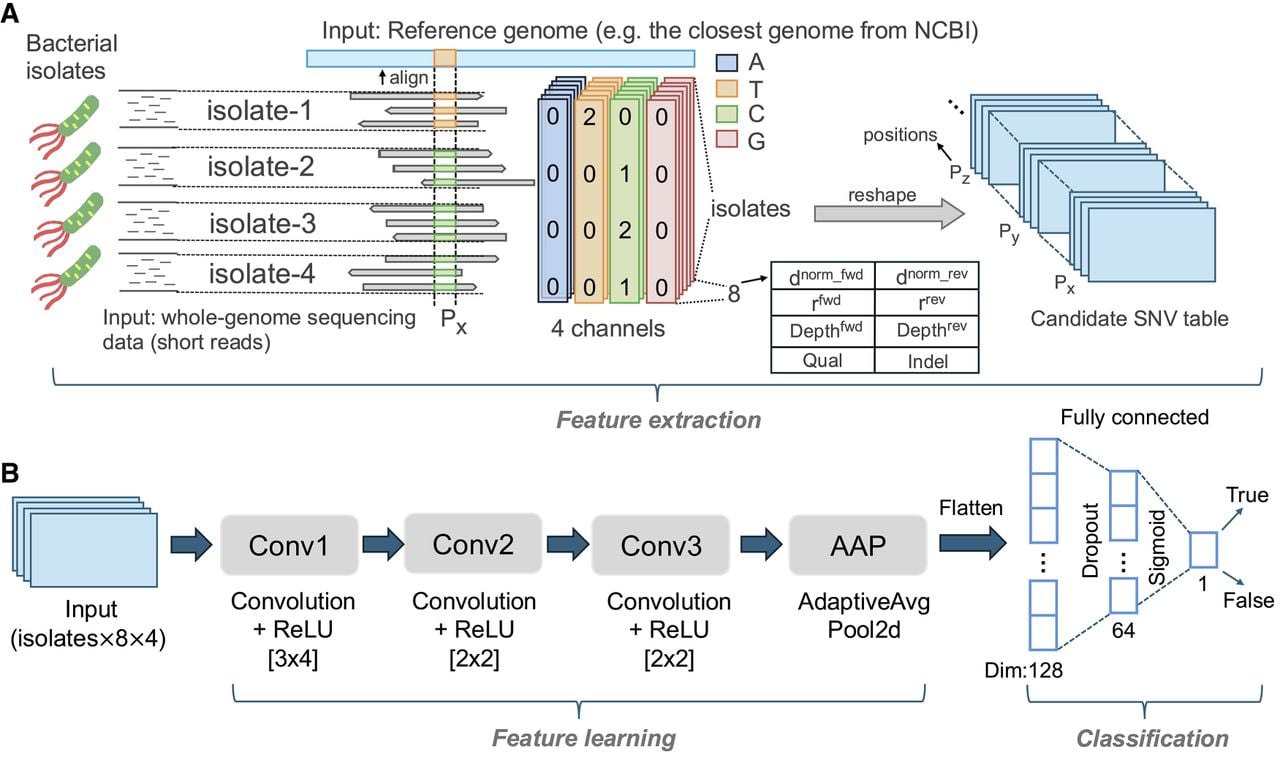
A deep learning framework that leverages across-sample comparisons for bacterial SNV calling. (A) Feature extraction pipeline: Short reads from bacterial isolates are aligned to a reference genome; features at candidate SNV positions are extracted across four channels (A, T, C, G). For each channel, there are eight features (for full details, see Supplemental Fig. S1): (Depthfwd, Depthrev) raw forward- and reverse-strand depths, (, ) forward- and reverse-strand normalized depths at each locus and each channel, (rfwd, rrev) forward- and reverse-strand relative depths showing the fraction of total coverage contributed by each isolate at each position and each channel, (Qual) consensus quality (FQ) scores produced by SAMtools, and (Indel) the number of reads supporting insertions and deletions at each position in that channel. These features are reshaped into a 4D (positions × isolates × features × channels) tensor and stored in a candidate SNV table for neural network input. (B) Model architecture: The input tensor is processed through three convolutional layers with ReLU activation and varying kernel sizes (shown in brackets), followed by adaptive average pooling. The output is then flattened and passed through fully connected layers with dropout for binary classification. The model finally outputs prediction probabilities, with SNVs classified as true if probabilities >0.5 and otherwise as false.