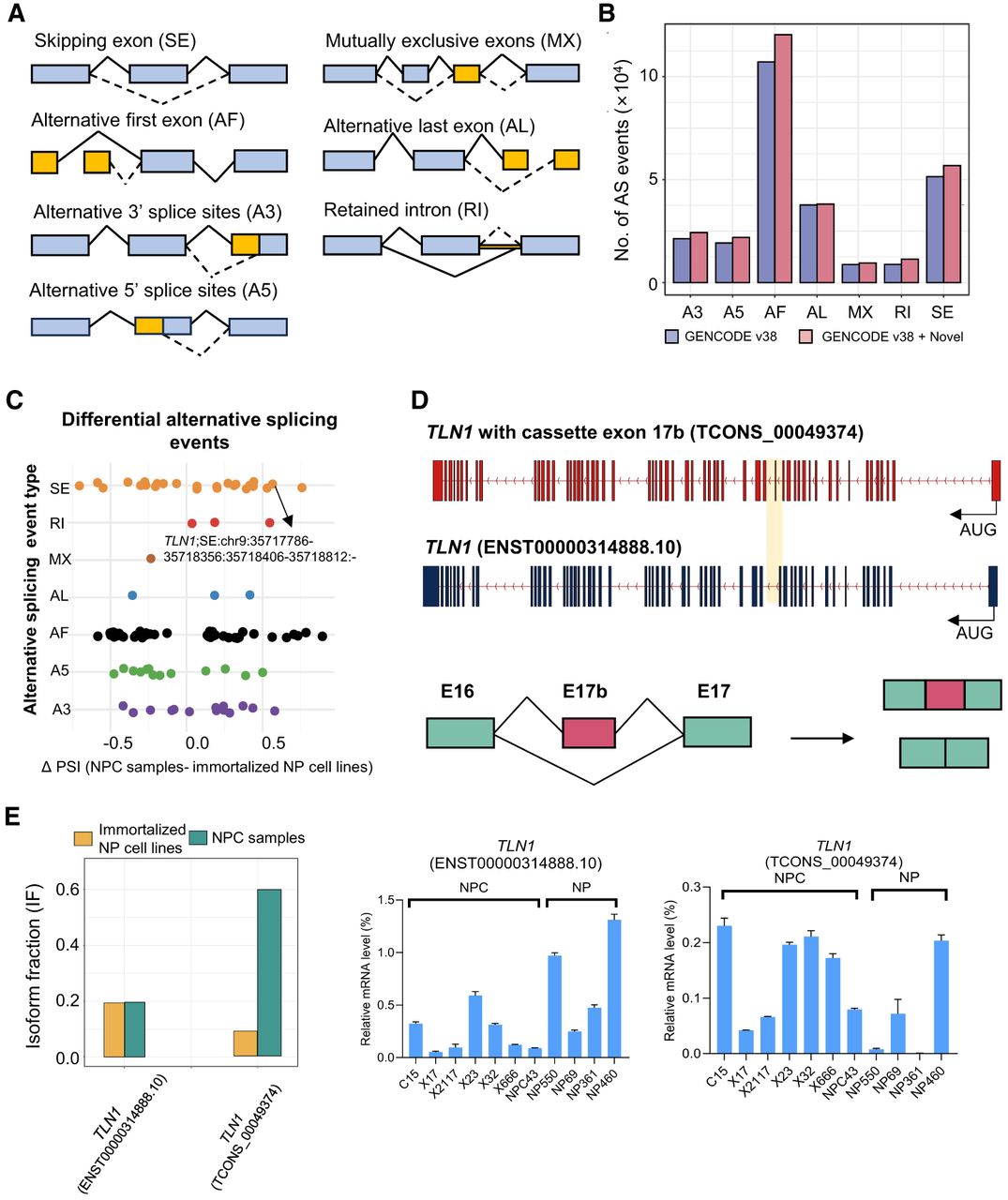
Novel transcripts contribute to isoform-level diversity and differential alternative splicing events (ASEs). (A) Schematic illustration of the seven types of ASEs: alternative 5′ splice site (A5), alternative 3′ splice site (A3), alternative first exon (AF), alternative last exon (AL), mutually exclusive exons (MX), retained intron (RI), and skipping exon (SE). (B) Bar plot comparing ASEs before and after incorporating novel transcripts into GENCODE v38 transcriptome. (C) Dot plot showing differential ASEs between NPC tumor samples and immortalized NP cell lines, identified by SUPPA2 with P < 0.05 and |ΔPSI| > 0.1. (D) Schematic illustrations of an example of a differential ASE involving the inclusion of a cassette exon (17b) in TLN1 and the resulting transcripts. (E) Bar plot comparing differential isoform usage of TLN1 (left), with and without exon 17b, between NPC samples and immortalized NP cell lines, validated by RT-qPCR (right). Each RT-qPCR experiment was repeated three times with independent RT preparations, with the standard deviation of each triplicate indicated by the error bars.