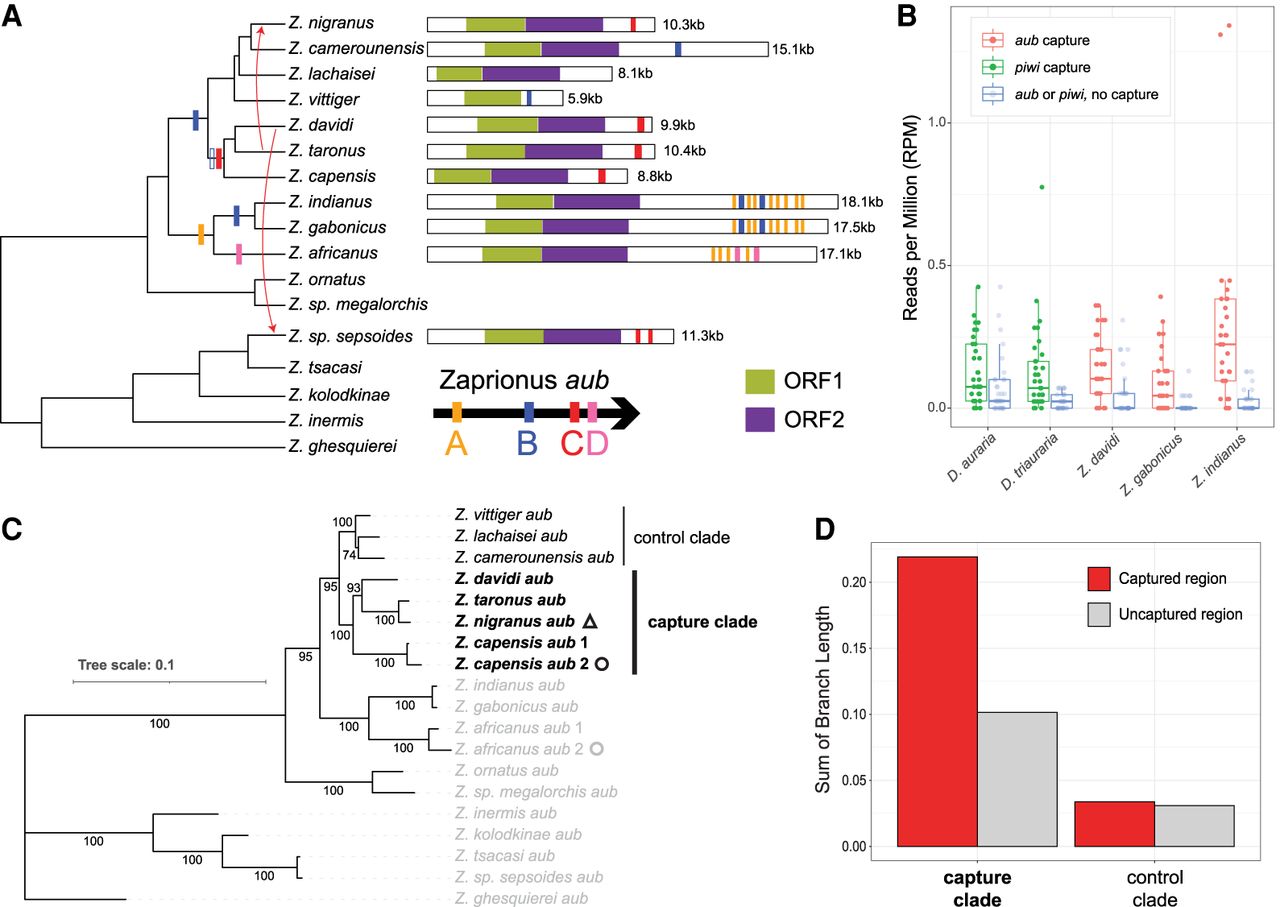
Multiple captures of aubergine (aub) by telomeric TEs in Zaprionus. (A) Zaprionus species tree showing independent gene capture events. The rectangles are colored based on the aub region that was captured. Diagrams show the location of the captured region within the full-length TE. Note that the region B of aub was captured in the ancestor of Z. vittiger and Z. capensis (solid blue rectangle) and subsequently lost in the Z. davidi/Z. taronus/Z. capensis clade (open blue rectangle), whose TEs now carry region C of aub. (B) Normalized piRNA abundance from the captured host gene (red indicates aub; green, piwi) calculated in 80 bp nonoverlapping windows across the gene transcript. aub is used as a control (blue) in species in which piwi was captured, and piwi is used as a control in species in which aub was captured. The control gene produces significantly fewer piRNAs in all within-species comparisons. Wilcoxon test P < 0.05 in all cases: D. auraria, P = 0.026; D. triauraria, P = 1.3 × 10⁻⁴; Z. davidi, P = 3.0 × 10⁻⁴; Z. gabonicus, P = 6.3 × 10⁻⁴; and Z. indianus, P = 5.2 × 10⁻⁸. (C) Gene tree inferred using aub coding sequence. The clades analyzed in D are indicated by vertical bars. (D) Comparison of rate of evolution of the captured (red) portion of aub versus the uncaptured portion. In the species in which telomeric TEs have captured part of aub (capture clade), the homologous sequence in the aub gene is evolving approximately twice as fast as the uncaptured portion of the gene (Fisher's exact test P = 2.7 × 10⁻⁵). In species in which this region has not been captured, it evolves at a similar rate as the uncaptured portion of the gene (Fisher's exact test P = 0.64).