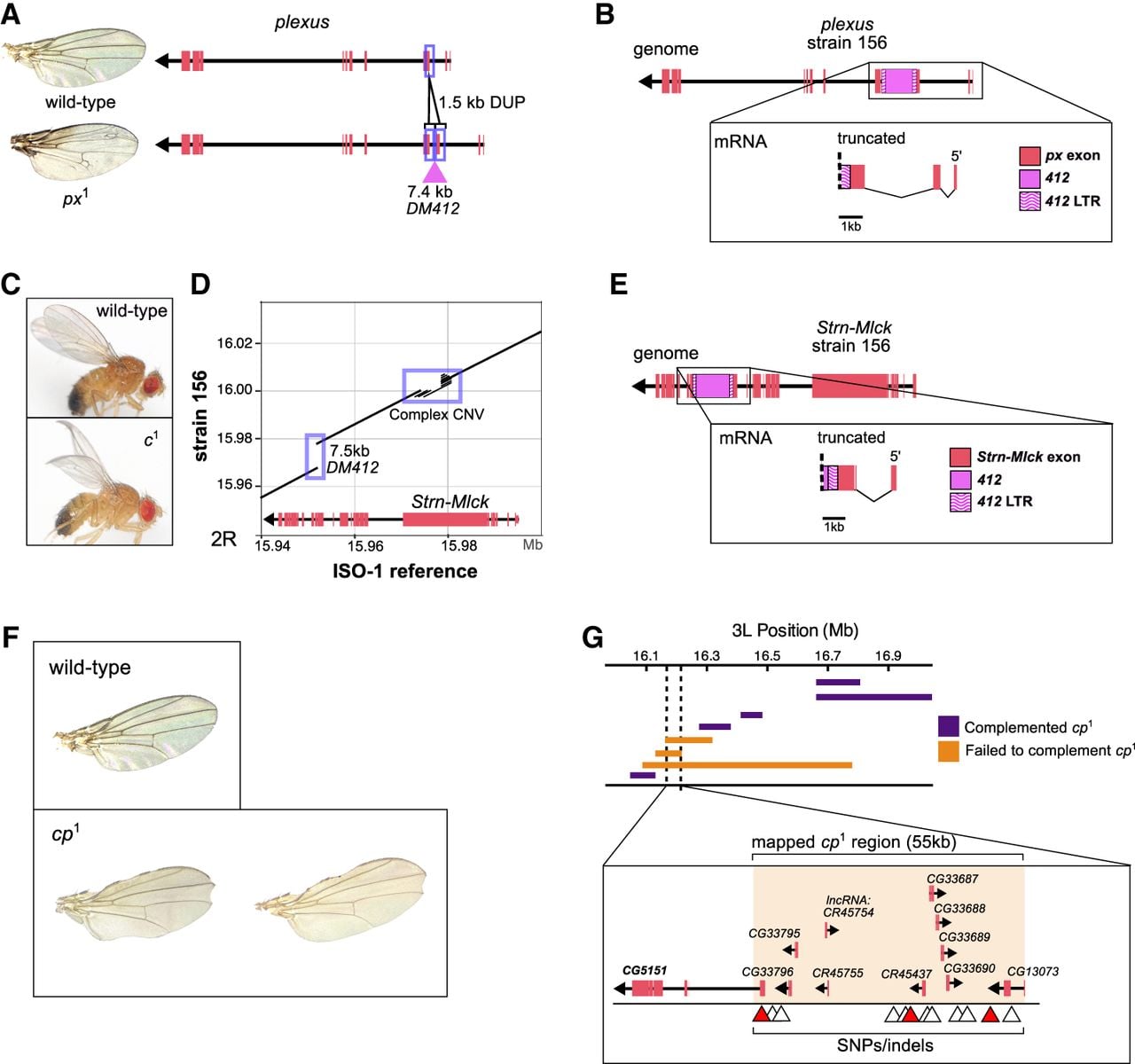
Structural variants underlying the plexus and curved visible phenotypes and their transcriptional consequences. (A) Wing phenotypes and genomic organization of the plexus (px¹) locus. Compared to the wild-type, px¹ flies show excess wing-vein patterning. The px¹ allele is associated with a 1.5 kb tandem duplication of a partial exon and a 7.4 kb insertion of the LTR retrotransposon, DM412. (B) Genomic structure and transcript model of plexus in strain 156, supported by ONT direct mRNA sequencing. The DM412 insertion disrupts the gene, producing a truncated, chimeric transcript that includes transposon-derived sequence and lacks downstream exons. (C) Wing phenotypes of wild-type and c1 flies. (D) Genome alignment at the Strn-Mlck locus underlying the curved (c¹) mutation. Relative to the ISO-1 reference, strain 156 carries a 7.5 kb DM412 insertion and a complex copy-number variant in Strn-Mlck. (E) Genomic and transcript models of Strn-Mlck in strain 156, supported by direct mRNA sequencing. The DM412 insertion truncates the transcript, resulting in loss of distal coding exons and incorporation of transposon sequence. (F) Wing phenotypes in wild-type and cp¹ flies. cp¹ mutants show variable wing notching patterns. (G) Complementation mapping with overlapping deletions narrowed the cp¹ candidate region to a 55 kb interval on Chromosome 3L (3L: 16,162,336–16,217,328; ISO-1 r6) containing CG5151, a gene implicated in wing development. Within this region, 15 SNPs and small indels unique to cp¹ strains were identified (triangles), with three candidates highlighted (red) based on their location within CG5151 or overlap with wing disc ATAC-seq peaks.