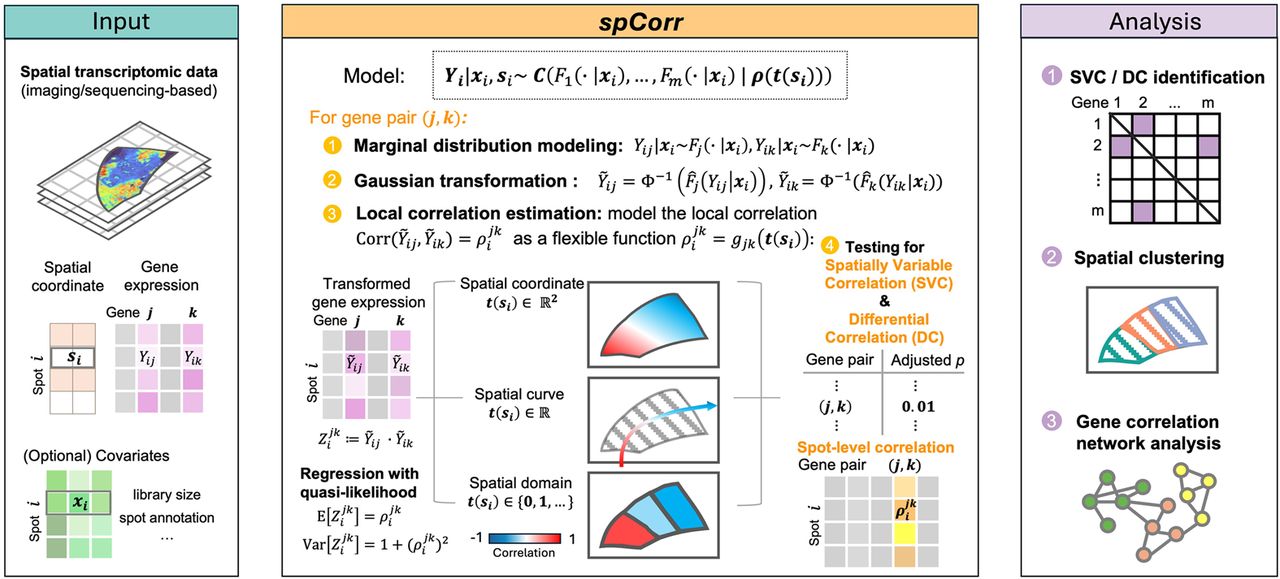
Overview of the spCorr framework for modeling spatially varying gene correlation in spatial transcriptomics data. spCorr is a statistical method that models how gene correlation varies across spatial locations in ST data. Input: The method takes as input spatial transcriptomics data, including spatial coordinates, gene expression levels, and optional spot-level covariates (e.g., library size and spot annotations) that may confound correlation estimates. Modeling: For each gene pair, spCorr performs four main steps: (1) marginal distribution modeling using generalized linear models (GLMs) to account for the confounding effects from spot-level covariates; (2) Gaussian transformation of gene expression values via probability integral transform and inverse normal transformation to standard Gaussian variables; (3) local correlation estimation by modeling the cross-product of transformed expressions of gene pairs using a quasi-likelihood generalized additive model (Quasi-GAM), using spatial coordinates, curves, or domain label as spatial predictors; and (4) hypothesis testing to identify (i) spatially varying correlations (SVCs) across continuous space and (ii) differential correlations (DCs) across predefined spatial domains. Output and analysis: spCorr yields interpretable spot-level correlation estimates and supports downstream tasks such as SVC/DC identification, spatial clustering based on correlation structure, and gene correlation network analysis.