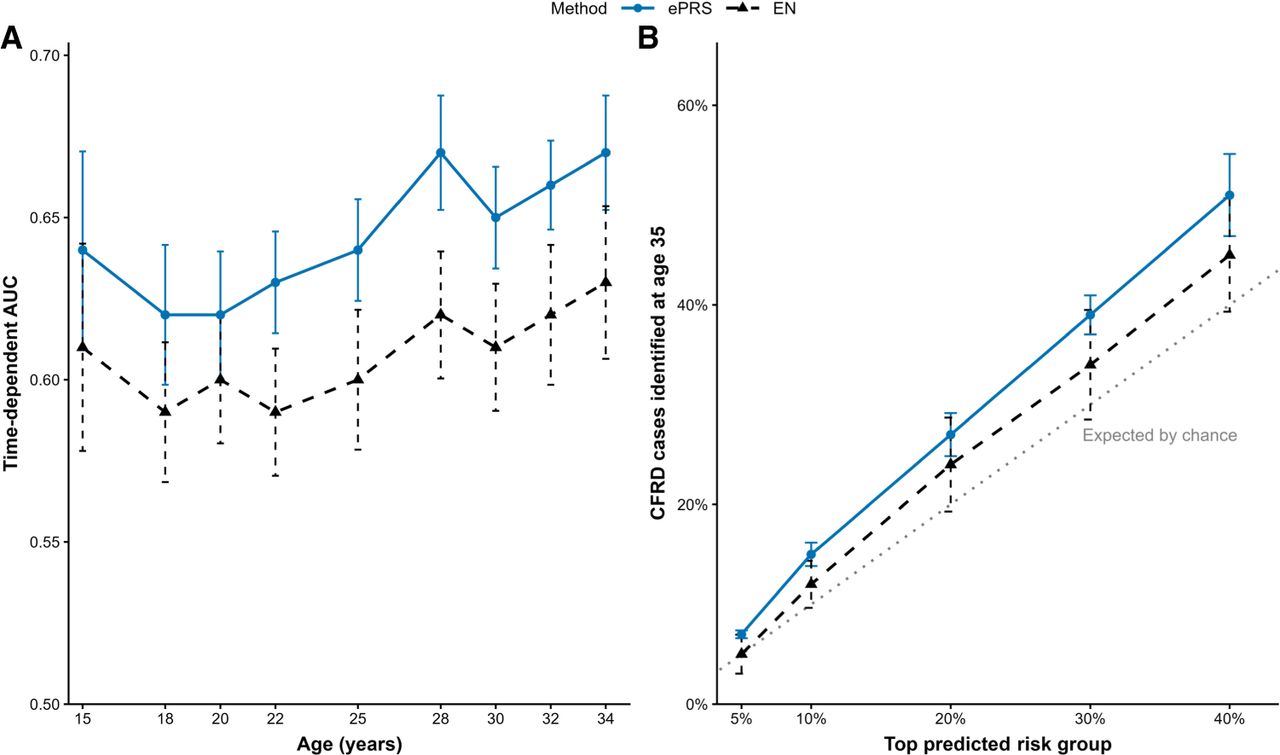
ePRSs improve within-cohort prediction and the identification of high-risk individuals for cystic fibrosis–related diabetes (CFRD) onset in the Canadian Cystic Fibrosis Gene Modifier Study (CGMS). (A) Model performance measured in time-dependent area under the curve (AUC) between the ePRS and elastic net (EN) in CGMS. Error bars represent the 95% confidence interval of model performance from 100 iterations of train-test splits. The ePRS consistently outperformed EN by 3%–4% in out-of-fold performance when predicting CFRD onset at all ages and simultaneously achieved more stable predictions compared with EN. (B) Ranking of held-out individuals by predicted risk and evaluation of the proportion of CFRD cases at age 35 identified within the highest-risk groups. The ePRS captured a larger fraction of CFRD cases than EN at each evaluated risk threshold. For example, the top 20% of individuals ranked by the ePRS captured ∼30% of CFRD cases, exceeding both EN and the expected proportion by chance. The ePRS not only improves time-dependent discrimination but also better prioritizes individuals at elevated risk of CFRD within a single harmonized cohort.