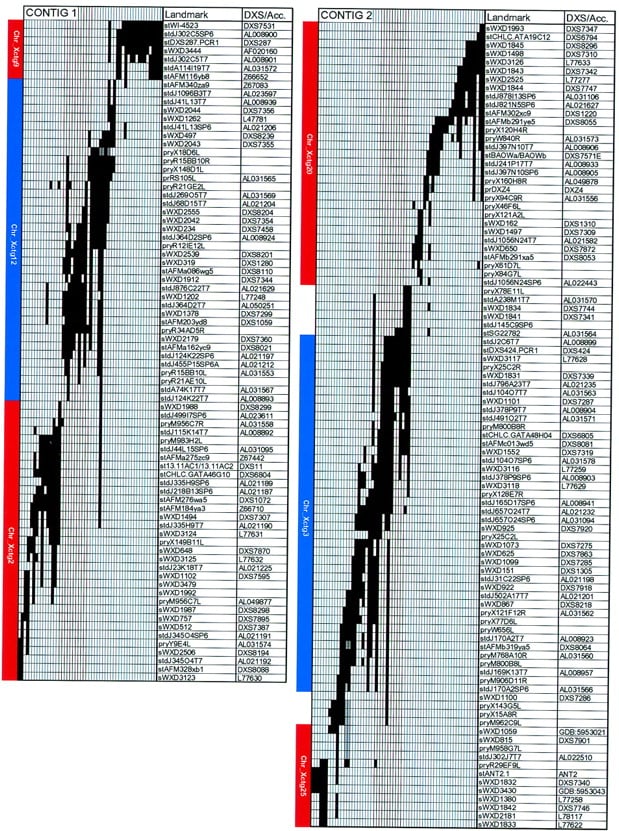
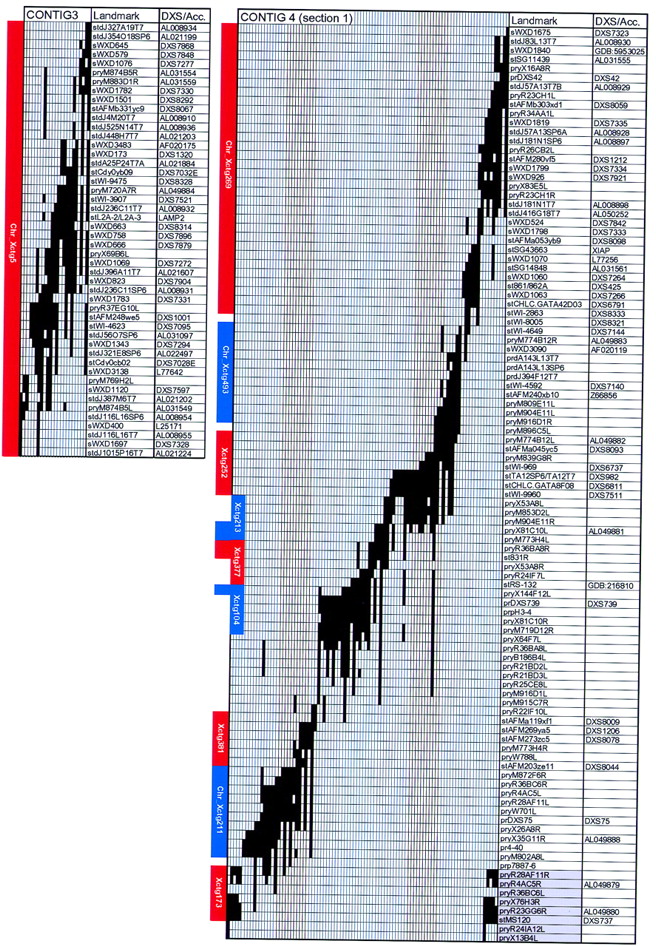
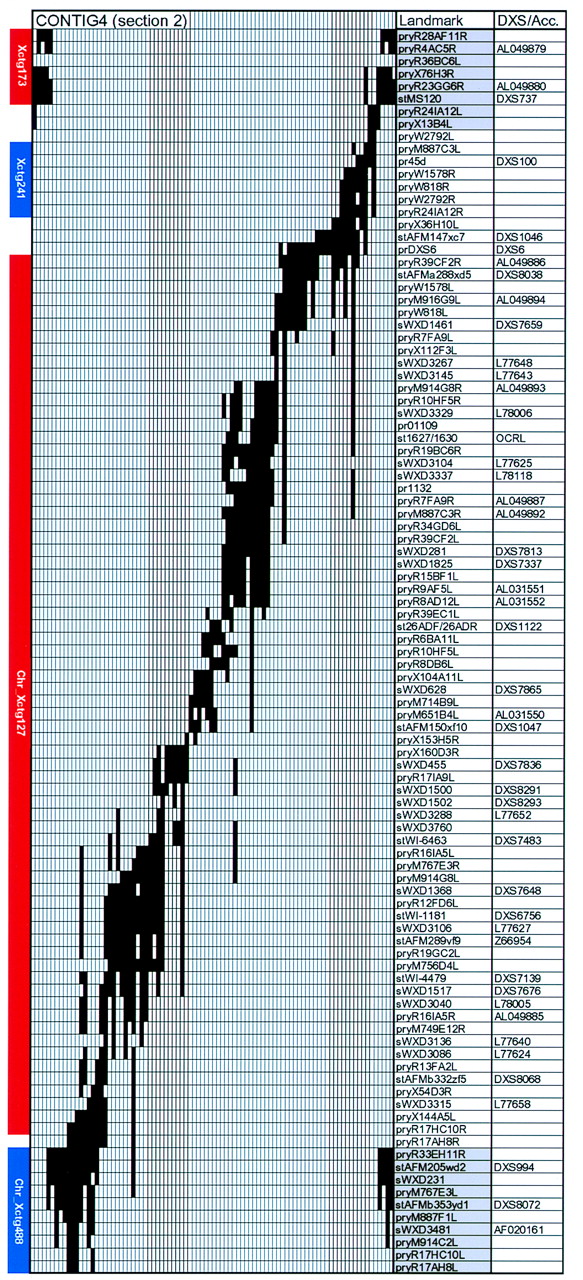
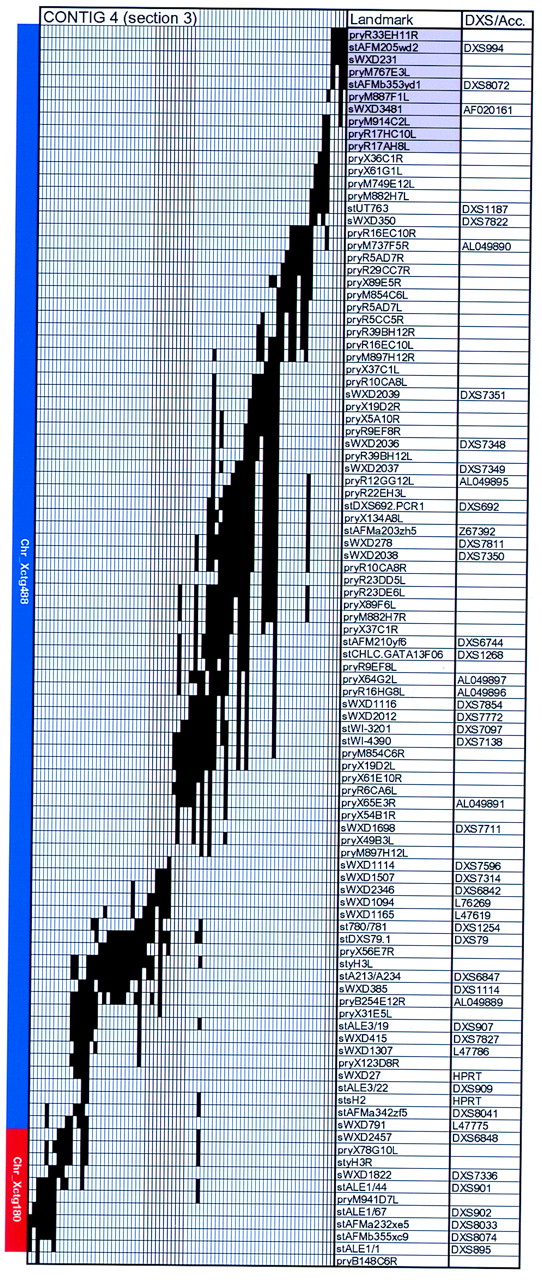
The landmark framework map of Xq23–q26.1. The landmark order on the four YAC contigs is illustrated. YAC clones are shown as thin vertical bars with positive landmark content indicated in black. Cases in which YAC clones have not been tested with specific markers are indicated by checkered boxes. Contig 4 is shown in three sections. For ease of alignment, some landmarks (solid gray boxes) and YAC clones have been shown duplicated at the end and beginning of appropriate sections. Landmark STSs (st or sWXD prefix) and probes (pr) are shown in the first column, and DXS numbers, database accession numbers, or Genome Database (GDB) identifiers in the second. Published STSs are derived from the Généthon (stAFM), Whitehead Institute (stWI), Co-operative Human Linkage Center (stCHLC), Center for Genetics in Medicine (sWXD) maps and databases, from GDB (various), or from the literature (see Methods). PAC end STSs are named after the PAC clone of origin with the suffix SP6 or T7 (e.g., stdJ364D2SP6). PAC clones are derived from the Roswell Park Cancer Institute libraries RPCI1, RPCI3, RPCI4, RPCI5 (dJ), and RPCI6 (dA). YAC end hybridization probes are named after the clones from which they are derived with the “L” or “R” suffix (see Methods). Clones are from the CEPH (yM), ICI (yR), ICRF [yX (ICRFy900), yY (ICRFy901), yZ (ICRFy905)], and Washington University libraries (yA, yB), or were provided by colleagues (see Methods). Where YAC end probes have been sequenced and used to design STSs, EMBL accession numbers are shown. Three of these STSs were used for YAC library screening in preference to the end hybridization probe [stSG11439 (pryR17HB2R), stSG14848 (pryM949F11R), and stSG22782 (pryM963A8R)]. At left of each YAC contig are shown the extents of the corresponding bacterial clone contigs as red or blue boxes. Bacterial clone contigs are numbered and have the prefix Chr_Xctg (where space allows). In contig 4 (section 1), contigs X_CTG213, 377, and 104 are labeled in boxes to the right of those describing their extents because of space constraints. All of the bacterial clone contigs can be viewed in detail by following instructions at http://www.sanger.ac.uk/HGP/ChrX/. To avoid confusion, the lower numbered contig will be maintained on the WWW site as contigs join. A magnified version of this map showing YAC clone names can be viewed via http://www.sanger.ac.uk/HGP/ChrX.