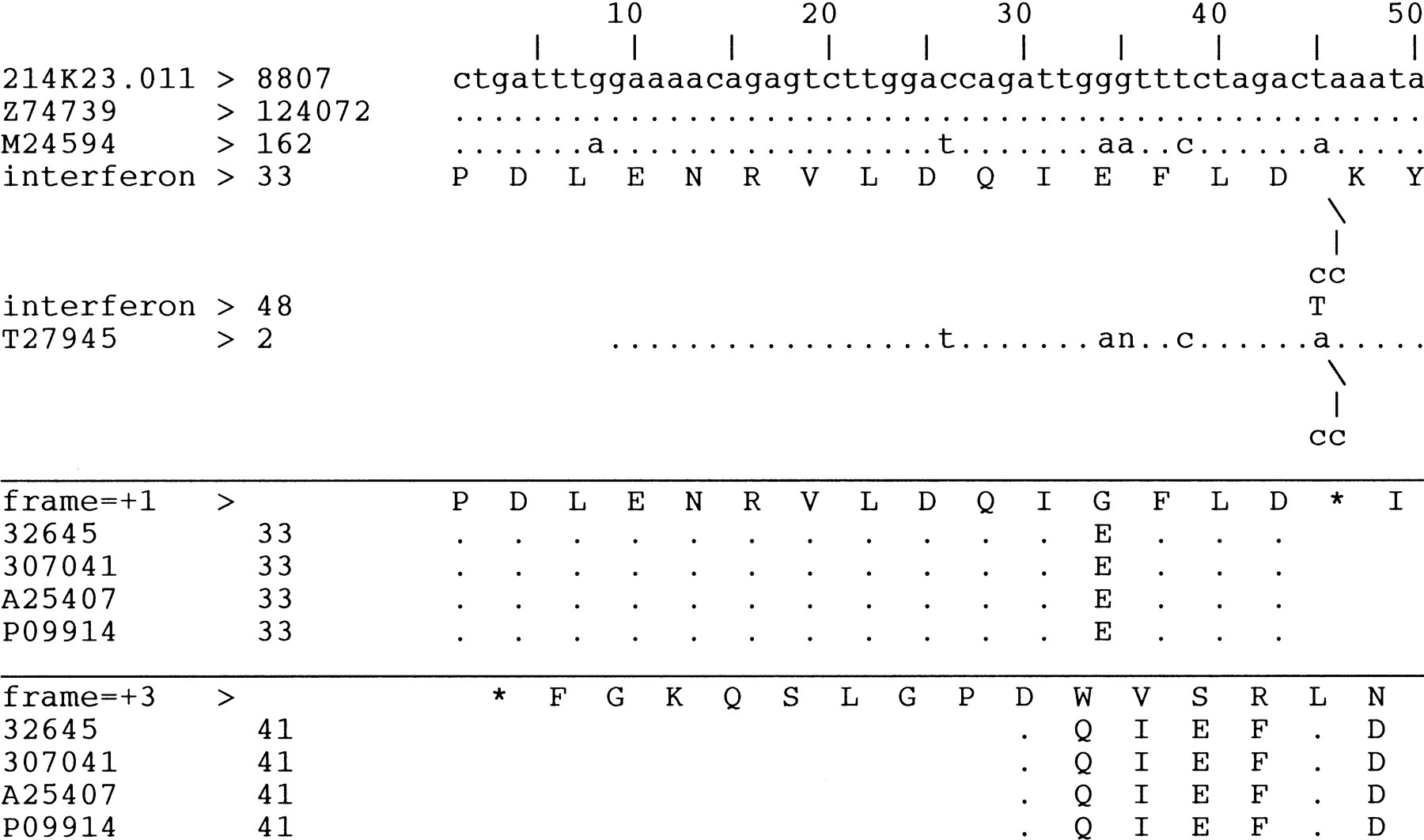
An abbreviated text view of the multiple alignments in Fig. 2. The results from BLASTN and BLASTX are separated into three panels. (Top) The results from BLASTN; (middle, bottom) the results from BLASTX with translation reading frames +1 and +3, respectively. Three BLASTN hits are displayed: the BRCA2genomic sequence (GenBank accession no. Z74739); an mRNA sequence (GenBank accession no. M24594), which encodes a 56-kD interferon-induced protein; and an EST sequence (GenBank accession no.T27945). The results are displayed as multiple pairwise alignments to compare the sequence identity between the query sequence and the matching database sequences. The mismatched residues are displayed, whereas the identical residues are shown as dots. Gaps on the master sequence, i.e., the query sequence, are displayed as insertions in the matching sequences, e.g., at nucleotide 8852 of the query sequence, both M24594 and T27945 have the same 2-nucleotide insertion represented by
/ | cc In this region, the coding region feature on M24594 is represented by labeling each translated amino acid residue in the middle of the 3-base condon. The translated amino acid residue at the insertion are labeled as well. The > or the < symbol attached to a sequence label indicates the plus or minus orientation of the alignment; the > or < symbol at the end of the annotated coding region feature indicates the orientation of the transcription in relation to the orientation of the alignment. If a sequence or a feature label exceeds 12 characters, it will be truncated, such as the label for “interferon-induced protein,“ which was shortened to interferon. For BLASTX results, the conceptual transactions with the specified reading frames are displayed in themiddle and bottom panels. The conceptual translation is compared with mathing sequences from the protein databases, and the identical residues are labeled as dots. In this view, all of the four protein sequences (GenBank accession nos. 32645, 307041, A25407, andP09914), align to the query sequence in both frames +1 and +3. The alignments for frame 1 translation stop at position 8852 on the query sequence, which corresponds to the 2-nucleotides gap in the query sequence. This gap also introduces a stop codon (represented by an asterisk, *) in the query sequence on the translation with frame = +1. Because the sequence variations are consistent in the alignments of the two transcript sequences as well as those of the protein sequences, the sequence homology suggests a pseudogene in this region.