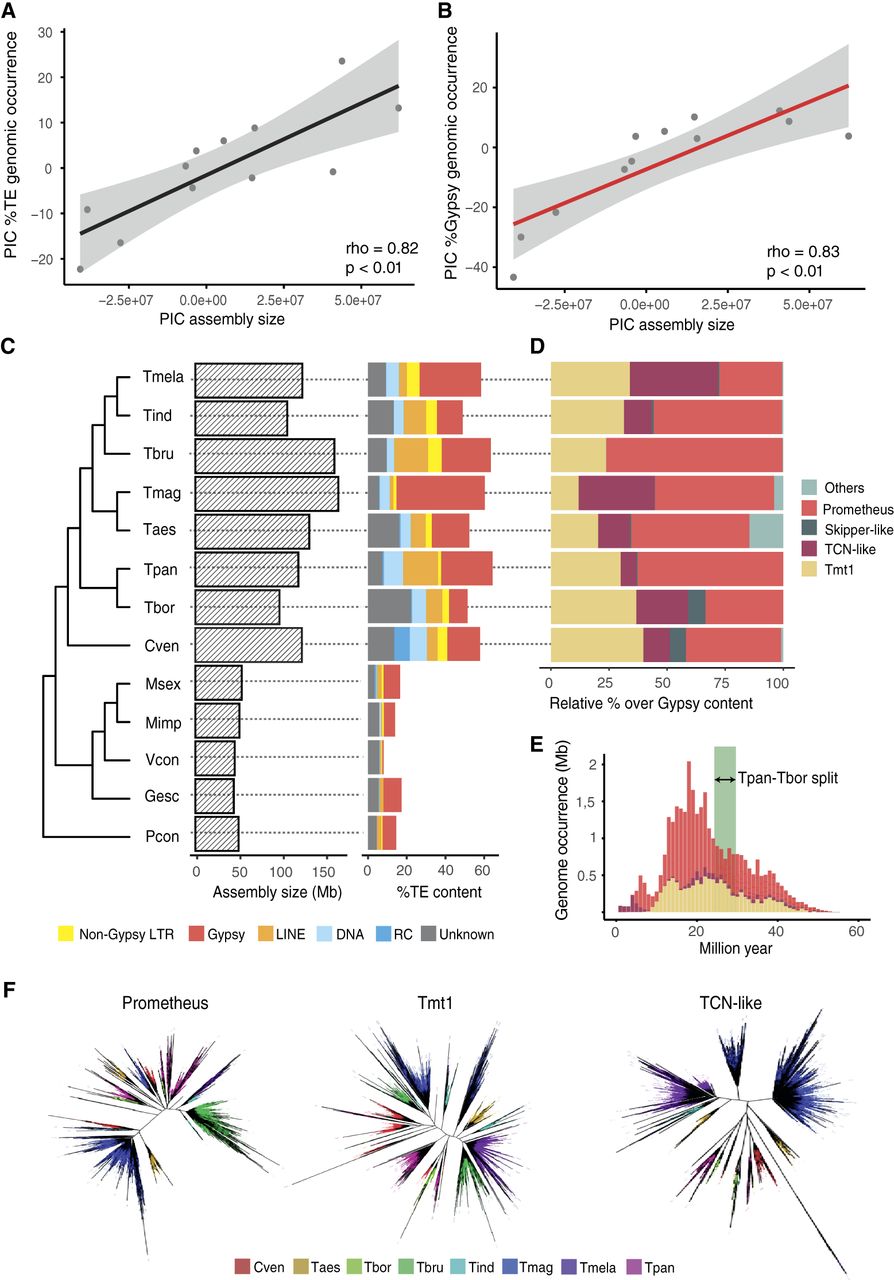
Lineage-specific proliferation of different Gypsy clades drives genome expansion in Tuberaceae. Correlations between total TE content (A) and Gypsy content with assembly size (B), used as a proxy for genome size after correcting for shared evolutionary history using phylogenetic-independent contrasts (PICs). (C) Assembly size and TE content for 13 Pezizales species used in comparative genomic analyses. (D) Relative contribution of identified clades to the total Gypsy content of Tuberaceae. Others refer to Gypsy clades that were not identified and characterized in T. panzhihuanense. (E) Repeat landscape profile describing the activity over time of Gypsy clades in the T. panzhihuanense genome after transforming the CpG-corrected Kimura distance into millions of years using a substitution rate of 3.36 × 10⁻³ per million year. The green box highlights the mean divergence time between T. panzhihuanense and T. borchii based on nucleotides (lower bound) and amino acids (upper bound). (F) Clade-specific phylogenetic trees of all Gypsy RT segments with a length of at least 100 amino acids extracted from all Tuberaceae genomes. Different colors highlight different species. All species abbreviations are reported in Figure 3.