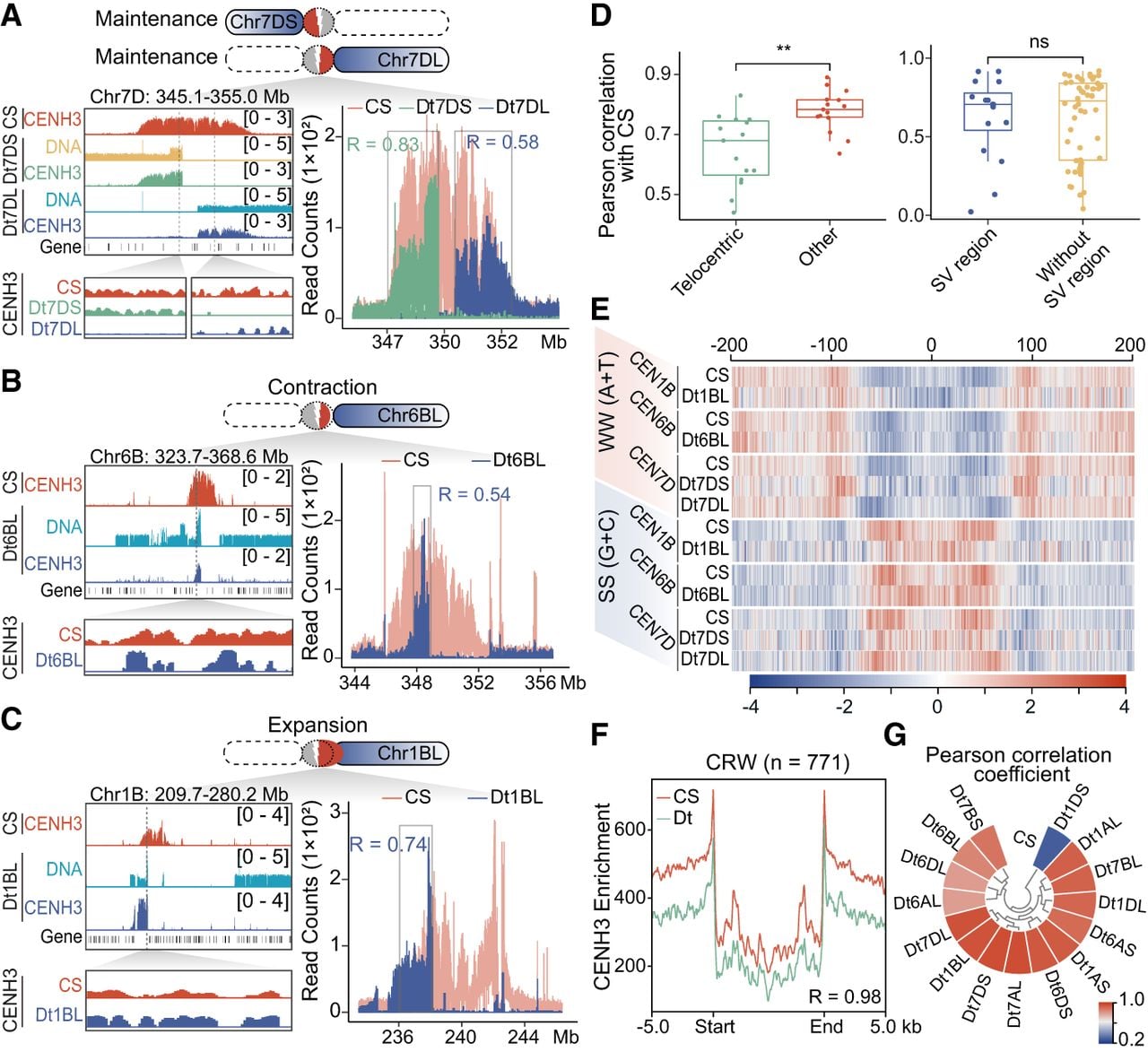
Remodeling of centromere architecture is associated with local structural variations and centromere repositioning following misdivision in wheat ditelosomic lines. (A–C) Comparative analysis of CENH3-enriched centromere domains between Chinese Spring wheat and specific ditelosomic lines: Dt7DS and Dt7DL (A), Dt6BL (B), and Dt1BL (C). Integrative Genomics Viewer (IGV) snapshots display CENH3 ChIP-seq enrichment patterns, genomic DNA coverage, and gene annotations across defined centromeric regions. In Dt7DS and Dt7DL, centromere structure and CENH3 positioning remain stable, consistent with the CS reference. In Dt6BL, a contraction of the CENH3-enriched domain is observed, indicating centromere shrinkage. In contrast, Dt1BL shows expansion of the centromere region. Correlation coefficients (R-values) quantify the similarity of CENH3 nucleosome positioning between ditelosomic chromosomes and their CS counterparts, calculated within the shared centromere intervals (highlighted in gray rectangles). (D) Box plot showing the correlation of CENH3 nucleosome distributions across chromosome. Left panel indicates the overall correlation between ditelosomic chromosomes (with centromere breakage) and other unaltered chromosomes compared to CS. Right panel indicates comparison of correlation in regions with local structural variations (SV region) versus those without (non-SV region), suggesting that centromere remodeling is not predominantly driven by surrounding chromosomal rearrangements. (E) Dinucleotide frequency analysis within ±200 bp flanking CENH3 nucleosome centers reveals conserved sequence features between ditelosomic and their corresponding chromosomes in CS. Peaks in WW (A or T) and SS (G or C) motifs are consistent across lines, indicating that underlying sequence composition near CENH3 remains largely unchanged. (F) Metaprofile analysis of CENH3 signals distribution around centromeric retrotransposon repeat of wheat (CRW, n = 771) compares ditelosomic chromosomes to their full-length counterparts in CS. (G) Pearson correlation coefficient of CENH3 positioning on CRWs among different lines is shown, indicating conservation of centromeric chromatin structure at the retroelement level. Student's t-test of signal enrichment: (*) P < 0.05, (ns) not significant.