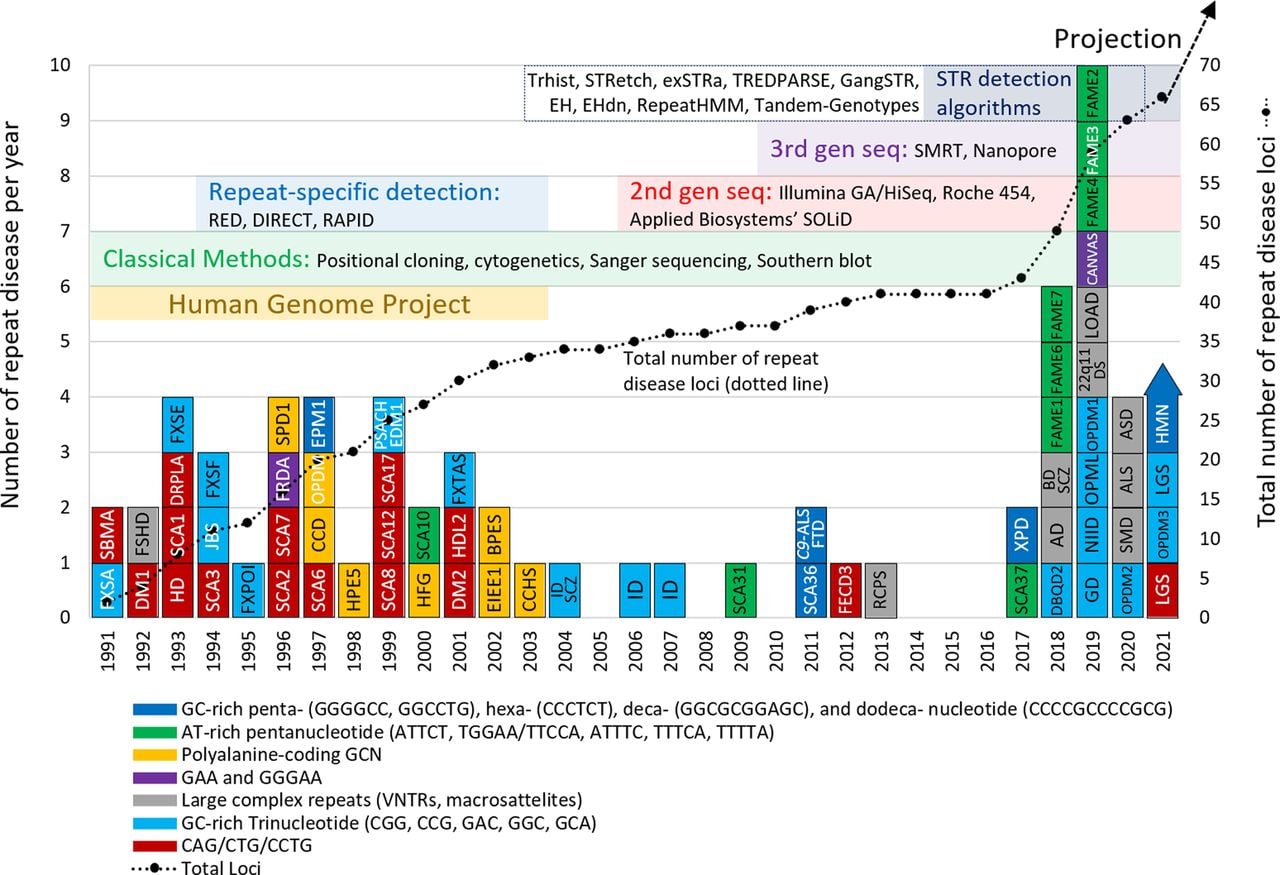
Overview of disease-associated repeat discovery by year, with colored inserts specifying the major technological breakthroughs that were used to make these discoveries. (AD) Alzheimer disease, (ALS/FTD) amyotrophic lateral sclerosis/frontotemporal dementia, (ASD) autism spectrum disorder, (BAFME) benign adult familial myoclonic epilepsy, (BD) bipolar disorder, (BPES) blepharophimosis, ptosis, and epicanthus inversus syndrome, (CANVAS) cerebellar ataxia, neuropathy, vestibular areflexia syndrome, (CCD) cleidocranial dysplasia, (CCHS) congenital central hypoventilation syndrome, (DBQD2) Desbuquois dysplasia 2, (DM) myotonic dystrophy, (DRPLA) dentatorubropallidoluysian atrophy, (EDM1) multiple epiphyseal dysplasia, (EIEE1) epileptic encephalopathy, early infantile, 1, (EPM1) epilepsy, progressive myoclonus-1, (FECD3) Fuchs endothelial corneal dystrophy-3, (FRDA) Friedreich's ataxia, (FSHD) facioscapulohumeral muscular dystrophy, (FXTAS) fragile X ataxia/tremor syndrome, (GD) glutaminase deficiency, (HDL2) Huntington disease-like 2, (HFG) hand-foot-genital syndrome, (HPE5) holoprosencephaly 5, (LOAD) late-onset Alzheimer disease, (MJD) Machado-Joseph disease, (NIID) neuronal intranuclear inclusion disease, (OPDM) oculopharyngodistal myopathy, (OPMD) oculopharyngeal muscular dystrophy, (OPML) oculopharyngeal myopathy with leukoencephalopathy, (PSACH) pseudoachondroplasia, (RCPS) Richieri-Costa-Pereira syndrome, (SBMA) spinal bulbar muscular atrophy, (SCA) spinocerebellar ataxia, (SMD) skeletal muscle disease, (SPD1) synpolydactyly-1, (SCZ) schizophrenia, (XPD) X-linked dystonia-parkinsonism, (22q11DS) 22q11 deletion syndrome. It has been concluded that FAME, BAFME, FEME, FCTE, and ADCME are the same clinical entity even if genetically heterogeneous—we use the acronym BAFME here as it is the most used acronym associated with the disease. The nonfolate-sensitive rare fragile sites FRA10B and FRA16B, caused by expanded AT-rich repeats, are not listed herein (see Table 1).