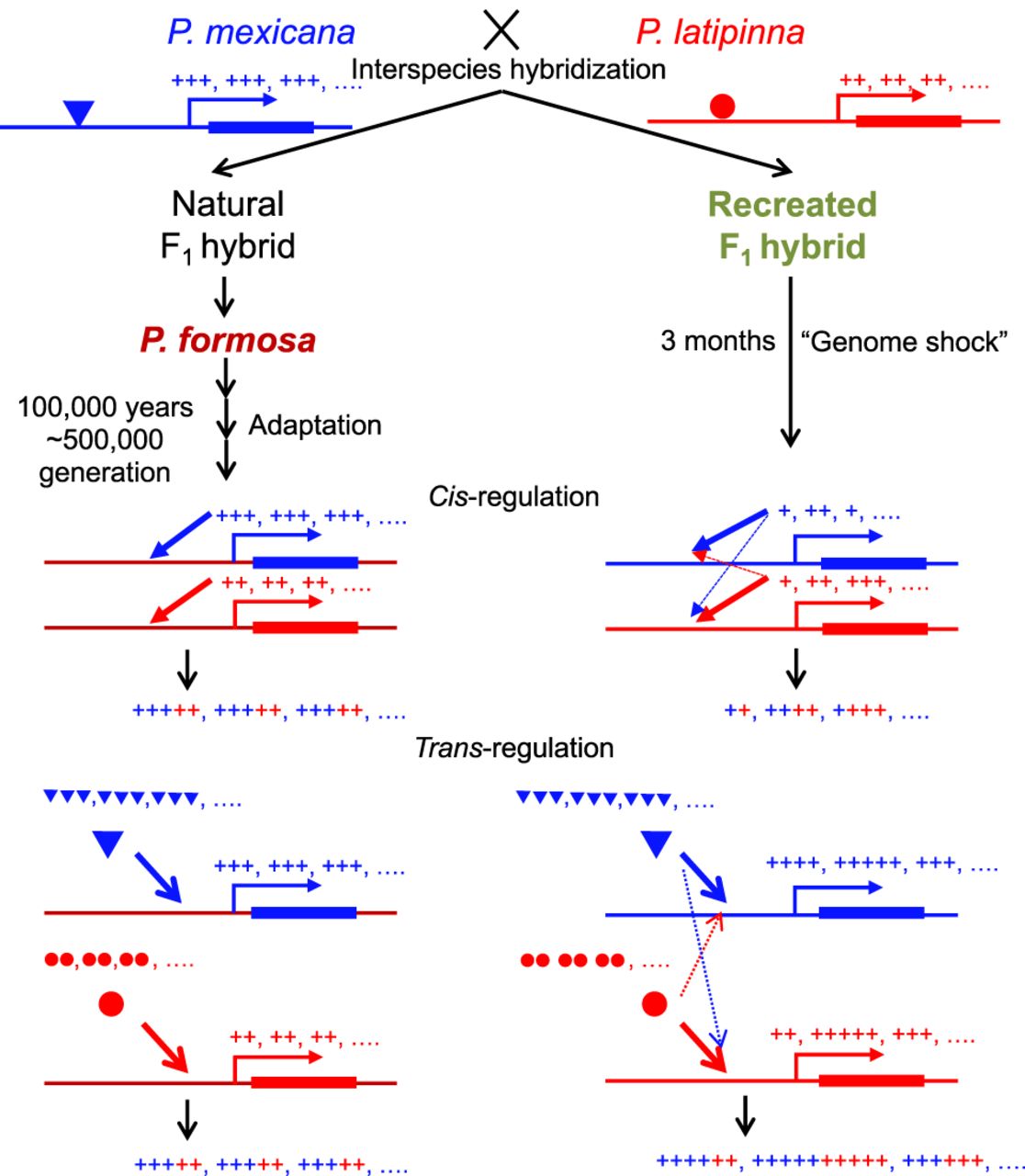
Schematic illustration of establishment of inter-allelic regulation. This figure illustrates novel inter-allelic expression upon hybridization that disrupts the coadapted parental regulation network and how parental allele expression is regulated in P. formosa to reach a consistent gene expression pattern within clonal fish. Colors represent different parental alleles, and symbols represent different parts of the gene expression regulation network: (thin line) genome sequence; (thick lines) gene; (triangle or circle) trans-element; (comma delimited “plus” sign) expression levels of different individuals; (thick solid arrows) adapted interactions; (thin dashed arrows) unadapted interactions. Cis- and trans-regulators and target genes are coadapted within each parental genome, respectively (i.e., P. mexicana, blue; P. latipinna, red). Upon hybridization (i.e., Recreated F1 hybrid), cross-interaction between the P. mexicana product and P. latipinna cis-regulatory element disrupts the regulation on P. latipinna gene products and vice versa. In P. formosa, such cross-interaction is eliminated owing to the alteration of one parental allele of cis-element by mutation or epigenetic modulation, divergence of both alleles, or development of a common cis-element that adapts to both gene products. For trans-regulation, even trans-regulators, for example, transcription factors, are expressed at a similar level in different individuals; cross-interaction can disrupt regulation on target gene expression. P. formosa clonal offspring inherited the same regulatory element coevolved with both parental alleles. Such regulatory elements minimize unregulated inter-allelic effects.