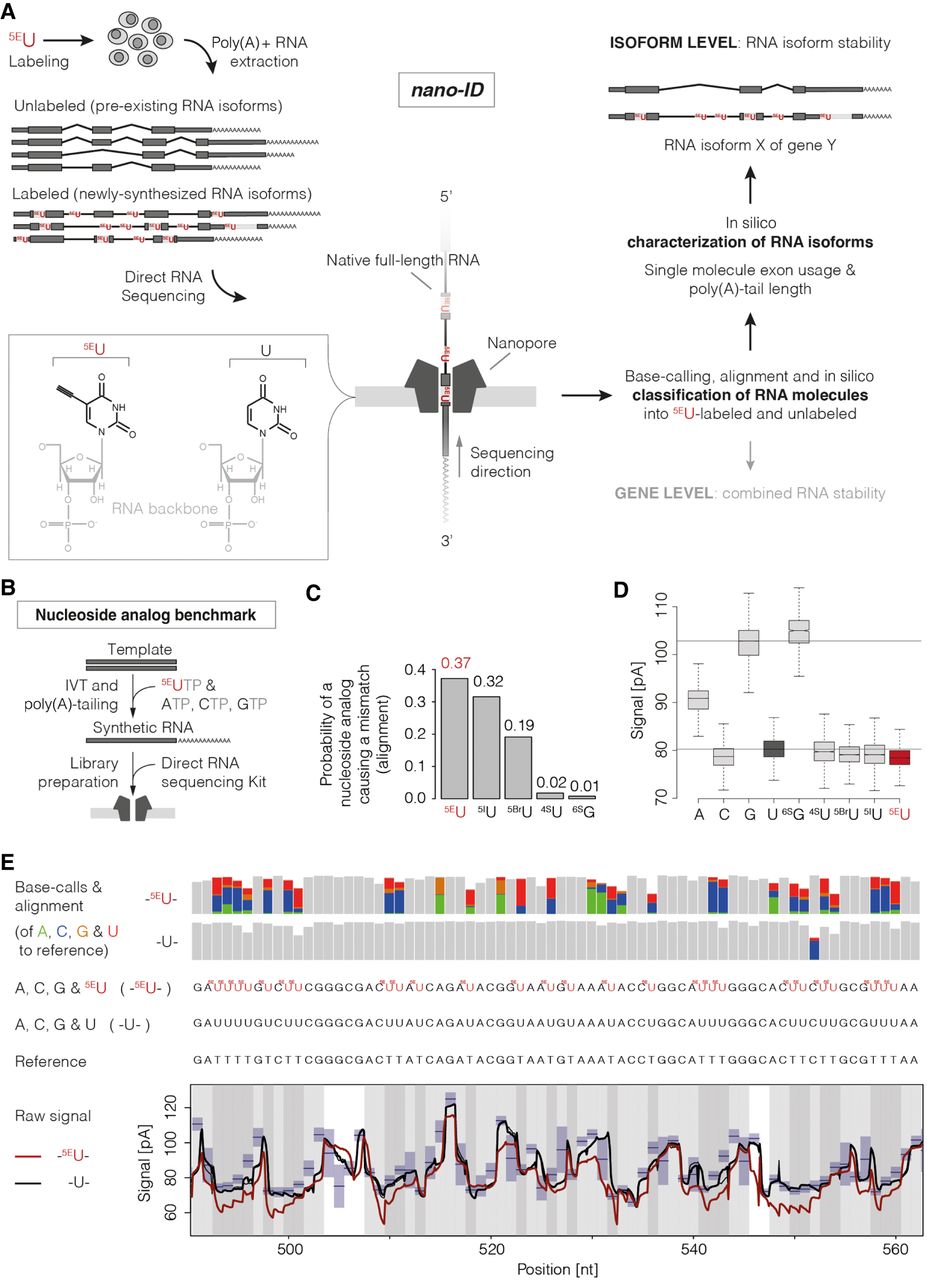
Nanopore sequencing–based isoform dynamics (nano-ID) combines metabolic RNA labeling with long-read nanopore sequencing of native RNA molecules. (A) Experimental schematic of 5EU-labeled RNA isoforms subjected to direct RNA long-read nanopore sequencing. Metabolic labeling of human K562 cells with the nucleoside analog 5-ethynyluridine (5EU) in vivo. Newly synthesized RNA isoforms will incorporate 5EU instead of standard uridine (U) residues. Newly synthesized RNA isoforms (labeled) can then be distinguished from pre-existing RNA isoforms (unlabeled) in silico after sequencing the native full-length molecules on an array of nanopores (Garalde et al. 2018). 5EU-containing RNA isoforms are computationally traceable and can thus be classified. Identification and quantification of single molecules subsequently enable assessment of exon usage, poly(A)-tail length, and RNA isoform stability. (B) Experimental schematic to derive synthetic RNAs for nucleoside analog benchmark. RNAs were in vitro transcribed: Either the standard bases A, U, C, and G were used as a control, or one of the natural bases was exchanged for a nucleoside analog (shown for 5EU). (C) Barplot showing the probability of a single-nucleoside analog to cause a mismatch in the alignment (compared with natural U or G, Methods) of all tested nucleoside analogs (5EU). (5BrU) 5-bromouridine; (5IU) 5-iodouridine; (4SU) 4-thiouridine; (6SG) 6-thioguanine. (D) Box plots showing the electric current readout (averaged per read) of the nanopore in pico-Amperes (pA; y-axis) associated with different nucleoside analogs 5EU, 5BrU, 5IU, 4SU, and 6SG (center position in 5-mer) in comparison to A, C, G, and U. Black horizontal lines indicate median raw electric current readout associated with G and U nucleosides. (E, top) Base miscalls (colored vertical bars) of the standard base-calling algorithm for synthetic RNAs containing 5EU instead of U (‘-5EU-,’ 7756 molecules) and synthetic control RNAs (‘-U-,’ 17,149 molecules) in comparison to the original sequence (reference) of an exemplary region on synthetic RNA “Spike-in 8” (Methods) (Supplemental Table S3). (Middle) Synthetic RNA sequences with (-5EU-) and without 5EU (-U-). (Bottom) Alignment of the raw signal readout of the nanopore in pico-Amperes (pA) to the reference sequence (nt). Synthetic control RNAs (-U-, 17,149 molecules) are shown in black. 5EU-containing synthetic RNAs are shown in red (-5EU-, 7756 molecules). Traces represent the average signal of all molecules. 5EU-containing synthetic RNAs show a clear deviation from the expected signal level in blue. Blue boxes indicate mean and standard deviation of 5-mers in the nanopore (provided by ONT).