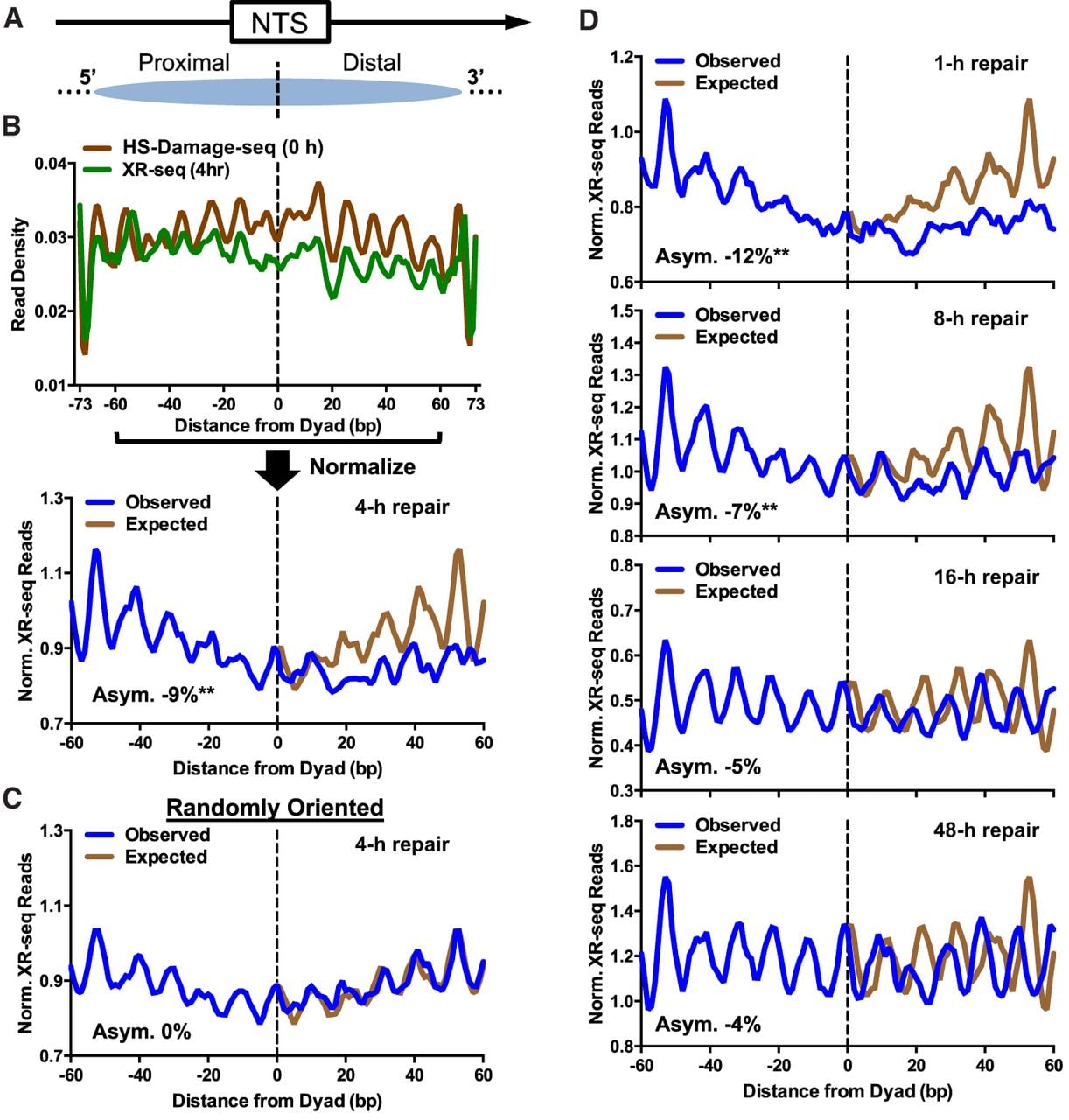
Repair of the NTS is asymmetric in human intragenic nucleosomes. (A) Diagram depicting the nontranscribed strand (NTS) associated with human intragenic nucleosomes oriented in the 5′-to-3′ direction, so that the 5′ side (i.e., TSS-proximal side) is consistently to the left of the dyad axis, whereas the 3′ side (i.e., TSS-distal side) is to the right of the dyad axis. Arrow indicates the direction of transcription. Dashed line indicates the aligned dyad axes of the intragenic nucleosomes. (B) The density of CPD excision repair-sequencing (XR-seq) reads (Adar et al. 2016) from UV-irradiated fibroblasts (4-h repair) along the NTS was calculated at each position in intragenic nucleosomes (from −73 to +73 bp from the dyad axis) and normalized using CPD HS-Damage-seq data (Hu et al. 2017a) from UV-irradiated fibroblasts (0-h repair). The normalized (Norm.) XR-seq read density was plotted for the nucleosome core, consisting of −60 to +60 bp from the dyad (lower). The “Expected” data are mirrored from the 5′ side of the dyad axis (i.e., expected if symmetric repair across the nucleosome dyad). The relative difference between the observed and expected curves quantifies the degree of asymmetry (Asym.) in repair, which is expressed as percent value, as in Figure 2. (C) Plot of normalized XR-seq reads along the NTS in intragenic nucleosomes, except the NTS was randomly oriented (i.e., 5′-to-3′ or 3′-to-5′). (D) Same as B, lower panel, except for different repair time points (1–48 h). XR-seq data were obtained from Adar et al. (2016). (**) P < 0.0001; (*) P < 0.01.