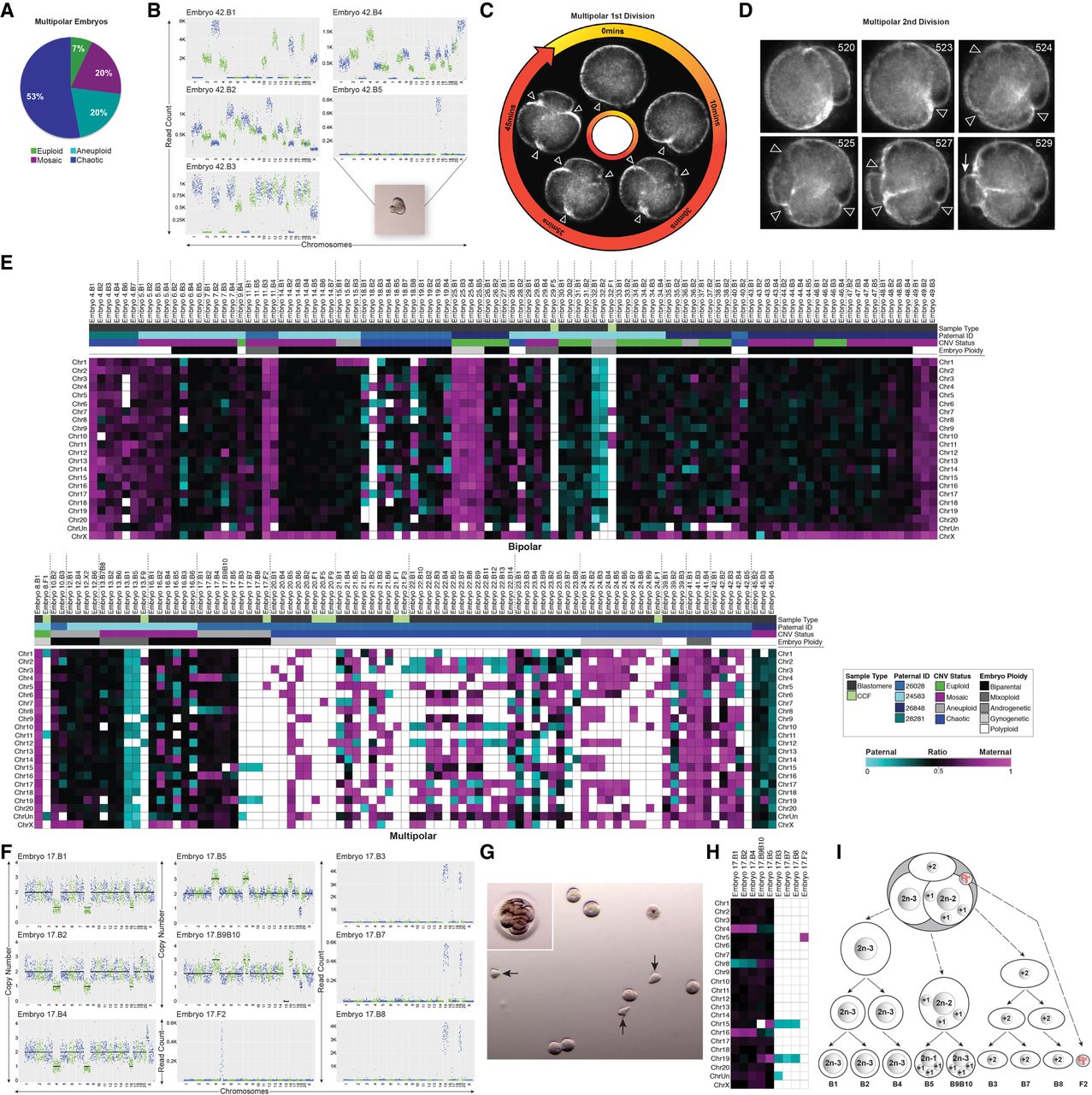
Multipolar divisions in embryos often result in chromosome loss and chaotic aneuploidy. (A) Ploidy status of rhesus embryos (N = 15) with multipolar divisions at the one- or two-cell stage. (B) CNV plots of blastomeres from an embryo, which underwent a multipolar first division, showing chaotic aneuploidy in almost every cell. Inset is a stereomicroscope image of blastomere 5 containing only Chr 15 with a cellular fragment-like protrusion. Darkfield time-lapse images of a zygote (C) and two-cell embryo undergoing a tripolar division (D). Arrowheads point to three simultaneous cleavage furrows. An arrow designates a small blastomere/large fragment produced from the multipolar second division, and the number refers to the frame. (E) Heat map of SNP allele parentage ratios in embryos that underwent bipolar (top) or multipolar (bottom) cleavage during the first three cell divisions. (F) The CNV plots of blastomeres from the tripolar zygote showing multiple reciprocal chromosome losses and gains. Note that blastomeres 3, 7, and 8 each contained only two chromosomes. (G) Stereomicroscope image of this embryo still intact (inset) and then disassembled. Arrows indicate the irregularly shaped blastomeres that had only two chromosomes. Blastomere 6 lysed and is demarcated with an asterisk. (H) Heat map of maternal versus paternal SNP allele ratios for the tripolar zygote delineates parental inheritance. (I) Schematic of the chromosome copy number state of this embryo based on the imaging and CNV analysis.