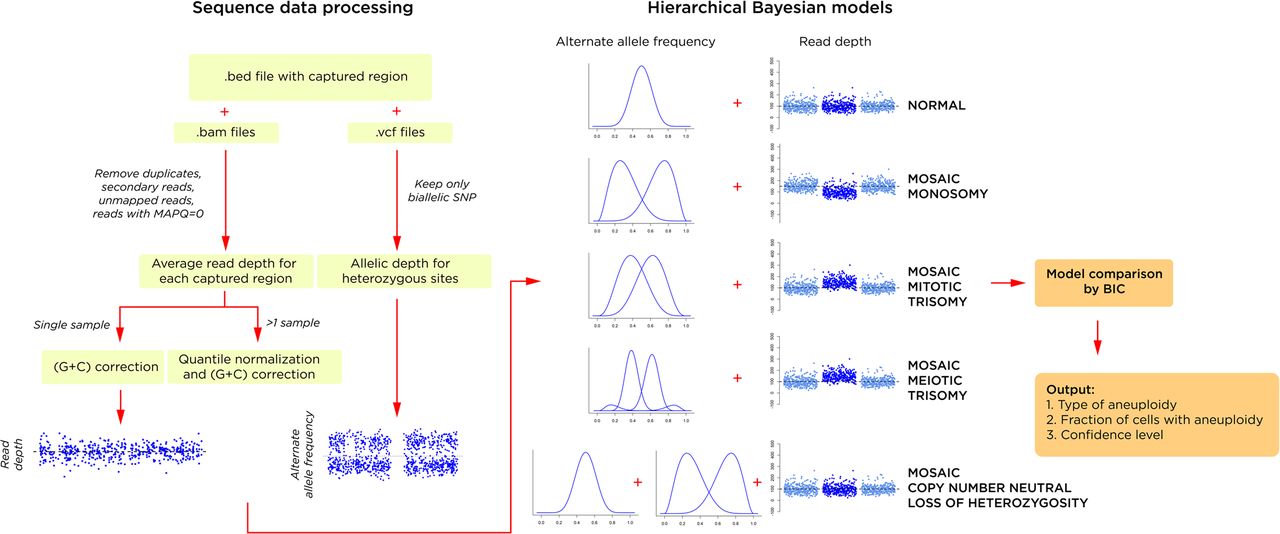
The MADSEQ analytical approach has two major components: the processing of the sequence data (left); and the use of alternate allele distributions and relative read depth to support a specific hierarchical Bayesian model (right). This model is based on fitting a mixture model of alternate allele frequencies (AAFs) at heterozygous loci (showing the additional distributions in a situation of mosaic meiotic trisomy) and read depth for the affected chromosome compared with the remainder of the genome. The winning model is selected by its significantly better Bayesian information criterion (BIC), generating an output of the presence and type of mosaic aneuploidy (or copy number neutral loss of heterozygosity), the proportion of cells with the aneuploidy, and the confidence of this prediction based on relative BIC values.