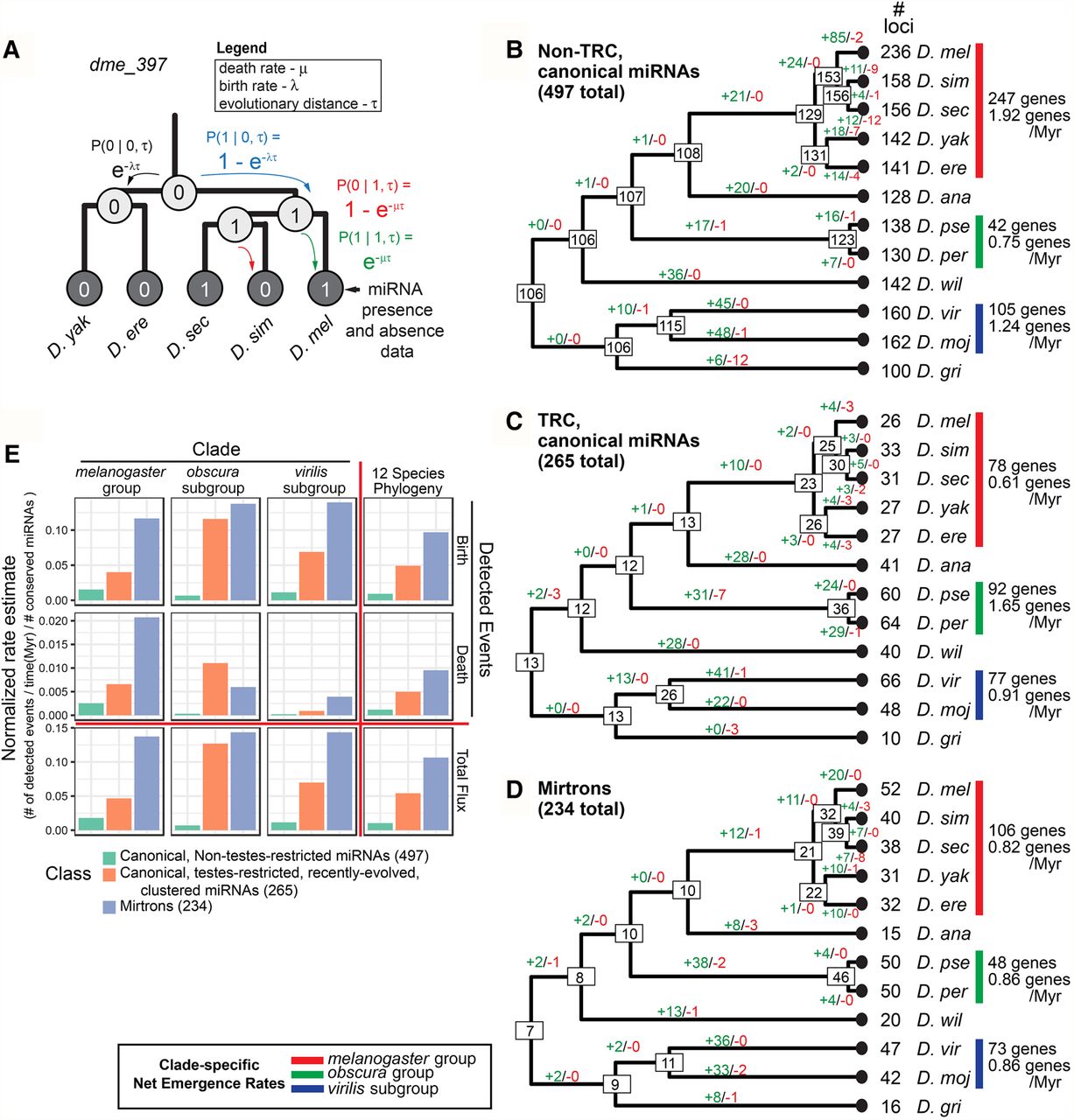
Estimation of miRNA birth and death rates in Drosophila. (A) A phylogenetic probabilistic graphical model for estimating rates of gene birth and death. The model takes binary data representing miRNA presence or absence at the leaves of the tree and uses numerical optimization methods to estimate model parameter (µ, λ) values by maximum likelihood. Branch lengths (τ) are fixed. Maximum-likelihood parameter estimates are then used to reconstruct node-wise miRNA presence/absence and edge-wise birth and death events. (B–D) Summary of estimated ancestral miRNA content and edge-wise birth and death events for three classes of miRNAs. miRNA classes are canonical miRNAs (B), testes-restricted, recently evolved, clustered canonical miRNAs (TRC) (C), and mirtrons (D). Estimates of edge-wise birth and death events are shown in green and red, respectively. Net emergence rate (i.e., total birth − death events/Myr) are shown in each class for the melanogaster group, obscura subgroup, and virilis subgroup species. (E) Rate of birth and death and net miRNA gain rate for three clades—melanogaster group, obscura subgroup, and virilis subgroup—are shown. Note that mirtrons and TRC miRNAs exhibit much higher rates of flux than do canonical non-testes-restricted miRNAs.