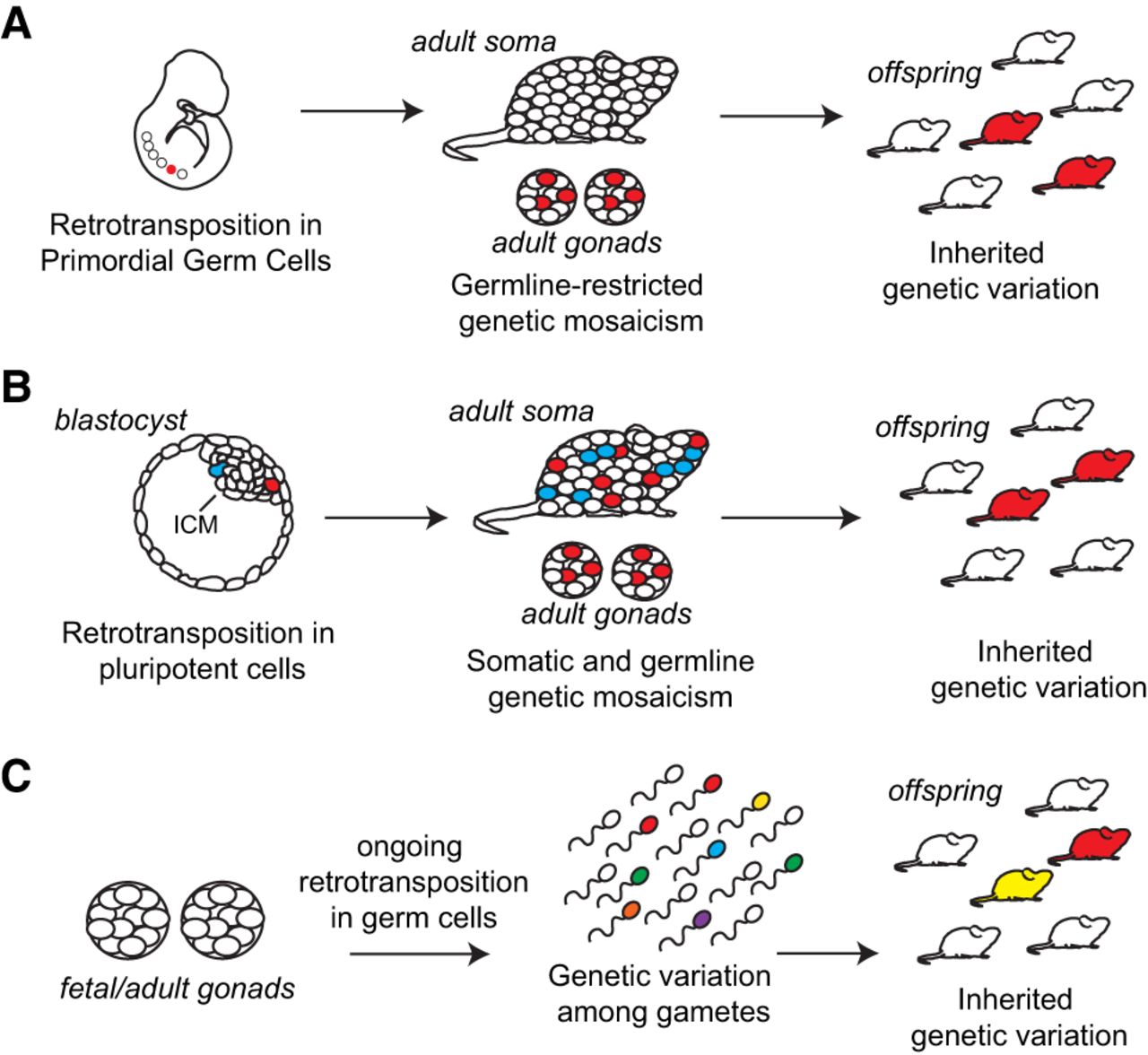
Model for the developmental origins of heritable L1 retrotransposition events. (A) Retrotransposition in the early primordial germline. From left: a retrotransposition event occurring in early PGCs (red) gives rise to germline-restricted genetic mosaicism in the adult animal. The L1 insertion is present in both testes and is heritable by subsequent generations, potentially by multiple F1 siblings. (B) Retrotransposition in the early embryo. Two retrotransposition events in pluripotent cells are indicated (red and blue). The red event contributes to somatic and germ tissues, while the blue event only contributes to somatic tissues in the adult animal. The red insertion is heritable by subsequent generations, potentially by multiple F1 siblings. (C) Retrotransposition in the late germline. Ongoing retrotransposition in adult germ cells, theoretically taking place at any stage from germline stem cells through mature gametes, may generate a large amount of diversity with individual insertions present at low frequency within the gamete pool (multicolored sperm). Each individual insertion has a low probability of contributing to genetic diversity in subsequent generations.