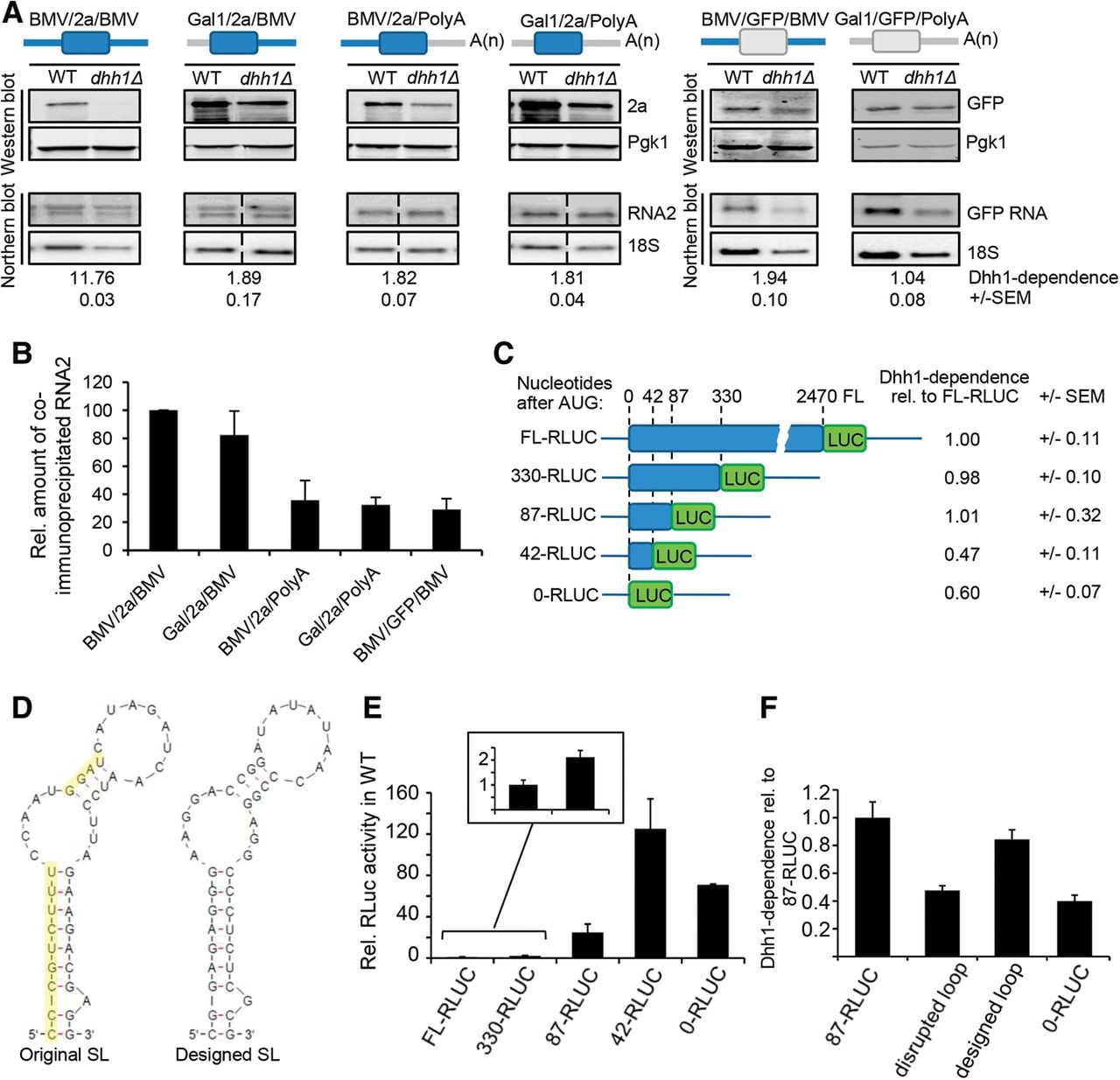
A stem–loop in the 2a CDS confers dependence on Dhh1 for translation. (A) Northern and Western blot analysis of WT and dhh1Δ yeast expressing different BMV and GFP mRNA constructs (schematic diagrams of the constructs depicted on top, in blue native BMV RNA2 sequences). Dhh1-dependence is calculated from the relative expression of 2a and GFP normalized to Pgk1 in WT and dhh1Δ cells. Dhh1-dependence ± SEM is given below. (B) Diagram shows the amount (±SEM) of co-immunoprecipitated RNA2-construct relative to that of WT RNA2 (BMV/2a/BMV) detected by qPCR. The amount of co-immunoprecipitated WT RNA2 was set to 100. (C) Schematic diagrams of RNA2-RLUC constructs containing complete or a part of the 2a CDS fused to RLUC. Translation was determined by measuring luciferase activity corrected by the amount of RNA determined by qPCR. (D) (Left) RNA-fold model of the secondary structure of nucleotides 42–85. Nucleotides marked in yellow have been replaced by complementary ones to disrupt the stem–loop. (Right) Designed structurally equivalent stem–loop. (E) The region between nucleotides 42–87 strongly inhibits RLUC activity. RLUC activity was measured and corrected by the amount of the RNA2 construct determined by qPCR and is represented relative to the activity in the presence of FL-RLUC, which was set to 1. (F) The structure and the position of the stem–loop is important for the dependence of RNA2 translation on Dhh1. WT and dhh1Δ yeast cells transformed with RNA2-RLUC constructs in which the stem–loop structure has been disrupted by point mutations (“disrupted loop”) or replaced by a designed stem–loop structure (“designed loop,” depicted in D). The relative Dhh1 dependence refers to the RLUC ratio between WT and dhh1Δ cells and was set to 1 for FL-RLUC to facilitate comparison. Mean values ± SEM were obtained from at least three independent experiments throughout the figure.