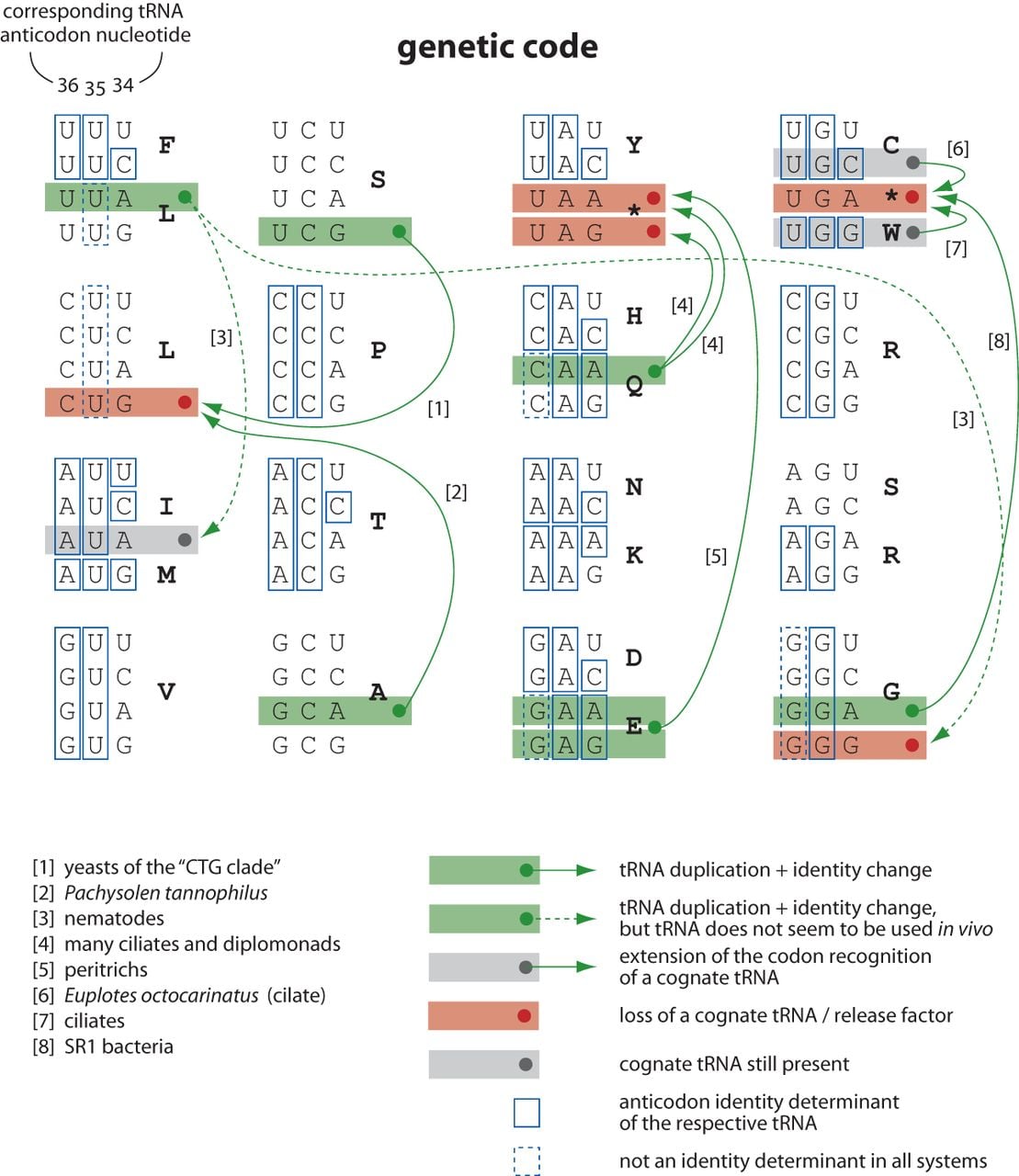
Compilation of nuclear codon reassignments. The scheme shows tRNA anticodon identity determinants plotted onto the genetic code. If mutated, Ala- and Ser-tRNAs (and in some systems also the Leu-tRNAs) should, in principle, be able to capture any other codon. Plotting all known cases of nuclear genetic code reassignments onto the codon table shows that most cases resulted from extending the decoding capabilities of near-cognate tRNAs. Reassignments reported for Mycoplasma capricolum, which was thought to lack a dedicated tRNA for decoding CGG although still containing six CGG codons in its genome (Oba et al. 1991), and Micrococcus luteus, which was thought to lack AUA and AGA codons (Kano et al. 1993), are not supported by whole-genome sequencing data (Young et al. 2010; Chu et al. 2011). The available data show that the Caenorhabditis elegans GGG codons are translated as glycine in vivo and not as leucine (Hamashima et al. 2015).