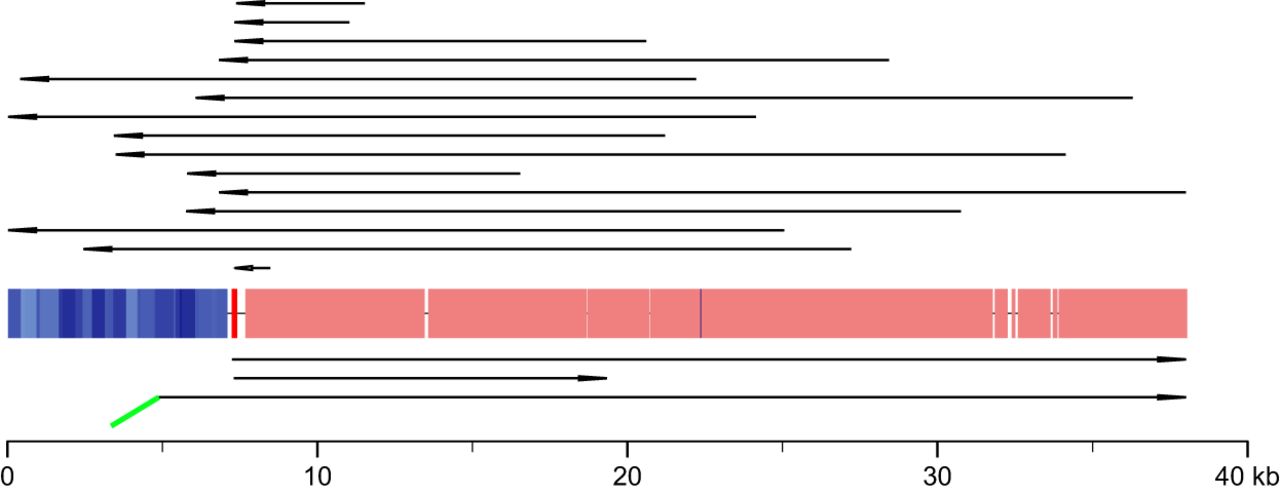
Sequencing bias in the Ppr-Y exon 3 region. This region has permissive transposable elements on the right side (pink) and a nonpermissive satellite block on the left (blue). The exon itself (shown in red) is flanked on both sides by two short single-copy regions (∼190 bp each; thin black line). A total of 18 reads cover the exon (black arrows), showing a strong strand bias (three forward reads:15 reverse reads) and nonuniformly distributed start points. Fifteen reads (top) originated on the right side, starting at scattered points within the TEs and extending through the exon and partially into the satellite block. Only two reads originated on the left side, both starting in the small 190 bp single-copy region between the satellite block and the exon and extending toward the exon and the TEs. The 18th read (SRR26246282.1589819, shown at the bottom) appears to originate within the satellite block but is actually a chimeric read. It begins with ∼3 kb of Chromosome 3L (a permissive sequence, shown in green) before transitioning into the end of the satellite block, reinforcing the pattern of satellite avoidance as a read start site. This avoidance explains several key observations: the low exon coverage, the strand bias, and the nonrandom exon position within reads (Table 1, columns 3–8), as read start sites are clustered outside the satellite block. We found additional chimeric or rearranged reads in other missing exons, suggesting that the scarcity of surviving reads increases the relative frequency of rare sequencing artifacts (Supplemental Fig. S5).