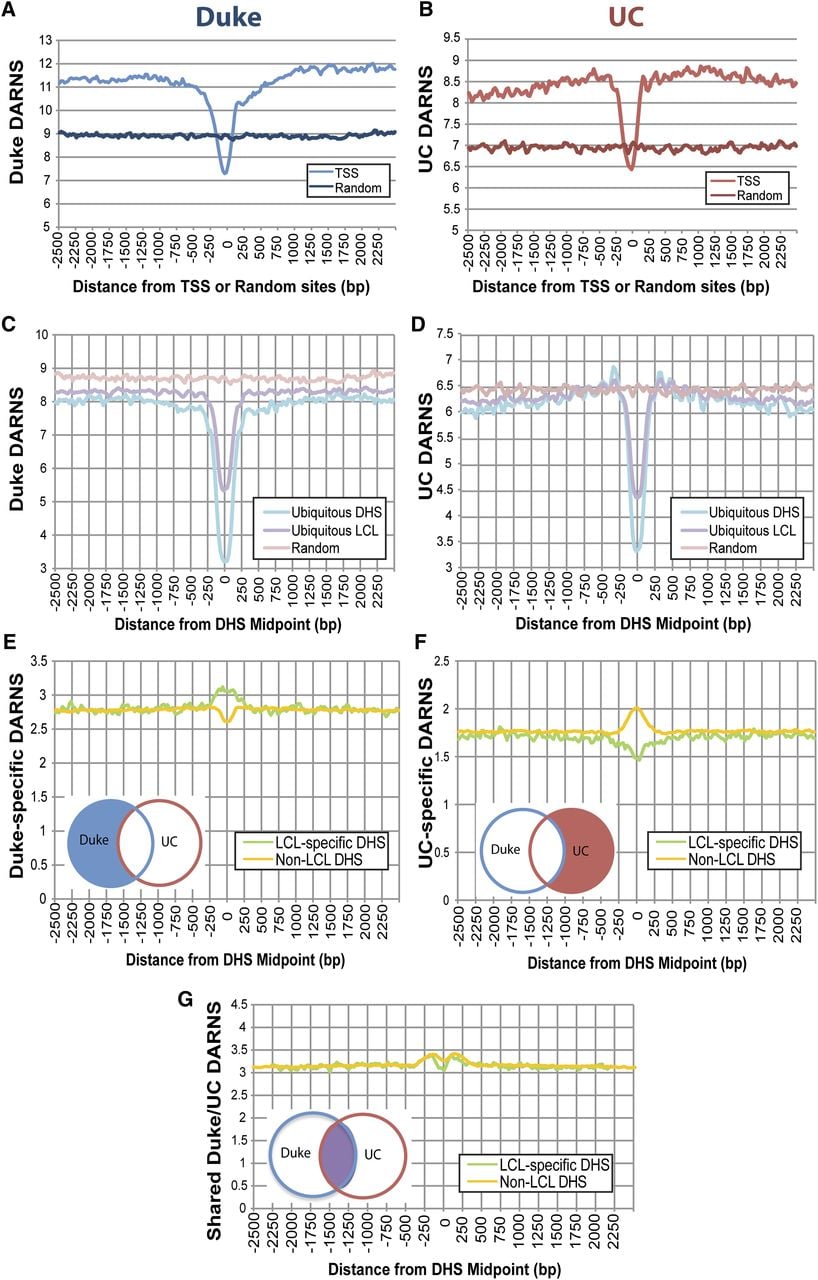
Properties of DARNS around transcription start sites (TSSs) and DHS sites. (Y-axis) The normalized density of DARNS. DARNS identified from Duke (left) and the University of Chicago (UC; right) (Degner et al. 2012). DNase-seq data are depleted around TSS (A,B) and enriched in surrounding areas (particularly downstream toward the gene body) relative to random intergenic coordinates. (C,D) DARNS (left, Duke; right, UC) are most depleted around ubiquitous DHS sites present in all cell types (ubiquitous DHS), as well as ubiquitous DHS sites identified in all LCL cell lines (ubiquitous LCL). DARNS were identified as Duke-specific (E), UC-specific (F), and shared by both data sets (G). (E) Duke-specific DARNS, but depleted around non-LCL DHS sites (yellow) and enriched around LCL-specific DHS (green). (F) In contrast, UC-specific DARNS are enriched for non-LCL DHS sites and depleted around LCL-specific DHS sites. (G) DARNS shared by both data sets show similar patterns around these DHS sites.