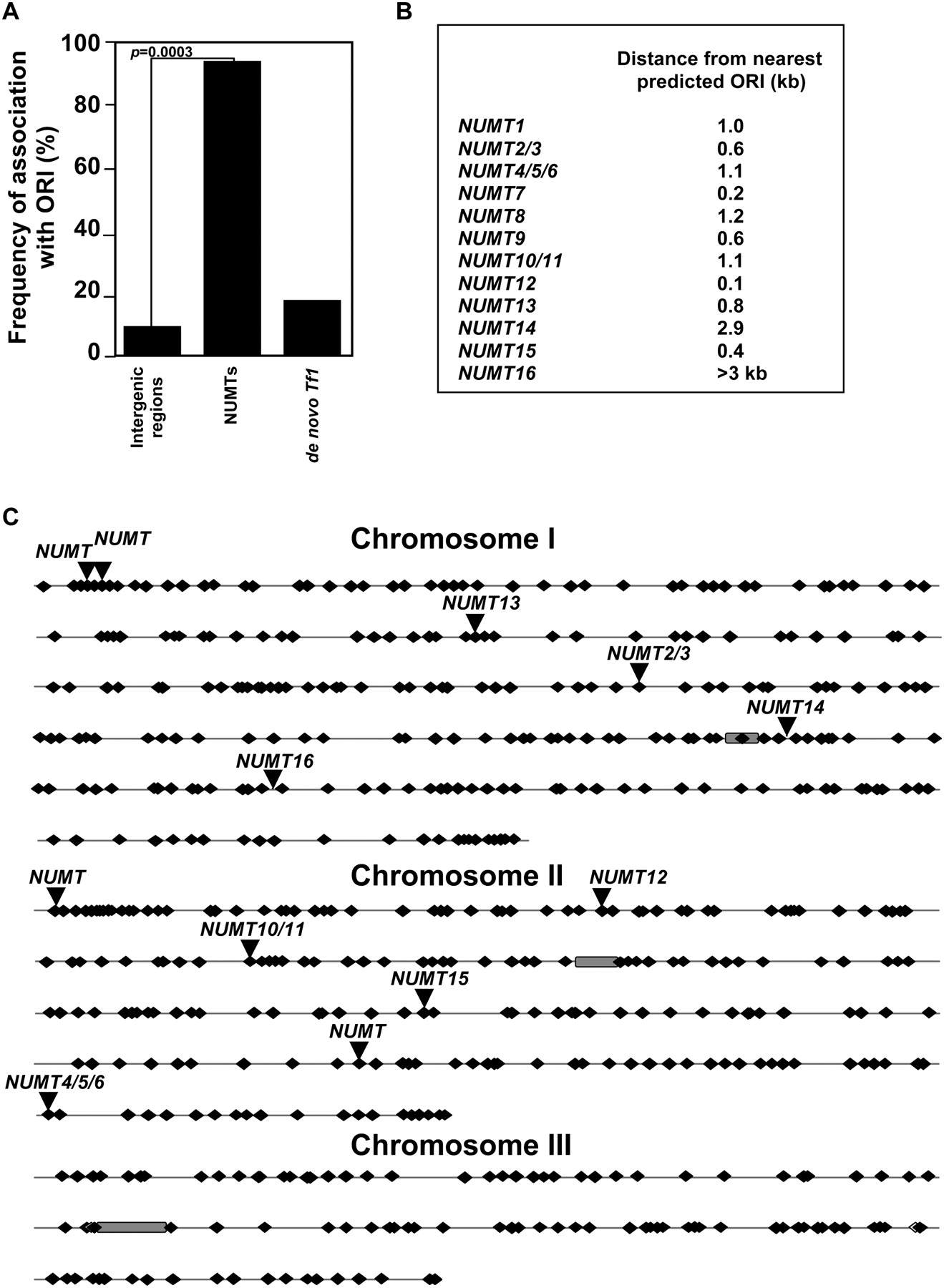
S. pombe NUMTs are preferentially located next to DNA replication origins. (A) Based on two distinct studies (Heichinger et al. 2006; Hayashi et al. 2007), the number of S. pombe DNA replication origins may be close to 557, leading to a frequency of replication origin-containing intergenic regions of ∼11% (557/5000). Eleven out of the 12 independent NUMT insertion sites are located in the proximity of a prereplication complex binding site. For comparison, the 26 de novo Tf1 insertion sites identified in another study (Behrens et al. 2000) show an expected frequency of association with DNA replication origins. Fisher's exact probability test was performed on http://faculty.vassar.edu/lowry/odds2x2.html. (B) Distance between each NUMT and the nearest predicted ORI (kb). (C) Replication origins deduced from Hayashi et al. (2007) and Heichinger et al. (2006) studies are represented on S. pombe chromosomes. For clarity reasons, diamonds do not reflect properly the size of ORIs, as replication origins cover at most 4.4% of the total S. pombe genome. NUMT16 is not associated with an ORI. (Gray rectangles) Centromeres.