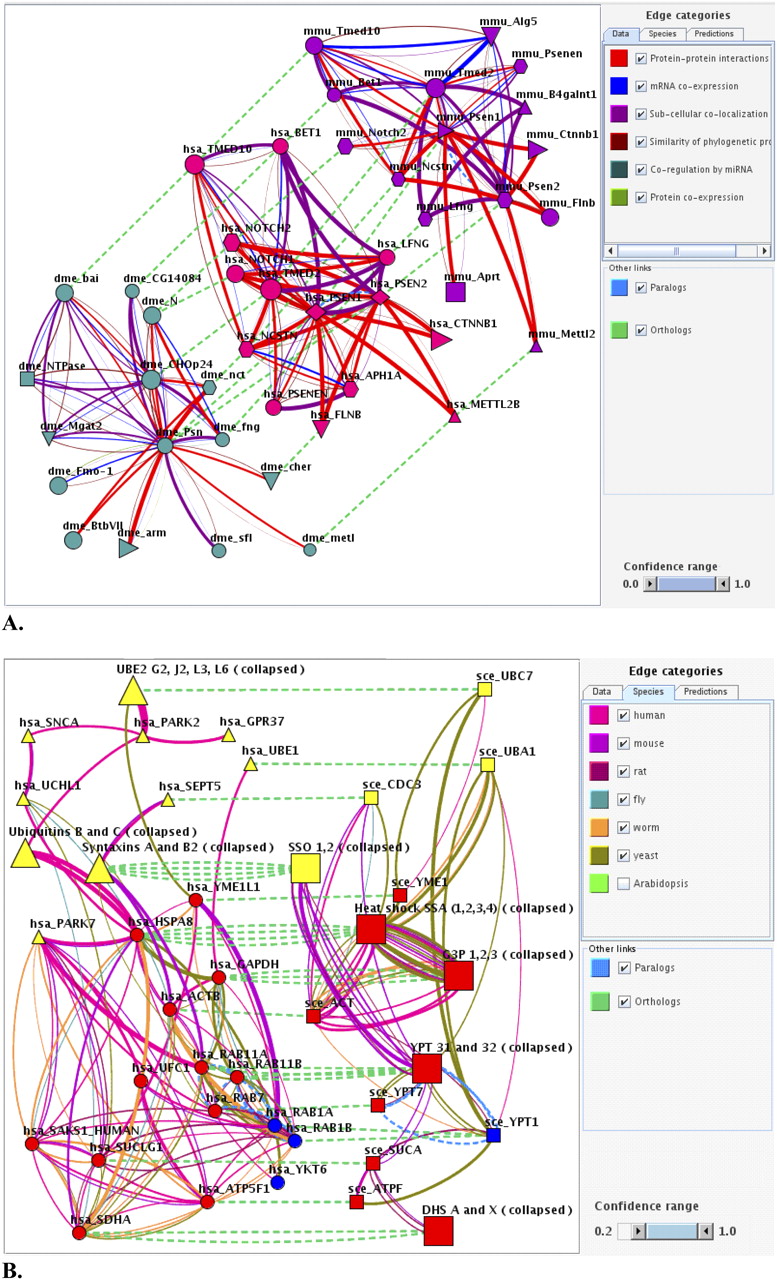
Comparative network analysis in FunCoup. (A) Subnetworks in human (middle), mouse (top), and fly (left) were generated by submitting human presenilin 1 and 2 (PSEN1 and PSEN2) to FunCoup, asking for one step of network expansion keeping the 20 strongest links with P > 0.5, and inclusion of orthologous subnetworks in mouse and fly. At the lower right are two newly predicted interactors of the gamma secretase complex, BET1 and LFNG. On the right, the color legend for the links is shown in terms of evidence type. Species are indicated by gene symbol prefixes: has, human; mmu, mouse; and dme, fly. Supplemental Figure 8 presents alternative views by species source or predicted class. The jSquid XML source to this figure is available as supplementary file psen_lfng_bet.xml. (B) Using FunCoup to identify novel candidate genes in Parkinson's disease. We here employ orthologous networks in human (left) and yeast (right, squares). Novel candidates were extracted by looking for human genes that were coupled both to known PD genes and to orthologs of yeast alpha-synuclein toxicity modifiers. This resulted in 12 novel candidate PD genes (red circles). PD and alpha-synuclein toxicity modifier genes not connected to these 12 genes were omitted from the network for clarity. Edge categories are shown in the figure. Node categories are as follows: (yellow) known human PD genes from the pathway KEGG05020 (triangles) and their yeast orthologs (squares); (blue) yeast modifiers of a-synuclein toxicity (squares) and their human orthologs (circles); (red) 12 novel human PD candidate genes (circles) and their yeast orthologs (squares); and larger shapes labeled “collapsed,” grouped genes—inparalogs, except for UBE2 that represents four ubiquitin-conjugating enzymes with similar molecular function. For details on how the subnetwork was generated, see Supplemental Methods; for a large scale prospective of the presented subinteractome, see Supplemental Figure 10.