Context of repeated elements in genome of N. punctiforme and E. coli
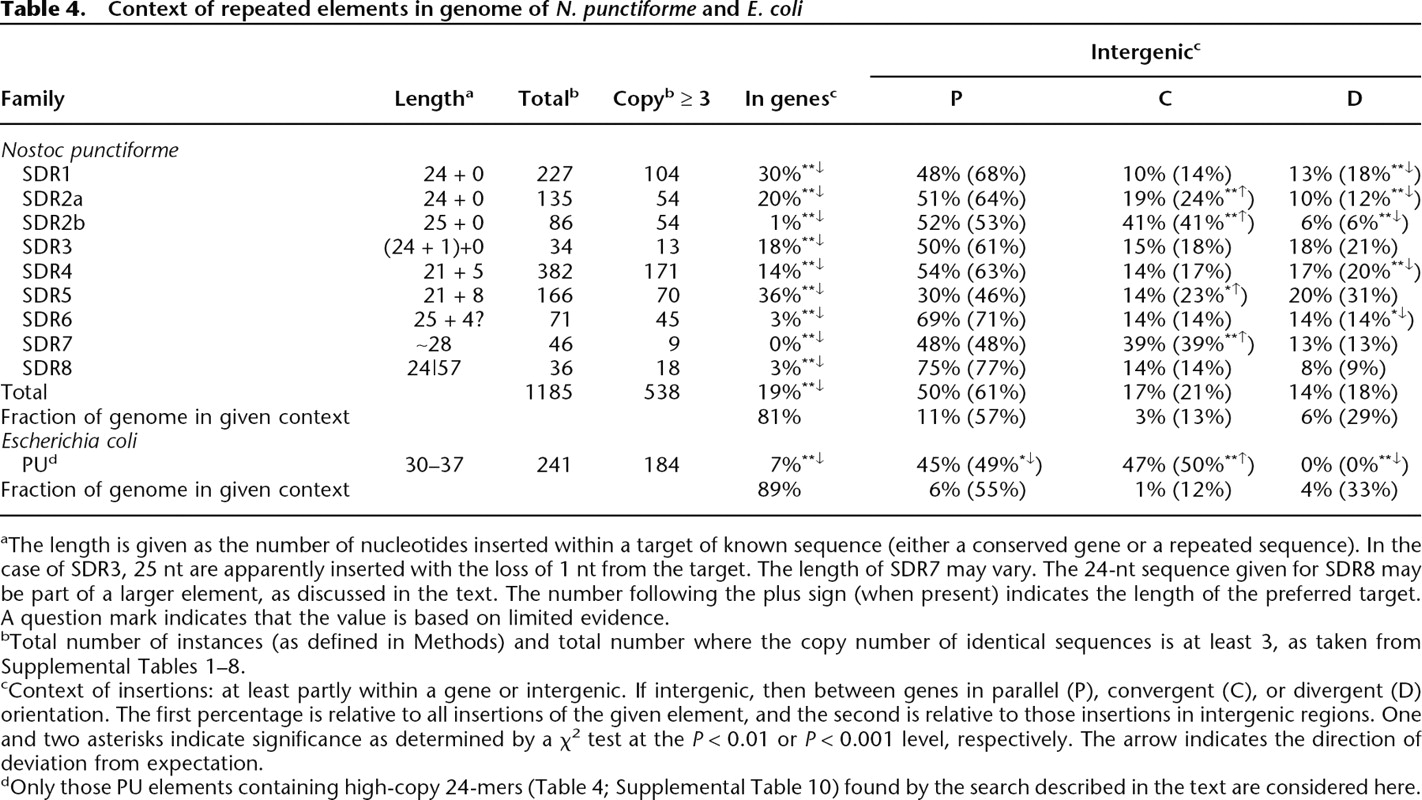
aThe length is given as the number of nucleotides inserted within a target of known sequence (either a conserved gene or a repeated sequence). In the case of SDR3, 25 nt are apparently inserted with the loss of 1 nt from the target. The length of SDR7 may vary. The 24-nt sequence given for SDR8 may be part of a larger element, as discussed in the text. The number following the plus sign (when present) indicates the length of the preferred target. A question mark indicates that the value is based on limited evidence.
bTotal number of instances (as defined in Methods) and total number where the copy number of identical sequences is at least 3, as taken from Supplemental Tables 1–8.
cContext of insertions: at least partly within a gene or intergenic. If intergenic, then between genes in parallel (P), convergent (C), or divergent (D) orientation. The first percentage is relative to all insertions of the given element, and the second is relative to those insertions in intergenic regions. One and two asterisks indicate significance as determined by a χ2 test at the P < 0.01 or P < 0.001 level, respectively. The arrow indicates the direction of deviation from expectation.
dOnly those PU elements containing high-copy 24-mers (Table 4; Supplemental Table 10) found by the search described in the text are considered here.