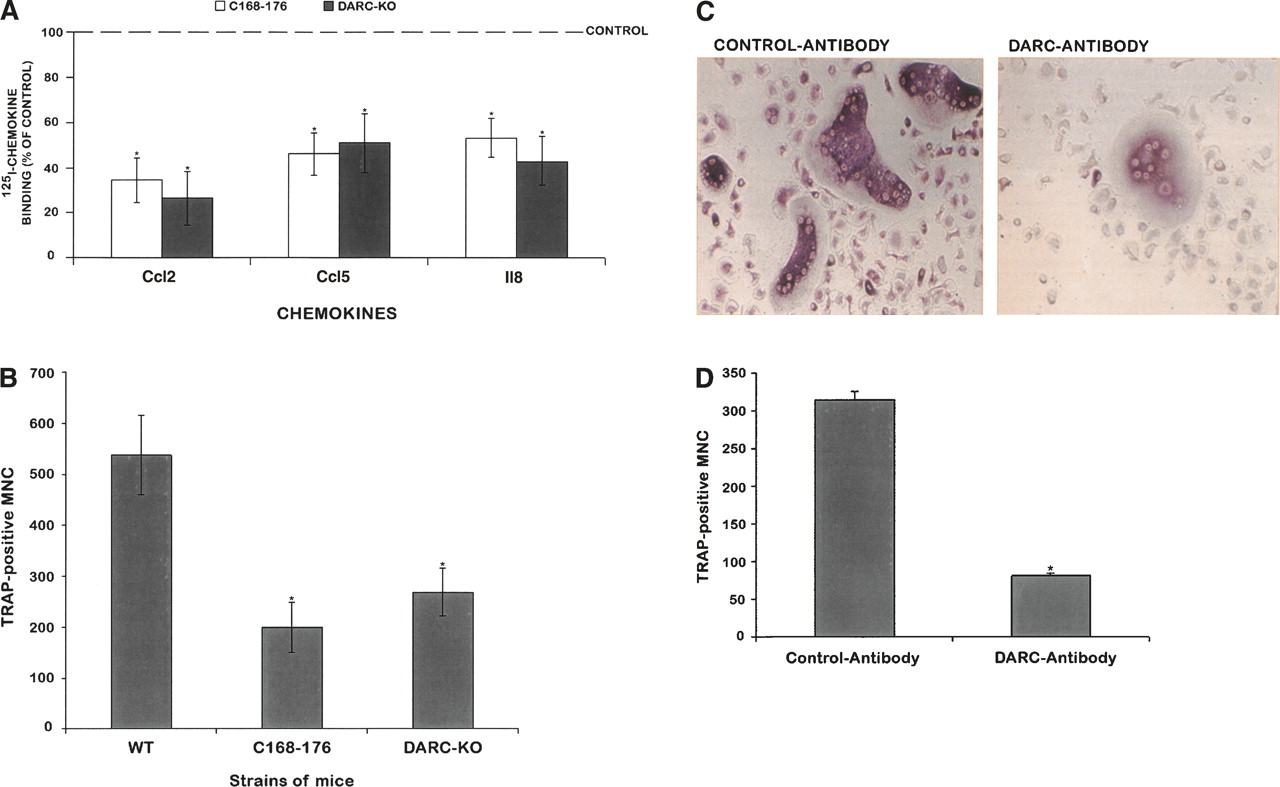
In vitro analysis of nonadherent bone marrow cells (NABMC) from B6, C168–176 congenic subline, Darc+/+, and Darc−/− mice. (A) Binding of three chemokines to NABMC. NABMC were incubated at 37°C/RT in the presence of either 125I-chemokine only or both labeled and unlabeled chemokine. The specific binding was expressed as the CPM value in the absence of cold chemokine subtracted from the CPM value in the presence of cold chemokine. Data are expressed as a percentage of 125I-chemokine binding to NABMCs derived from B6 control mice, n = 8–10. (B) Osteoclast generation in response to Tnfsf11 (100 ng/mL) and Csf1 (100 ng/mL). After 10 d in culture, cells were stained for TRAP activity, and only cells with more than two nuclei (MNC: multinucleated cells) were counted. Data are expressed as a mean ± SEM. Six to eight mice were used for each strain of mice. (WT) Wild-type mice. Groups were compared with wild-type mice with Student’s t-test. (*) P < 0.05 vs. B6 control mice. (C) Effect of Darc-antibody on TRAP-positive cells derived from NABMC of wild-type B6 mice. After 6 d of treatment with goat polyclonal Darc-Ab in the presence of Tnfsf11 and Csf1 (right panel), the number of TRAP-positive multinucleated cells decreased considerably compared with cells treated with control IgG in presence of Tnfsf11 and Csf1 (left panel). (D) Number of TRAP-positive MNC derived from NABMC of wild-type B6 treated with Tnfsf11 and Csf1 in the presence of either Darc-antibody or control antibody. The data are expressed as mean ± SEM. The experiment was repeated twice with cells derived from four mice each time. (*) P < 0.05 vs. control antibody (normal goat IgG).