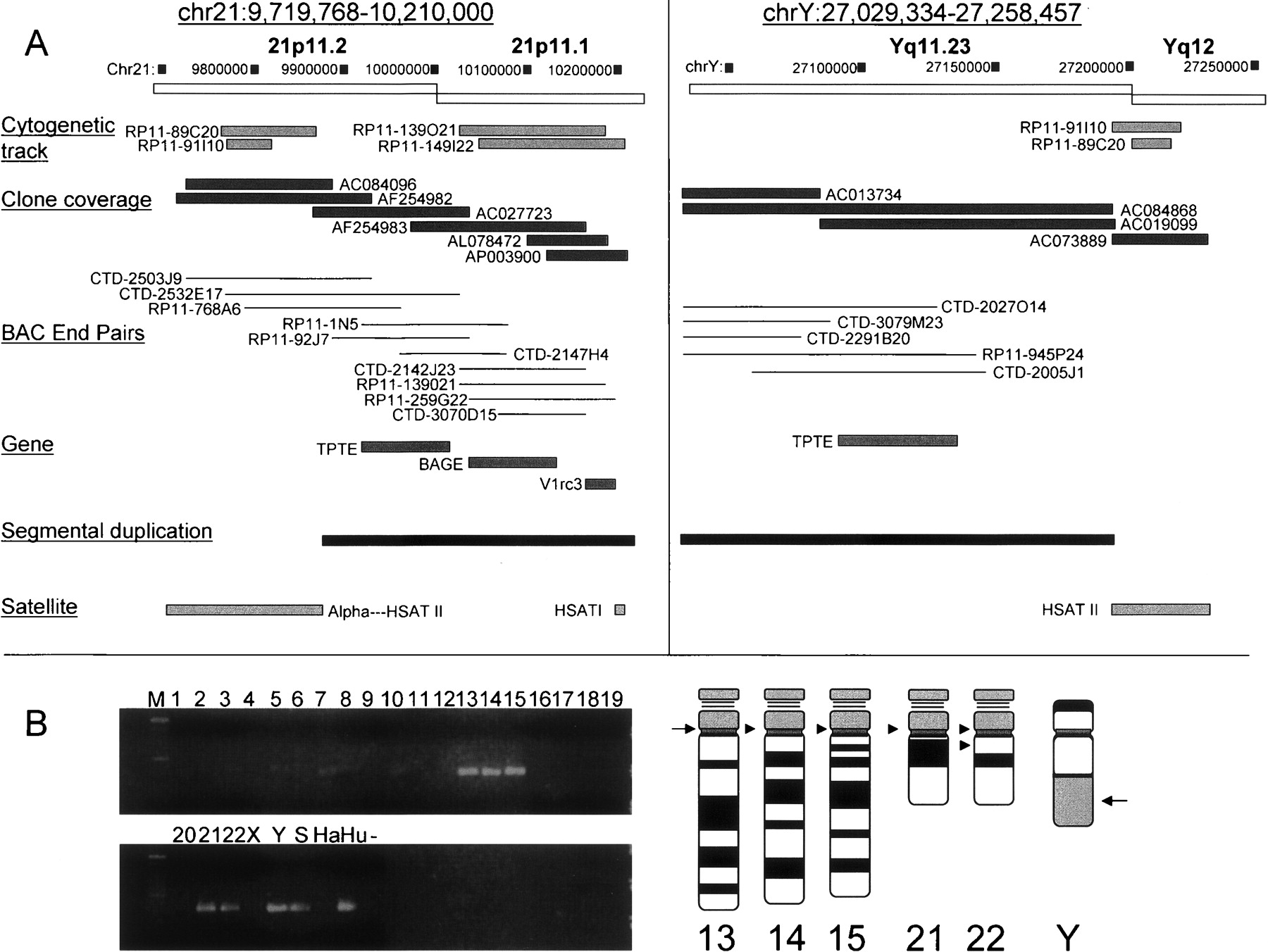
HSAT I/AT-rich repeat is found on the acrocentric chromosomes and Y. (A, left) A chromosome 21p11 pericentromeric island of overlapping clones contains the tripartite repeat element (listed as HSAT I in the satellite track). The genomic clones used for physical (Clone coverage track) and FISH mapping (Cytogenetic track) are indicated below the boxes representing the acrocentric pericentromeric interval on chromosome 21p11.2 and 21p11.1 as adapted from the UCSC Browser, March 2006 assembly. Three genes were identified as shown, with their exon-intron structure (Gene track). The segmental duplication tract was incorporated into the diagram, with satellite type shown. There are three classes of satellites in this region, α-satellites, present at the very 5′ end of the chromosome 21p11.1 region; HSAT II [(GAATG)n]; and HSAT I satellites. (Right) The chromosome Yq11.23–12 junction contains similar features as the 21p11 region. There is striking similarity between the clones mapping to 21p11 and the Yq11.23-q12 interval. The Yq11.23-q12 junction is shown depicting the genomic clones used for physical and FISH mapping as adapted from the UCSC Browser. The 3′ ends of BAC clones AC019099, AC084868, and AC073889 contain HSAT II simple satellite sequence. The contigs are connected to the Yq12 interval based upon FISH mapping with clones RP11-91I10 and RP11-89C20. Additional validation as to the presence of HSAT II is shown in Figure 7. The TPTE gene maps to the 21p11 and Yq11.23 regions as shown. The tripartite repeat is missing from the reference human sequence for this interval and it is now shown in A. (B) The HSAT I element maps to the acrocentric chromosomes. PCR was performed using DNA template from the hamster-human somatic cell hybrid panel (Coriell repositories) using HSAT I F/R primers. The first lane represents a 100-bp ladder, each number represents the individual human chromosome, including X and Y. Ha is hamster DNA, Hu is human DNA, S is GM06317 (chromosome Y hamster–human somatic cell hybrid), and − is the negative control. The PCR product from different chromosomes were 400 bp in size. The acrocentric chromosomes 13, 14, 15, 21, 22, and Y were amplified. An idiogram of the acrocentric chromosomes and chromosome Y, with arrows in the putative position where the HSAT I elements are present, is shown.