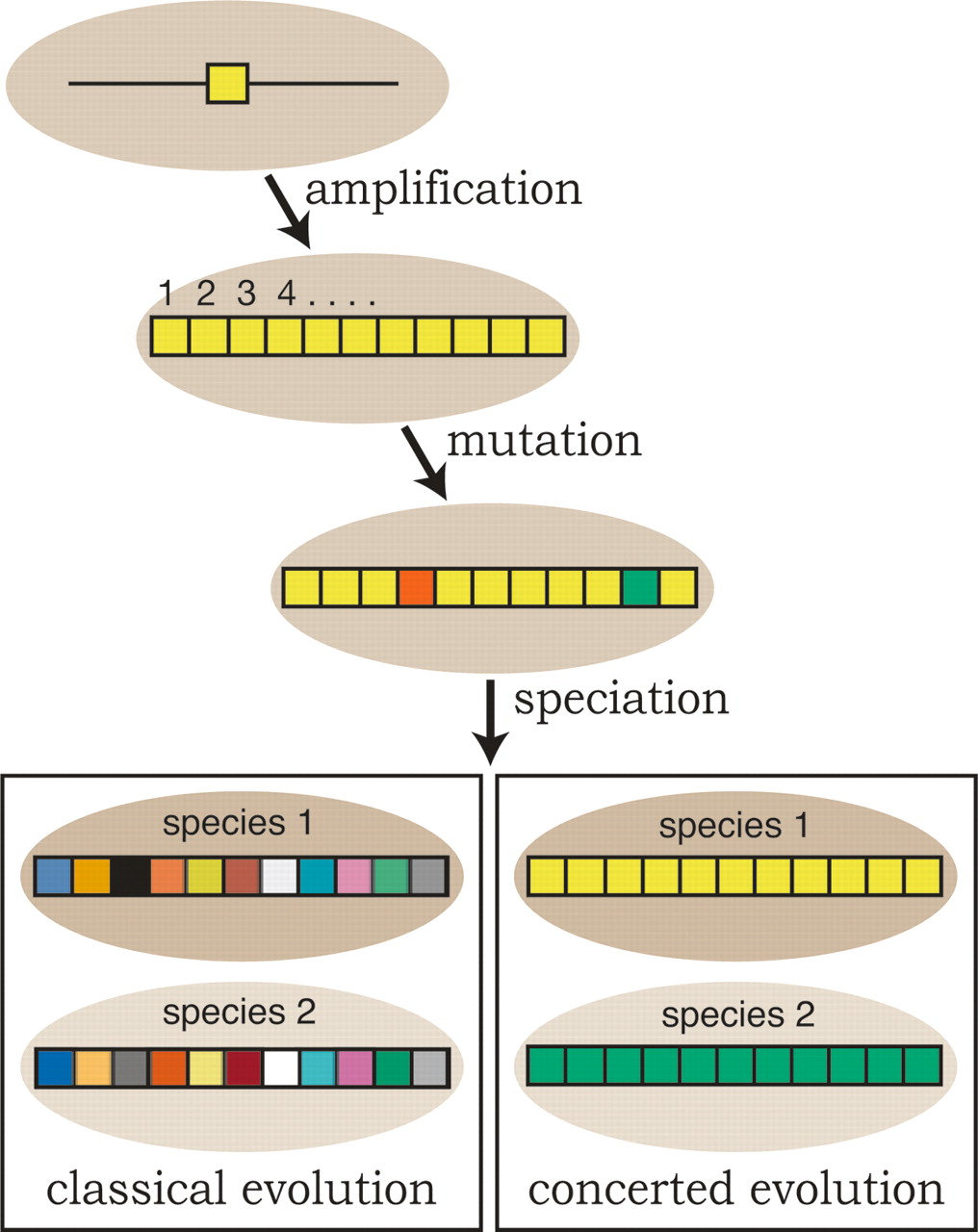
Classical evolution vs. concerted evolution. Repeats (individual boxes) in a repeat array are initially formed by a gene amplification event. The repeats accumulate mutations (alternatively colored boxes) through time. Under classical evolution these mutations persist and therefore, after speciation events, the orthologous relationships of the repeats remain (e.g., repeat #1 from species 1 will resemble repeat #1 from species 2 more closely than the other repeats in species 1; indicated schematically by different shades of the same color). However, under concerted evolution, homogenization continuously sweeps one repeat variant (at random) to fixation within the array. Therefore, the repeats within a genome are all expected to be similar, but differ in sequence from the repeats in a closely related species. Birth-and-death evolution is a more complex form of classical evolution mixed with some aspects of concerted evolution, and is not depicted.