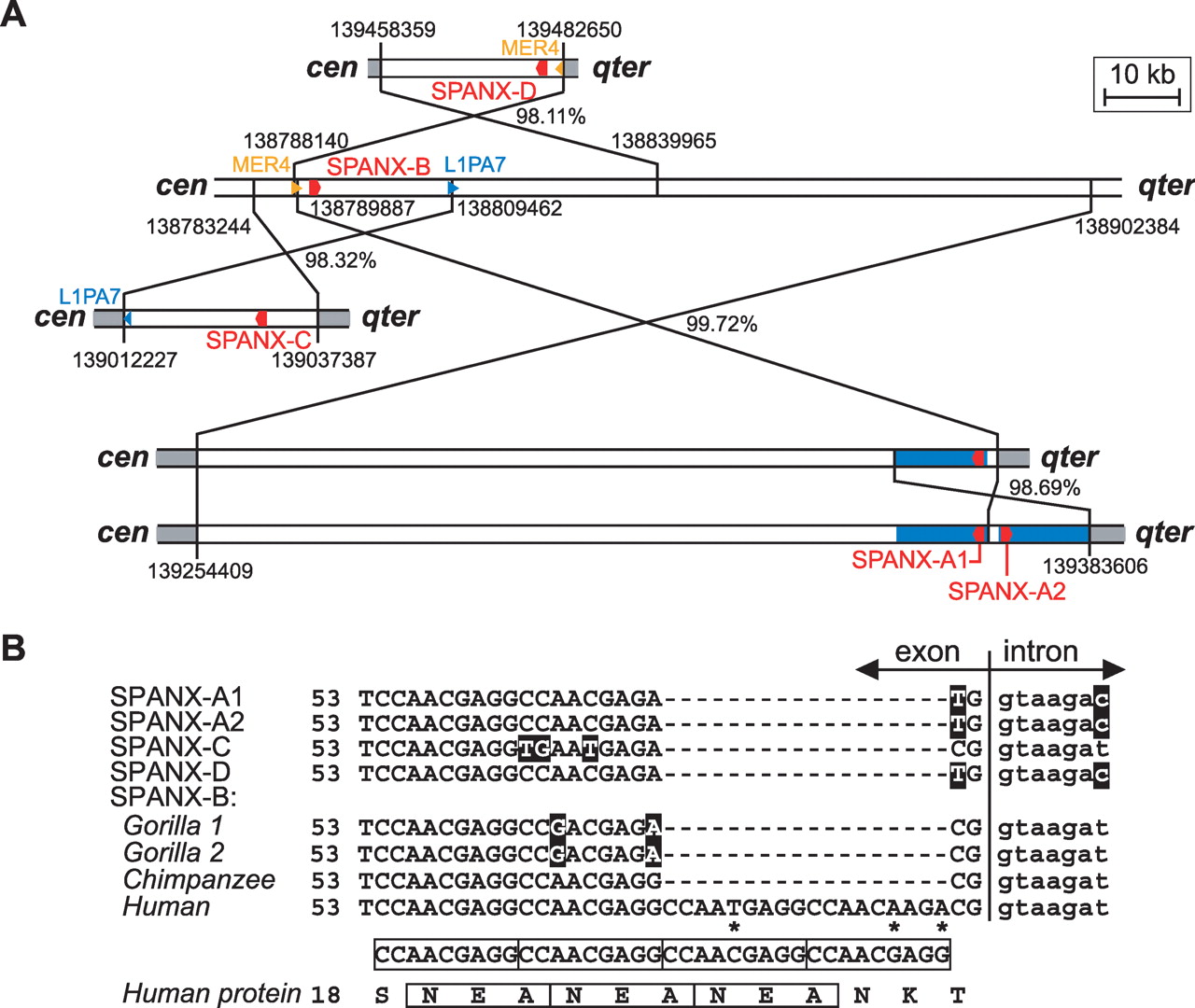
Evolution of the SPANX-A/D genes. (A) The probable scheme of evolution of the SPANX-A/D gene family by segmental duplications. The genes are marked in red. Positions relative to the centromere (cen) and telomere (qter) are marked. The numbers near duplication breakpoints indicate positions of the duplicated regions in the human genome (hg16; UCSC July 2003 genome version). SPANX-B seems to be the original locus. SPANX-B and its duplications are shown as white boxes, the sequences flanking the duplications are gray. The number next to the crossed lines shows the nucleotide identity between the duplicated regions, after excluding gaps. SPANX-D is derived from an inverted duplication of SPANX-B. The SPANX-D telomeric breakpoint colocalizes with the terminus of a MER4 element (orange), whereas the corresponding SPANX-B centromeric breakpoint contains a longer MER4 element that spans further from the duplicated region. The origin of the SPANX-C locus from SPANX-B by LINE1-mediated recombination was confirmed by a comparison with other primates (see Fig. 3). The SPANX-A1/A2 locus was probably created by a two-step process that first duplicated a large (∼115-kb) segment from the SPANX-B region and subsequently amplified an ∼17-kb-long segment containing the SPANX-A1 gene (blue boxes). (B) The origin of the human-specific 18-bp-long insertion in SPANX-B exon 1. The terminal part of the first exon contains a duplication of the 9-bp-long motif CCAACGAGG also detectable at the protein level (boxed). Whereas all other human SPANX-A/D genes and African Great Ape SPANX-B genes contain only two copies of the 9-bp repeat, the human SPANX-B gene exhibits two additional copies of the repeat. Asterisks mark deviations from the repeat consensus.