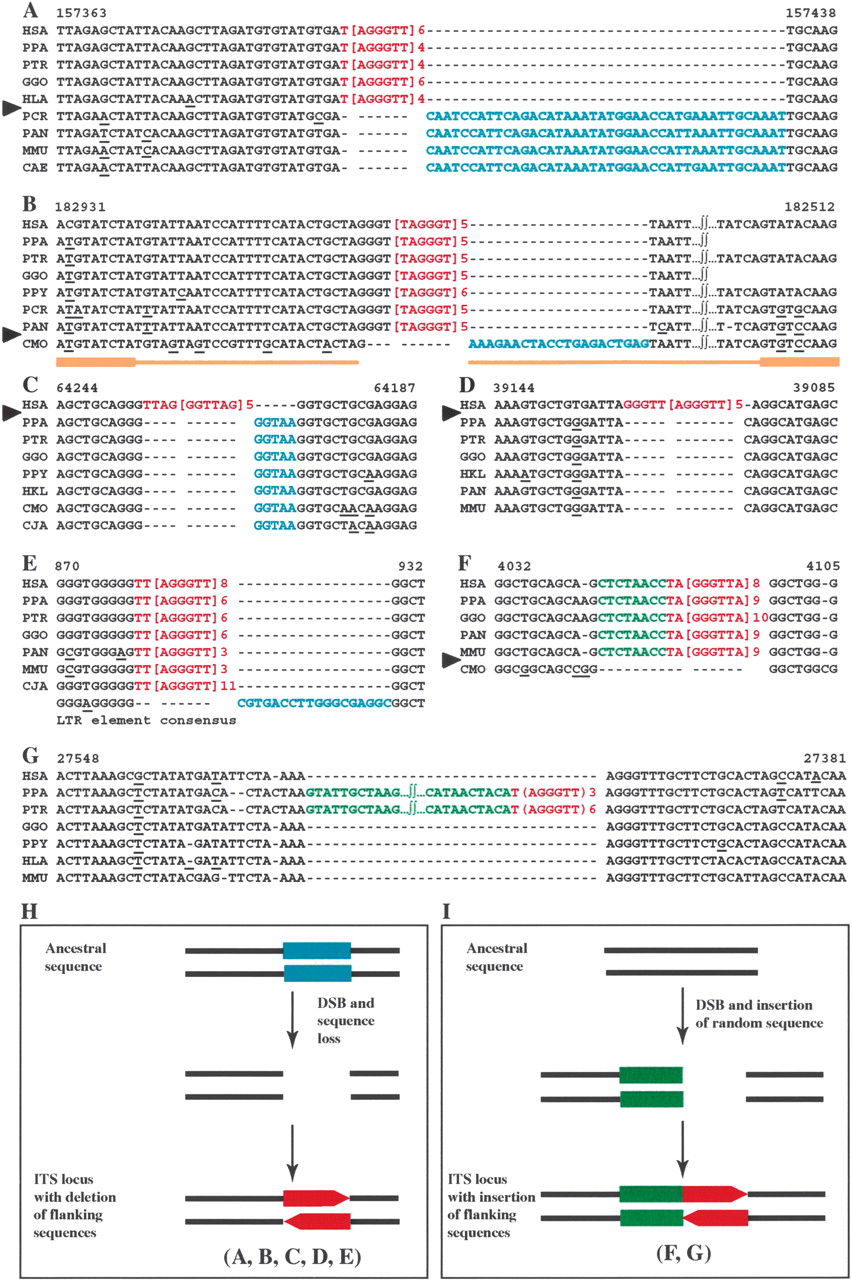
Interstitial telomeric-like repeat insertion with flanking sequence deletion or insertion. (A,B,C,D,E) Five examples of ITS insertions accompanied by deletions of flanking sequences. The dates of insertion of these ITS vary between 6 and 25-40 Mya. (F,G) The interstitial telomeric repeats appear together with a random sequence. The repeat in G is very recent, being present only in chimpanzees. The inserted telomeric repeats are shown in red, the deleted nucleotides in blue, and the inserted random nucleotides in green. The ITS shown in B is inserted within an LTR/THE1D element (thin yellow lines), which is inserted inside an LTR/MLT1C element (thick yellow lines). (H,I) Models for these types of insertion (deleted sequences: blue boxes; telomeric repeats: red boxes; inserted random nucleotides: green boxes). (HSA) Homo sapiens; (PTR) Pan troglodytes; (PPA) Pan paniscus; (GGO) Gorilla gorilla; (PPY) Pongo pygmaeus; (HLA) Hylobates lar; (HKL) Hylobates klossii; (PAN) Papio anubis; (PCR) Presbytis cristata; (MMU) Macaca mulatta; (CAE) Cercopithecus aethiops; (CMO) Callicebus moloch; (CJA) Callithrix jacchus. (A) The human ITS locus is the AL354723 sequence from Chromosome 9p22; (B) AF216808, Chromosome 8p12; (C) AC009054, Chromosome 16q22; (D) AC025982, Chromosome 3q25; (E) AF236882, Chromosome 7q36; (F) AC005032, Chromosome 7q36. (G) The chimpanzee ITS locus is the BS000043 sequence from chimpanzee Chromosome 22.