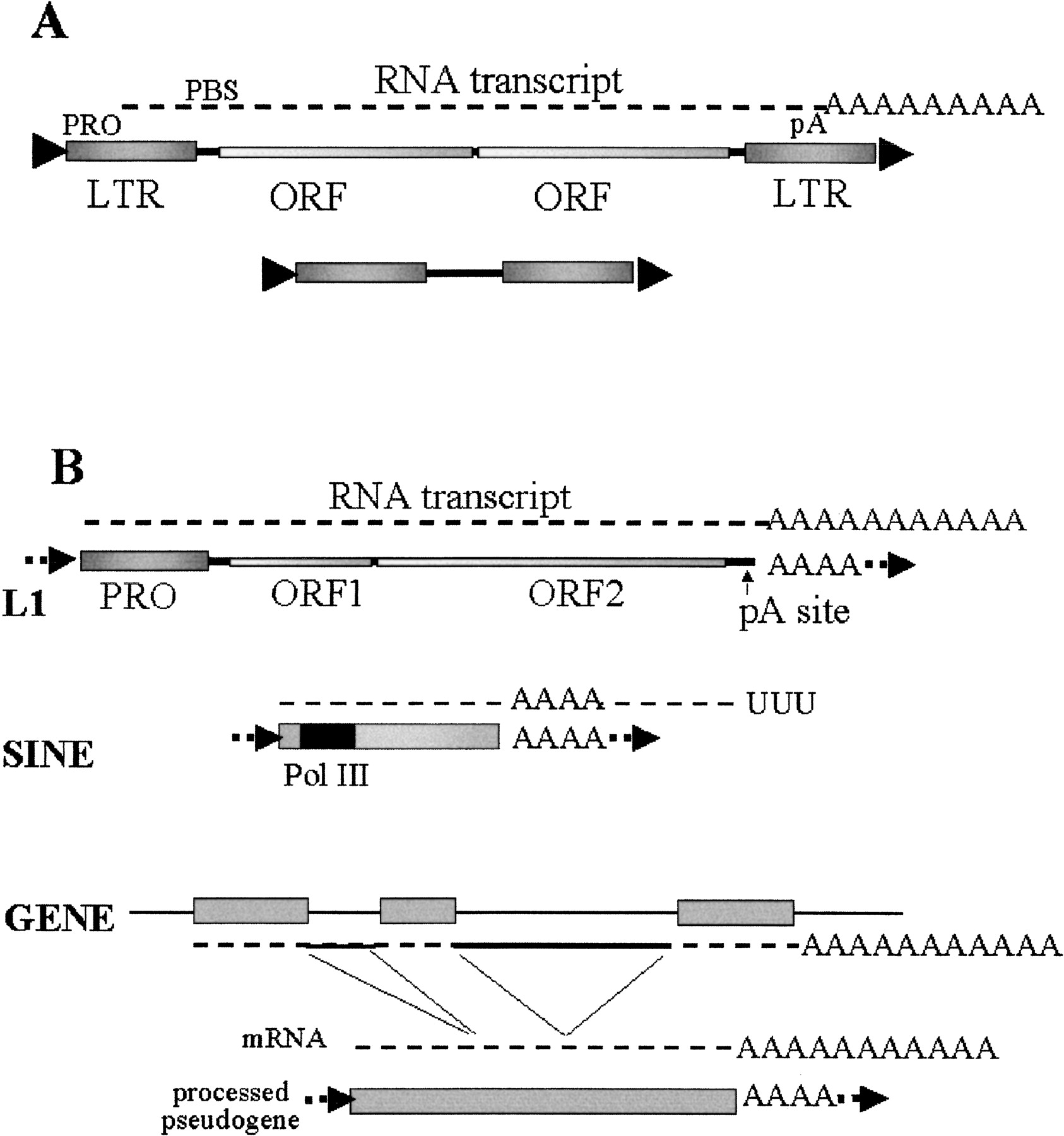
Classes of retroelements. (A) LTR-retrotransposons. The LTR-retrotransposons have long-terminal repeats at both ends of the elements that contain sequences that serve as transcription promoters, as well as terminators. These sequences allow the element to code for an mRNA molecule that is processed and polyadenylated. There are at least two genes coded within the element to supply essential activities for the retrotransposition mechanism. The RNA contains a specific primer binding site (PBS) for initiating reverse transcription. A hallmark of almost all mobile elements is that they form small direct repeats formed at the site of integration. (B) NonLTR retrotransposons. L1 elements in humans represent the most abundant class of these elements. They have an unusual RNA polymerase II-promoter structure in which the promoter is included within the final transcript. These elements create a polyadenylated mRNA which codes for a bicistronic mRNA. The consensus poly A addition site is relatively weak, resulting in transcripts that commonly extend into downstream sequences, resulting in transduction of those downstream sequences to new chromosomal loci. Integration of a nonLTR element into a new chromosomal location results in a chromosomal duplication of variable length forming relatively short, flanking direct repeats. The mechanism for expression of the second open reading frame (ORF) is also uncertain. SINEs represent elements that are independently derived from RNA polymerase III-transcribed RNA genes (tRNAs and 7SL RNA). SINEs are transcribed by RNA polymerase III and encode a poly A, or A-rich region, at the 3′ end of the element. However, transcription extends into unique flanking sequences downstream of the poly A stretch. These elements have no protein coding capacity and share flanking direct repeats with properties similar to those of L1 elements and are thought to be dependent on the L1 proteins for their retroposition. Processed pseudogenes are derived from the mature mRNAs (spliced) from numerous genes. These are also likely to be dependent on the L1 retrotransposition mechanism.