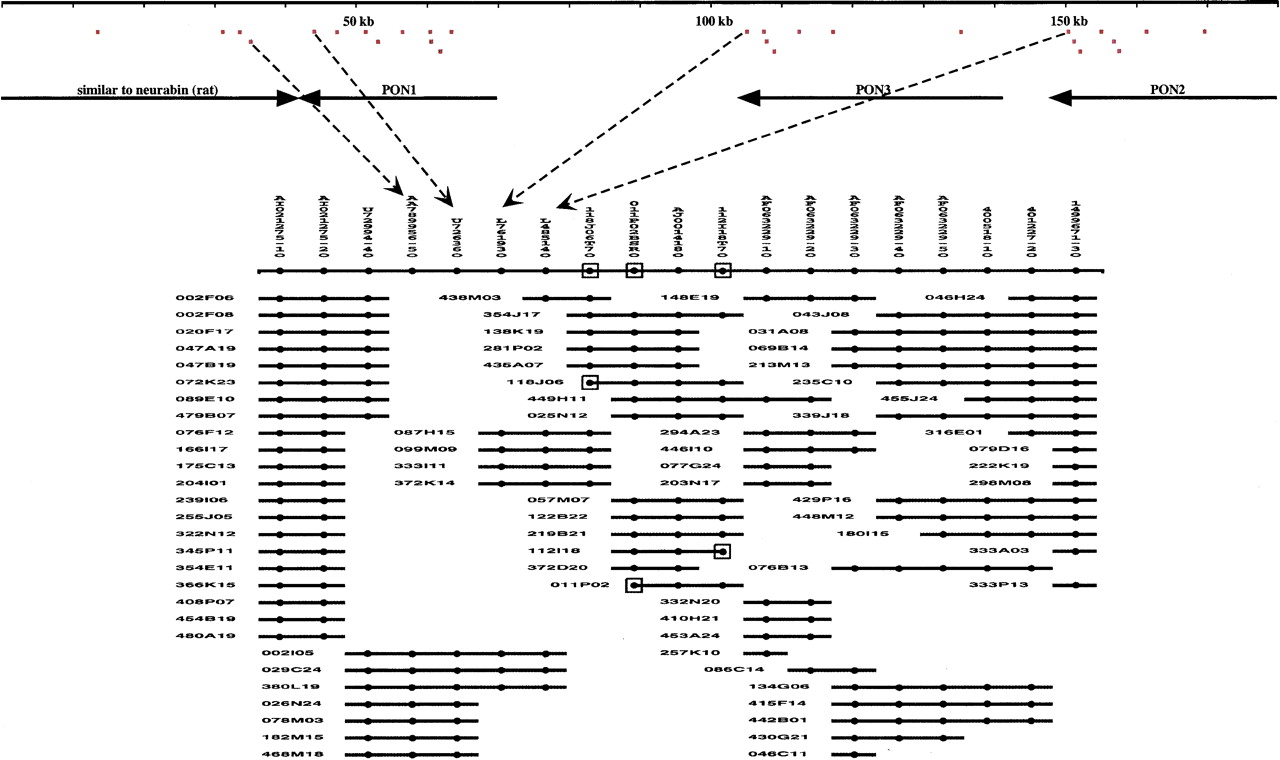
Accelerated construction of a mouse sequence-ready BAC contig using human genomic sequence. Roughly 180 kb of genomic sequence (top line) from human chromosome 7q22 (GenBank AC004022 and AC005021) was analyzed by RepeatMasker (A.F.A. Smit and P. Green, unpubl.; seehttp://www.genome.washington.edu/UWGC/analysistools/repeatmask.htm) to mask repetitive elements and then compared to GenBank using PowerBLAST (Zhang & Madden 1997). The small red dots below the human sequence represent a simplified view of matching mouse and rat mRNA/EST sequences. Three complete genes (PON1, PON2,PON3) and the 3′ end of a gene similar to rat neurabin (GenBank U72994) were detected in the region, with arrows indicating the direction of transcription. Based on this analysis, four overgo-type hybridization probes were designed from the matching mouse sequences (indicated by dashed arrows, with their names reflecting the corresponding GenBank accession numbers), optimizing for gene content and spacing (see text for details). These probes along with others designed from flanking human sequence were used to screen the mouse RPCI-23 BAC library, with the resulting probe-content data allowing assembly of three nascent contigs. The subsequent development and mapping of BAC insert end-specific overgo probes (indicated by squares) allowed the merger of the three contigs into the depicted >1-Mb contig from mouse chromosome 6.