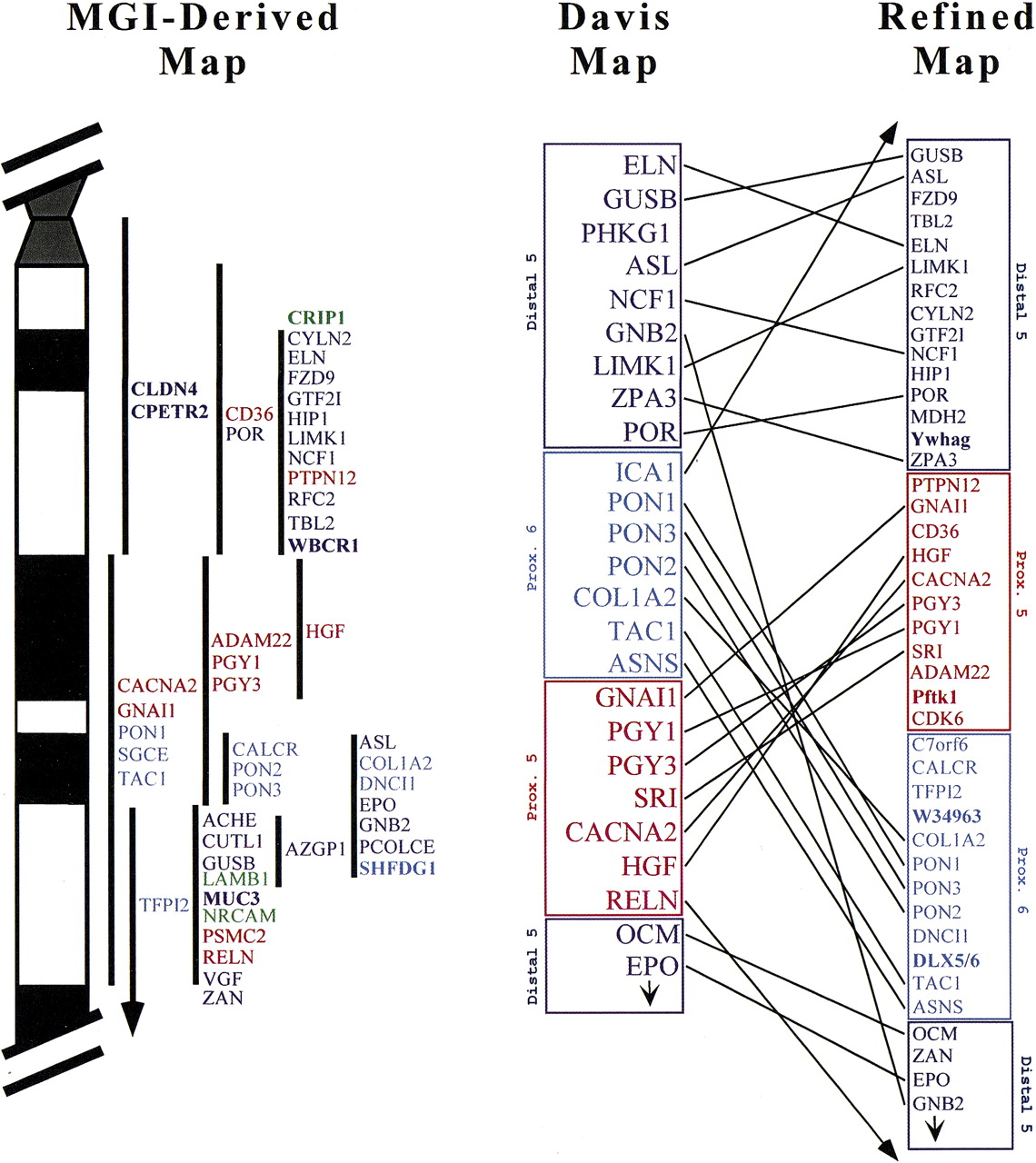
Small region of the refined human-mouse comparative map corresponding to a segment of human chromosome 7. On the left is a cytogenetic human-mouse comparative map of human chromosome 7q11-q22, based on information derived from MGI (ftp://ftp.informatics.jax.org/pub/informatics/reports/HMD_Human1.sq1.rpt).The predicted order of many of the same genes within this region of chromosome 7, as depicted on the Davis Human/Mouse Homology Map (DeBry & Seldin 1996) (see http://www.ncbi.nlm.nih.gov/Homology), is shown in the middle. On the right is our refined comparative map of the identical region, assembled with the aid of an available STS map (Bouffard et al. 1997) and genomic sequence from human chromosome 7 (see text for details). The complete refined comparative map is available at http://genome.nhgri.nih.gov/chr7/comparative. Note that the MGI-derived map includes a broader region than that shown for the Davis and refined maps. No definitive human gene order can be readily deduced from the crude cytogenetic positions available from the MGI-derived map. Using older information, the Davis map combined human cytogenetic mapping data with mouse genetic mapping data to deduce an order for human genes. All three maps indicate that this region of human chromosome 7 is orthologous to at least three different regions of the mouse genome. However, comparison of the Davis and refined maps reveals that the order of the proximal MMU6 and proximal MMU5 segments are inverted, the gene order within these segments is significantly different, and two genes included in the Davis map (ICA1 andRELN) are not present in this region. In general, human gene symbols are shown, except in cases where the human gene has not been named, in which case the mouse symbol or accession number is used. Lines connect identical genes present on both the Davis and refined maps. Genes depicted in bold are unique to one map, while those depicted in green on the MGI-derived map are located on MMU12.