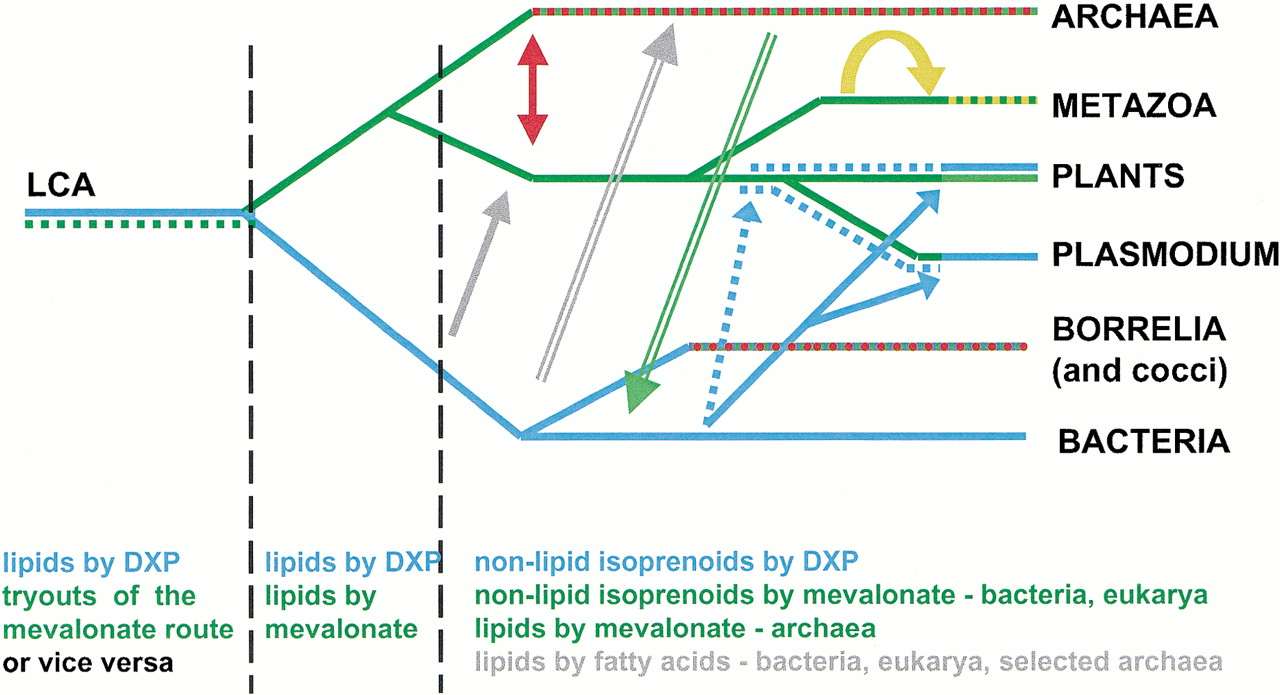
Frequent horizontal transfers in the evolution of isoprenoid biosynthesis. Alternative pathways and displacements are color coded, mostly according to Fig. 1. Evolution of fatty acid biosynthesis has not been dissected in detail but is also shown for comparative purposes. Green lines, mevalonate pathway; blue lines, DXPS pathway; yellow, displacement of phosphomevalonate kinase in metazoans; red arrow and red-and-green line, displacement of three enzymes of mevalonate pathway, resulting in the chimeric pathway in archaea. Gray arrows, transfer of fatty acid biosynthesis genes to eukaryotes (solid line) and to selected archaea (double line). Green double line represents the transfer of HMG-CoA reductase to Vibrio cholerae, apparently from archaea (Heidelberg et al. 2000). The donor of the mevalonate pathway to Borrelia and cocci is unknown; a yet undiscovered isopentenyl diphosphate isomerase enzyme in these species may be shared with other bacteria (blue checkers) or with archaea (red checkers).